

TikTok campaigns often start fast and die just as fast. A setup can show cheap clicks, strong engagement, good early CPA, and even positive tracker ROI in the first 24–48 hours — then collapse by Day 3, Day 4, or Day 5. CTR drops, CPC climbs, CPA becomes unstable, lead quality softens, and the buyer starts wondering why TikTok campaigns stop working almost overnight.
The problem is usually not just “bad creatives.” It is the mechanics of the platform. TikTok is built around fast content discovery, short creative lifecycles, aggressive engagement testing, and constant replacement of anything that stops holding attention. For affiliate teams, this creates a brutal operating environment: if the creative, audience, offer, and funnel are not refreshed and controlled, the campaign burns out before it becomes a real asset.
Contents
- Why TikTok campaigns burn out so fast
- How TikTok algorithm actually works in 2026
- What breaks first in a campaign
- The role of creative fatigue
- Where money is lost during burnout
- How to extend campaign lifespan
- FAQ
Why TikTok campaigns burn out so fast
TikTok is not a slow optimization platform. It is a high-speed attention marketplace. The platform constantly pushes new content into testing, reads user behavior quickly, and shifts delivery when the creative stops producing strong signals. That is why tiktok ads burn out much faster than many buyers expect.
On Meta, native, search, or push, some campaigns can run with slower fatigue curves. On TikTok, the creative is much closer to the product. The ad does not simply deliver the offer; it has to behave like content. If it stops feeling native, fresh, or watchable, the delivery quality drops quickly.
A lot of affiliate marketing TikTok ads problems come from treating TikTok like a normal paid traffic source. Buyers launch one or two “good” creatives, get early signal, scale too fast, and then act surprised when the same assets stop working after a few days. But on TikTok, a winning video is rarely a stable asset. It is usually the start of a creative cycle.
Short content lifecycle
The first reason TikTok campaigns burn out quickly is the short content lifecycle. TikTok users consume content extremely fast. They scroll, react, skip, watch, and move on. The platform itself is built to reward novelty and replace content that loses behavioral strength.
A creative may work on Day 1 because it feels fresh enough to stop the scroll. By Day 3, the same opening, pacing, visual pattern, or hook may already feel familiar. Even if the exact video has not been seen by every user, the pattern may have been seen many times.
This is important. TikTok ads fatigue is not only about one file being overexposed. It is often about the structure becoming recognizable.
For example:
- same UGC-style opening;
- same “I found this app” hook;
- same reaction-face intro;
- same screen-recorded demo;
- same before-after structure;
- same fake discovery angle;
- same urgent bonus framing;
- same “people don’t know this” setup.
The buyer thinks the creative is new because the footage changed. The user feels it is old because the pattern is the same.
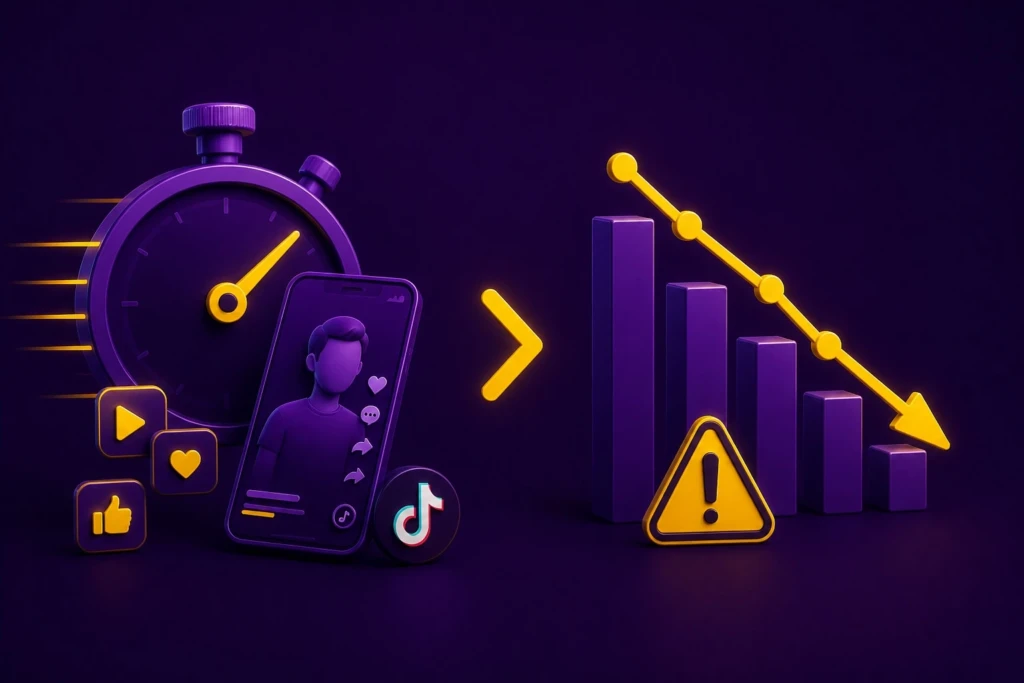
That is why a TikTok campaign may go through a familiar curve:
Day 1: strong early push, cheap clicks, fast engagement.
Day 2: still profitable, but first softness appears.
Day 3: CTR starts dropping, CPC starts climbing.
Day 4: CPA becomes unstable, lead quality worsens.
Day 5: campaign is either refreshed or bleeding.
The exact timeline varies, but the logic is consistent. TikTok is constantly looking for fresh signals. If your creative cannot produce them, the platform moves on.
High competition density
The second reason is competition density. TikTok is crowded. Brands, dropshippers, app advertisers, iGaming teams, leadgen buyers, finance funnels, nutra affiliates, and AI-style offer promoters are all fighting for attention in the same high-speed feed.
That means users are exposed to a huge number of similar commercial patterns. Even if your offer is different, the ad structure may feel identical to something they already ignored ten times.
Competition density affects campaigns in several ways:
- hooks become saturated faster;
- visual formats get copied quickly;
- UGC styles become predictable;
- trend-based creatives age fast;
- CPM pressure rises in competitive pockets;
- users become less responsive to repeated promises;
- algorithms have more alternative content to choose from.
This is one reason why TikTok ad performance drop often feels sudden. The campaign does not always die because the offer stopped working. It dies because the creative is no longer competitive inside the feed.
Attention is the first auction. Media cost is only the second one.
How TikTok algorithm actually works in 2026
Nobody outside TikTok can fully describe the algorithm with certainty. But from a media buying perspective, the working pattern is clear: TikTok tests fast, rewards strong user behavior, and reallocates delivery when engagement or conversion signals weaken.
This makes TikTok powerful, but also unstable. A campaign can receive fast delivery when signals are strong, then lose quality quickly when those signals decay.
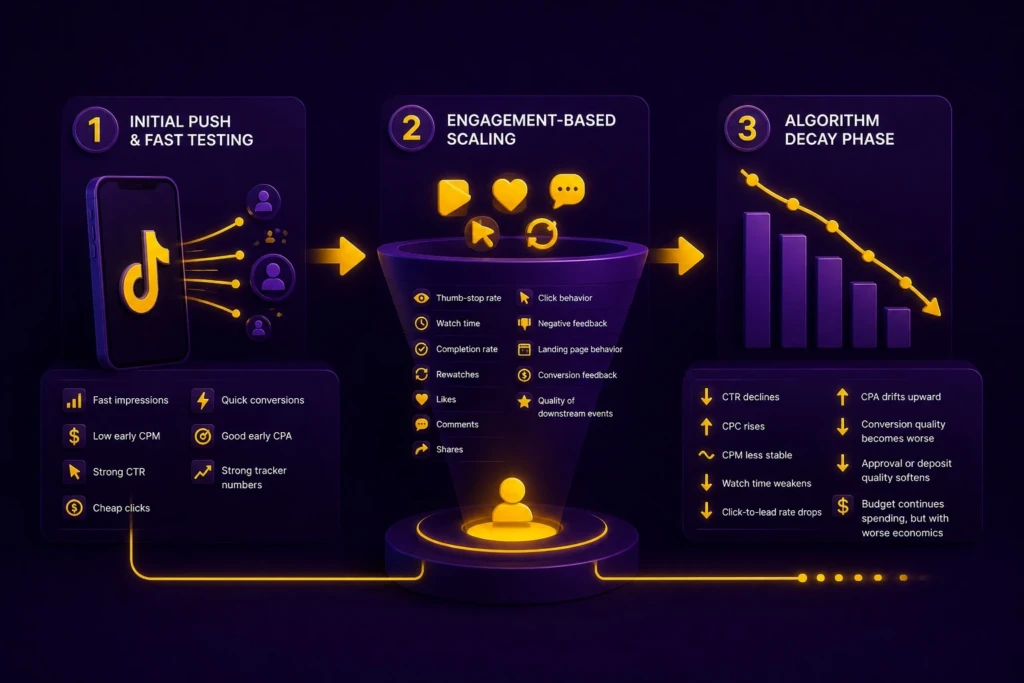
Initial push and fast testing
TikTok often gives new ads a fast testing window. The algorithm needs to understand who responds to the creative, how they respond, and whether the asset deserves more distribution.
During this phase, the buyer may see:
- fast impressions;
- low early CPM;
- strong CTR;
- cheap clicks;
- quick conversions;
- good early CPA;
- strong tracker numbers.
This is where many buyers get trapped. They treat the initial push as proof of campaign strength. But early TikTok performance is often just the platform testing a fresh asset against responsive audience pockets.
The real question is not whether the ad performs on the first push. The real question is whether it keeps performing after the easiest audience layer is gone.
A campaign that works only in the first algorithmic pocket is not a scalable campaign. It is a fast test result.
Engagement-based scaling
TikTok delivery is heavily influenced by user behavior. The platform wants content that holds attention and creates valuable action. For ad campaigns, that means performance is shaped by both in-feed engagement and post-click outcomes.
Useful signals may include:
- thumb-stop rate;
- watch time;
- completion rate;
- rewatches;
- likes;
- comments;
- shares;
- click behavior;
- negative feedback;
- landing page behavior;
- conversion feedback;
- quality of downstream events.
For affiliates, this creates a specific risk. A creative can generate attention without generating valuable users. It may get clicks because it is curiosity-heavy, dramatic, or emotionally sharp. But if users bounce, submit weak leads, fail deposit, or do not approve, the setup is not commercially strong.
This is where many affiliate teams misread TikTok. They see engagement and assume the campaign is healthy. But engagement is not profit. A viral-style creative can still be a terrible business asset if the traffic does not survive the funnel.
Algorithm decay phase
The algorithm decay phase begins when the ad stops producing strong enough signals compared with other content in the auction. This does not always mean delivery stops. Often, the campaign still spends, but the quality of delivery worsens.
The decay phase usually looks like this:
- CTR declines;
- CPC rises;
- CPM may become less stable;
- watch time weakens;
- click-to-lead rate drops;
- CPA drifts upward;
- conversion quality becomes worse;
- approval or deposit quality softens;
- budget continues spending, but with worse economics.
This is the most dangerous part of TikTok burnout. The campaign is not obviously dead yet. It still gets traffic. It still gets some conversions. It still looks like it might recover. But the peak has already passed.
A buyer who does not recognize decay early will keep spending into the weakest part of the lifecycle.
What breaks first in a campaign
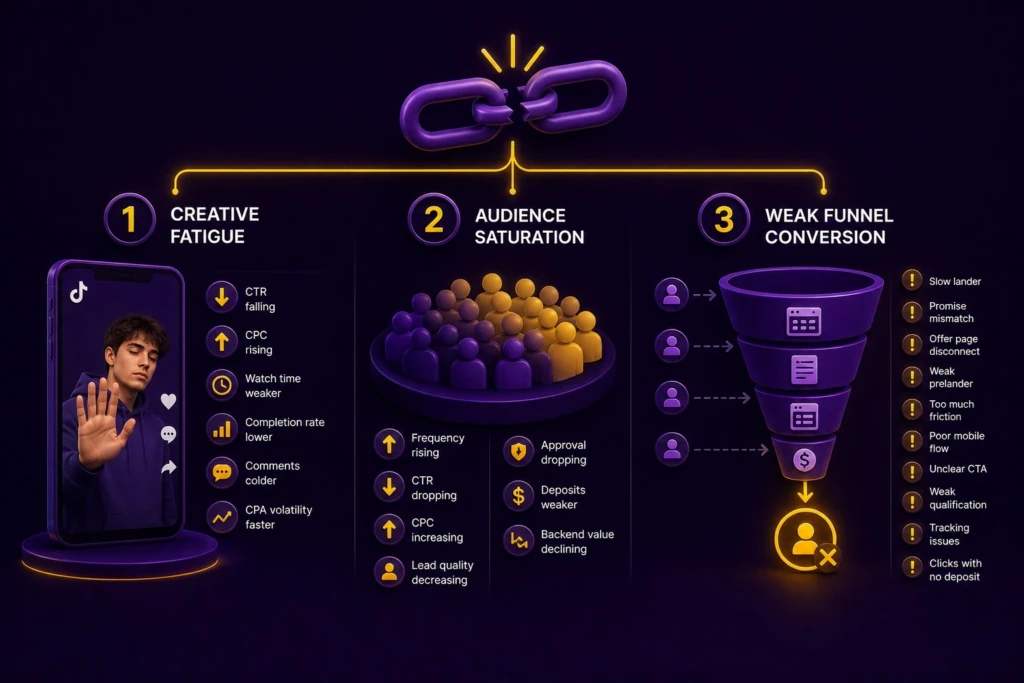
Most TikTok campaigns break in one of three places: creative novelty, audience capacity, or funnel conversion. The buyer’s job is to identify which one broke first instead of randomly changing everything.
Creative fatigue
Creative fatigue is the most obvious break point. If the ad no longer stops the scroll, the campaign loses oxygen.
Creative fatigue usually shows up through:
- falling CTR;
- rising CPC;
- weaker watch time;
- lower completion rate;
- colder comments;
- worse thumb-stop;
- faster CPA volatility;
- shorter lifespan after duplication.
But TikTok creative fatigue is not just about “bad video.” A polished video can fail if the hook is stale. A rough video can work if it feels native and emotionally sharp.
The first seconds matter heavily. If the opening does not create curiosity, tension, relevance, or recognition, users scroll before the offer has a chance. But the deeper problem is often angle fatigue. Buyers keep refreshing the visual skin while repeating the same strategic idea.
A real creative refresh changes at least one of these:
- hook logic;
- emotional trigger;
- proof structure;
- pacing;
- creator type;
- visual environment;
- promise framing;
- CTA logic;
- offer qualification.
Changing only captions or crops is usually not enough.
Audience saturation
The second break point is audience saturation. At low spend, TikTok may find a clean pocket of users who respond well. At higher spend, the campaign needs to reach broader, colder, or less qualified users.
That is when the numbers start changing.
Audience saturation can appear as:
- frequency rising;
- CTR dropping;
- CPC increasing;
- casual clicks increasing;
- lead quality decreasing;
- approval dropping;
- deposits becoming weaker;
- backend value declining.
A campaign that works at $200/day may fail at $1,000/day because it is no longer buying the same quality of user. The buyer thinks they are scaling the same campaign. In reality, TikTok is expanding into a different traffic mix.
This is one of the biggest TikTok scaling issues. Scale does not just increase volume. It changes the composition of traffic.
Weak funnel conversion
The third break point is the funnel. TikTok traffic is fast, impulsive, and entertainment-led. That means the funnel has to turn weak attention into qualified action quickly.
A funnel may break because:
- the lander loads too slowly;
- the ad promise and lander promise do not match;
- the offer page feels too different from the creative;
- the prelander creates curiosity but not intent;
- the form has too much friction;
- the mobile flow is clunky;
- the CTA is unclear;
- qualification is too weak;
- tracking loses events;
- users click but do not deposit or approve.
This is why a TikTok ad can get clicks but no money. The creative did its job at the attention layer. The funnel failed at the commercial layer.
If the offer needs high-intent users and the creative brings curiosity clicks, the campaign will collapse after the first soft audience pocket. TikTok did not “break.” The setup was not built for the type of traffic TikTok produced.
The role of creative fatigue
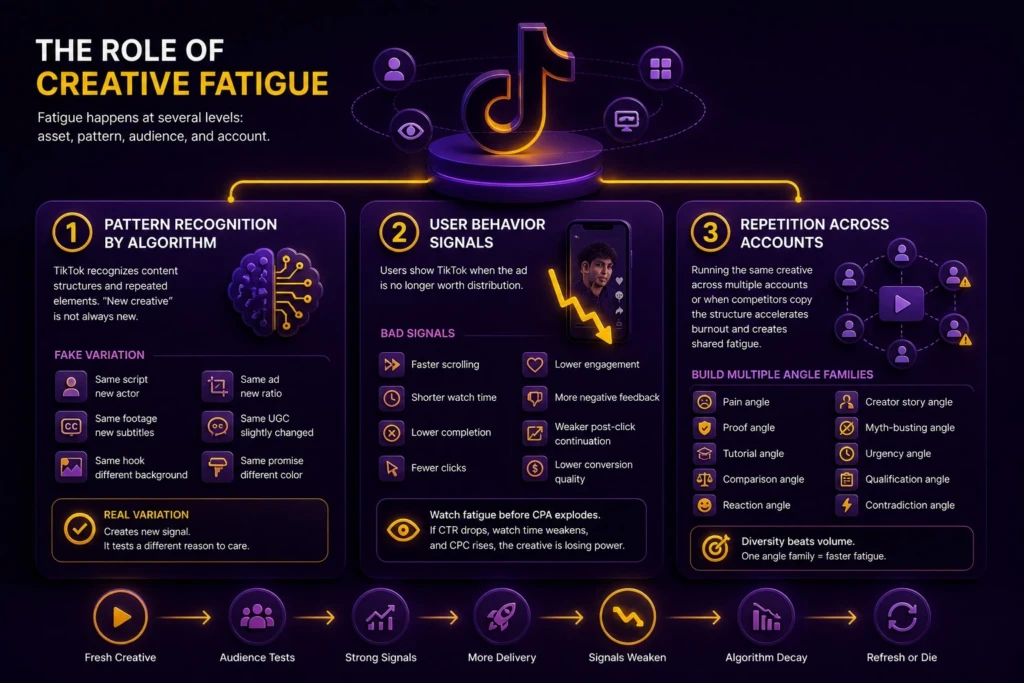
Creative fatigue is the main reason TikTok campaigns feel unstable. But to manage it, buyers need to understand that fatigue happens at several levels: asset, pattern, audience, and account.
Pattern recognition by algorithm
TikTok is strong at recognizing content structures. The system can identify repeated elements: visual layout, pacing, opening frames, editing rhythm, voiceover style, object focus, text placement, and engagement behavior.
That means “new creative” is not always new.
Fake variation looks like this:
- same script with a new actor;
- same footage with new subtitles;
- same hook with different background;
- same ad cut into a new ratio;
- same UGC confession with slightly changed wording;
- same promise on a different landing page color.
These variations may work briefly, but they often do not reset fatigue properly. The market and the algorithm may still treat them as part of the same tired pattern.
Real variation creates new signal. It tests a different reason to care.
User behavior signals
Users also accelerate fatigue through behavior. They show TikTok when the ad is no longer worth distribution.
Bad signals include:
- faster scrolling;
- shorter watch time;
- lower completion;
- fewer clicks;
- lower engagement;
- more negative feedback;
- weaker post-click continuation;
- lower conversion quality.
The platform does not need to understand your offer like a human. It only needs to see that users are less interested than before. Once that happens, delivery can decay quickly.
A good buyer watches fatigue before CPA explodes. If CTR drops, watch time weakens, and CPC rises, the campaign is already telling you that the creative is losing power.
Repetition across accounts
Affiliate teams often run the same creative across multiple accounts, BMs, agencies, or cloned setups. This can accelerate burnout because the audience sees the same pattern from different entry points.
The same happens when competitors copy the structure. Your creative may be fresh inside your account, but old in the market.
This creates shared fatigue.
To fight it, teams need multiple angle families, not just multiple video files. For example:
- pain angle;
- proof angle;
- tutorial angle;
- comparison angle;
- reaction angle;
- creator story angle;
- myth-busting angle;
- urgency angle;
- qualification angle;
- contradiction angle.
If all creatives come from one angle family, the campaign will fatigue quickly even if production volume looks high.
Where money is lost during burnout
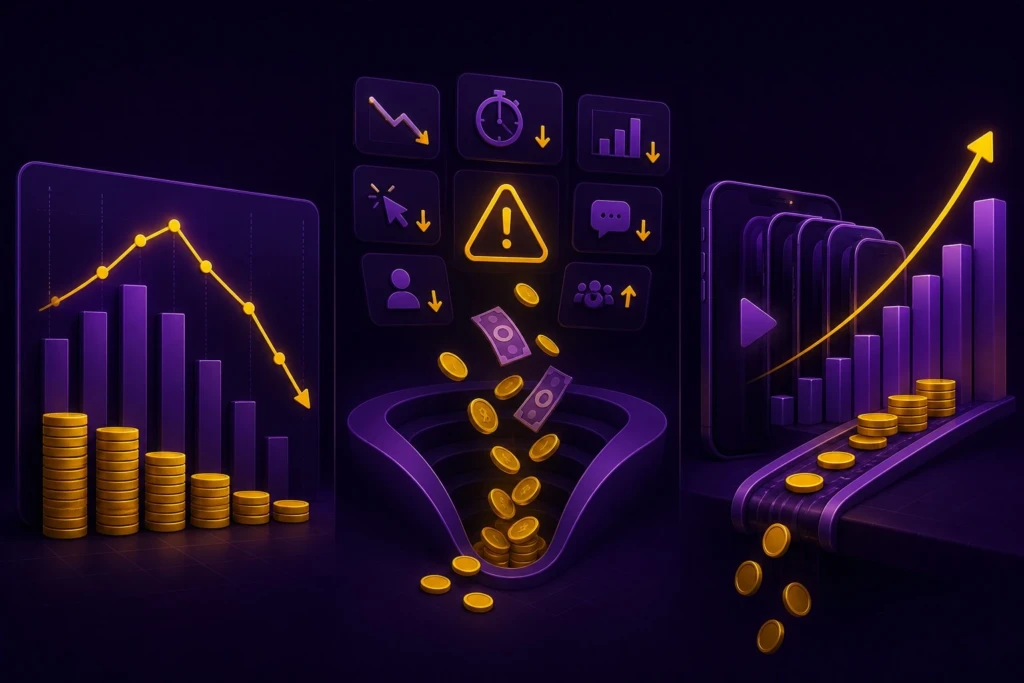
TikTok burnout becomes expensive when buyers keep spending after the campaign has already peaked. The loss is not the death itself. Campaigns die. The loss is funding the decay phase.
Spending after peak performance
Many TikTok campaigns have a short performance peak. The buyer’s job is to recognize when the peak is over.
Example:
Day 1 CPA: $18
Day 2 CPA: $24
Day 3 CPA: $34
Day 4 CPA: $49
Day 5 CPA: $66
If the campaign can only support a $30 approved CPA, it stopped being useful around Day 3. But buyers often keep spending because the first two days looked strong. They average the performance and defend the campaign emotionally.
That is how TikTok burns budgets. Not just through bad launches, but through late exits.
Ignoring early signals
Burnout gives warnings before full collapse.
Early warning signs include:
- CTR falling from peak;
- CPC rising for two review windows;
- watch time declining;
- click-to-lead rate weakening;
- CPA volatility increasing;
- comments becoming colder;
- approval lagging behind raw conversions;
- frequency rising too quickly;
- duplicate campaigns performing worse than the original.
If a buyer waits until every metric is obviously bad, they are too late. On TikTok, the profitable window can be narrow. Slow reaction turns normal fatigue into real budget loss.
Scaling dying creatives
The worst move is scaling a creative that is already entering decay. It happens because buyers scale based on yesterday’s numbers.
The campaign had a strong Day 1. The buyer duplicates it, raises budget, or pushes it into new accounts. But by the time the scale move starts spending, the creative has already lost novelty.
The result:
- higher CPM;
- weaker CTR;
- worse CPC;
- broader low-quality traffic;
- weaker approval;
- unstable CPA;
- faster fatigue across duplicates.
That is not scaling. That is multiplying the decay curve.
A TikTok creative should be scaled while it is still producing strong signals, not after the buyer has spent two days convincing themselves it is still alive.
How to extend campaign lifespan
You cannot remove TikTok fatigue. But you can manage it, delay it, and stop paying for it too long.
Constant creative rotation
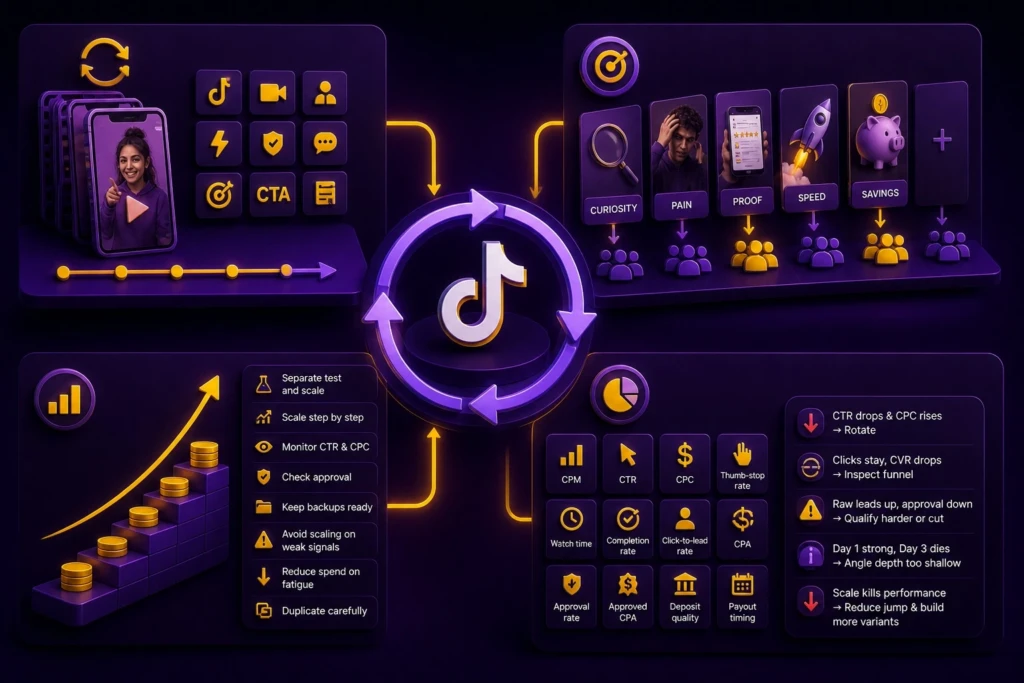
TikTok needs constant creative rotation. Not random volume, but structured variation.
A serious creative system includes:
- fresh hooks;
- different openings;
- new UGC scripts;
- different creator types;
- alternate pacing;
- fresh proof points;
- new CTA structures;
- different lander promises;
- new emotional triggers;
- backup videos ready before fatigue.
For every live winner, a team should already have replacement creatives in production. If you start making new assets only after CPA jumps, you are late.
A practical TikTok workflow is simple: every working creative needs a next generation before the current generation dies.
Multiple angles testing
Do not depend on one angle. A single emotional trigger can burn fast.
Test multiple angle families:
- curiosity;
- pain;
- proof;
- speed;
- savings;
- risk reduction;
- social validation;
- mistake correction;
- comparison;
- contrarian insight.
Different angles attract different pockets of users. Some bring cheaper clicks. Some bring better approval. Some last longer. The goal is not just to find the highest CTR. The goal is to find the angle that survives the full funnel.
Controlled scaling strategy
TikTok scaling should be gradual and measured.
A better approach:
- separate test and scale campaigns;
- increase budgets step by step;
- avoid large jumps on immature data;
- monitor CTR and CPC during scale;
- check approval, not just conversions;
- keep backup creatives ready;
- avoid scaling if watch time is already dropping;
- reduce spend when fatigue signals appear;
- duplicate carefully, not blindly.
A campaign that works at $300/day has not automatically earned $3,000/day. It has earned the next controlled test.
Data-driven decisions
Buyers need to act on fatigue signals instead of defending creatives emotionally.
Track:
- CPM;
- CTR;
- CPC;
- thumb-stop rate;
- watch time;
- completion rate;
- click-to-lead rate;
- CPA;
- approval rate;
- approved CPA;
- deposit quality;
- performance by day;
- performance by creative family;
- payout timing.
Then decide quickly.
If CTR drops and CPC rises, rotate.
If clicks stay but CVR drops, inspect the funnel.
If raw leads come but approval weakens, qualify harder or cut.
If Day 1 is strong and Day 3 repeatedly dies, your angle depth is too shallow.
If scale kills performance, reduce jump size and build more horizontal variants.
Data will not stop burnout. But it will stop you from funding it after the edge is gone.
FAQ
Why do TikTok ads burn out so fast?
TikTok ads burn out fast because the platform rewards novelty, engagement, watch time, and fresh user behavior. When the creative stops producing strong signals, delivery quality drops quickly.
Why do TikTok campaigns stop working after 3–5 days?
Many campaigns stop working after 3–5 days because the creative loses novelty, the first responsive audience pocket gets saturated, CPC rises, CTR drops, and the funnel cannot convert broader traffic profitably.
What is TikTok ads fatigue?
TikTok ads fatigue is the performance decay that happens when users stop responding to a creative or creative pattern. It usually shows up as falling CTR, rising CPC, weaker watch time, and unstable CPA.
How do I fix TikTok ad performance drop?
Rotate creatives early, test multiple angle families, monitor CTR and watch time, validate approval quality, avoid aggressive budget jumps, and cut campaigns when decay signals are clear.
Can TikTok campaigns scale long-term?
Yes, but not usually from one video. Long-term scaling requires a creative pipeline, controlled budget increases, funnel optimization, and constant testing of new angles and variations.
How often should TikTok creatives be refreshed?
In competitive affiliate verticals, refresh cycles can be every few days or even daily. The stronger the competition and the more duplicated the angle, the faster the creative needs replacement.