


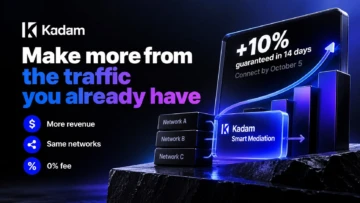
For publishers, increasing revenue does not always mean finding more traffic. Sometimes the bigger opportunity is in monetizing the traffic they already have more efficiently.
This is the idea behind Kadam Kadam Smart Mediation, a new monetization solution from Kadam that automatically distributes publisher traffic between connected ad networks based on the revenue they actually generate.
Publishers can keep their current monetization partners, add Kadam’s own advertiser demand and let the system continuously determine which source performs best for different traffic segments. And there is no mediation fee on revenue generated through existing networks.
Why the Highest CPM Does Not Always Mean More Revenue
Publishers working with several ad networks are used to comparing CPMs. The problem is that CPM alone does not show the full picture.
Imagine Network A reports a $2.10 CPM, but monetizes only 60% of the traffic sent to it. From 1,000 impressions, only 600 are monetized:
600 × $2.10 CPM = $1.26 in actual revenue
The $2.10 figure may look stronger in the dashboard, but the publisher ultimately earns $1.26 from the original 1,000 impressions.
Another network with a lower reported CPM but a higher acceptance rate could generate more money from exactly the same volume.
This is where Kadam Smart Mediation takes a different approach. Instead of simply comparing the rates shown by different networks, it looks at how much revenue each source generates from the traffic actually sent to it.
The goal is simple: scale revenue from existing traffic with automatic optimization instead of relying on headline CPMs and manual traffic distribution.
One Traffic Source Can Have Many Different Winners
There is another issue with looking at average performance: traffic is rarely uniform.
A network that performs well for one GEO or operating system may deliver completely different results for another. Kadam Smart Mediation therefore evaluates performance across individual traffic segments using parameters such as proxy, operating system, or user uniqueness
This means there does not have to be one “best network” for an entire website.
One source might generate more revenue from US iOS users, while another could be more profitable for macOS traffic from Germany. Kadam Smart Mediation can identify these differences and distribute traffic accordingly.
As performance changes, the allocation changes too.
For publishers managing several monetization partners, this reduces the need to constantly check reports, compare results and manually adjust traffic shares.
Publishers Keep Their Existing Networks
Kadam Smart Mediation is not designed around replacing a publisher’s current monetization stack.
Existing ad networks remain part of the setup and continue paying the publisher directly. They are connected to Kadam Smart Mediation via API, allowing the system to compare their performance and optimize distribution between them.
Publishers can also test the system without moving all their traffic at once.
For example, they can start with a single website or placement and see how mediation performs before expanding it further.
When a new monetization source is added, it first receives a test share of traffic. Once enough performance data has been collected, further allocation is based on the results.
Different zones from the same network can also be evaluated independently, allowing the system to account for performance differences between individual placements rather than treating an entire network as one source.
Kadam Demand Joins the Competition
The system does not only optimize between networks already used by the publisher.
Kadam’s own advertiser demand also competes for traffic, including direct demand and retargeting campaigns.
This matters because some users can be significantly more valuable to particular advertisers than the average visitor.
According to Kadam’s internal data, around 1.2% of popunder clicks and 0.5% of banner impressions may match retargeting demand that is substantially more valuable than the average for the corresponding segment. In some cases, these impressions can reach 6–20 times the average rate.
Kadam Smart Mediation gives this demand a chance to compete with the publisher’s other monetization sources.
If Kadam can generate a stronger revenue result for a particular segment, it can receive that traffic. If another connected network performs better, the traffic stays with that network.
In other words, Kadam demand is an additional bidder for the publisher’s inventory rather than a mandatory replacement for existing partners.
Why Kadam Charges 0% Mediation Fee
The commercial model is also different from mediation solutions that take a percentage of publisher revenue.
Kadam charges 0% mediation fee on revenue generated through the publisher’s existing networks. Those networks continue paying publishers directly.
Kadam monetizes the traffic when its own advertiser demand wins against the other connected sources.
For publishers, this means adding an optimization layer without giving up a percentage of the revenue already generated through their existing partners.
More Revenue With Existing Traffic
The core idea behind Kadam Kadam Smart Mediation is not to bring publishers more traffic, but to help them extract more value from the traffic they already have.
Publishers keep their existing networks and direct payouts. Those sources are compared using a common performance logic, while Kadam introduces additional advertiser demand into the mix. Traffic distribution is then optimized automatically at a more granular level as performance changes.
For publishers already juggling several monetization partners, the value is straightforward: more competition for each traffic segment, less manual optimization and an opportunity to increase revenue without changing the underlying traffic volume.
Publishers can start with one site or placement, evaluate the results and scale the setup from there.
Learn more about Kadam Smart Mediation




1 comment
The $2.10 CPM on 60% fill example makes the case really clearly; a headline CPM hides how much traffic a network never actually monetizes. Evaluating performance per segment like OS or GEO instead of crowning one best network for the whole site makes a lot of sense. No mediation fee on revenue from existing networks also lowers the risk of trying it alongside current partners.