

In Telegram affiliate marketing, the bot is not just a technical step between the ad and the offer. It is one of the main profit points in the whole funnel. The same traffic, same GEO, same offer, same payout, and same ad placement can produce completely different results depending on what happens inside the bot. One bot kills the user after the first message. Another bot warms the same user, filters intent, pushes the right CTA, and turns a dead click into a reg, dep, sale, or qualified lead.
That is why smart buyers do not treat Telegram bots as “just automation.” A Telegram bot is a conversion engine, a pre-sell layer, a qualification filter, and a monetization tool at the same time. If the bot is weak, traffic burns. If the bot is sharp, the same traffic can go from x0 to x2 or x3 ROI. This article breaks down how bots affect money, where most bots leak users, and how to approach telegram bot conversion optimization like a real performance asset.
Contents
- The role of bots in Telegram funnels
- How bots kill profit
- How bots multiply conversions
- Key elements of a high-performing bot
- Common bot mistakes
- Where money is lost inside bots
- How to optimize Telegram bots for profit
- FAQ
The role of bots in Telegram funnels
A Telegram bot sits at the most sensitive point of the funnel: right after the click.
The user has already reacted to the ad, placement, channel post, native mention, or creative hook. They showed micro-interest. But that interest is still fragile. They are not sold. They are not qualified. They are not ready to deposit, buy, register, or complete a serious action. They are just curious enough to open the next step.
This is where the bot either protects intent or destroys it.
A good bot continues the promise, explains value, builds trust, and moves the user forward. A bad bot creates confusion, friction, doubt, and drop-off. In telegram bot affiliate marketing, this difference is huge because traffic is often impulse-driven. Users click fast and leave even faster.
The bot is where raw attention becomes qualified traffic — or disappears.
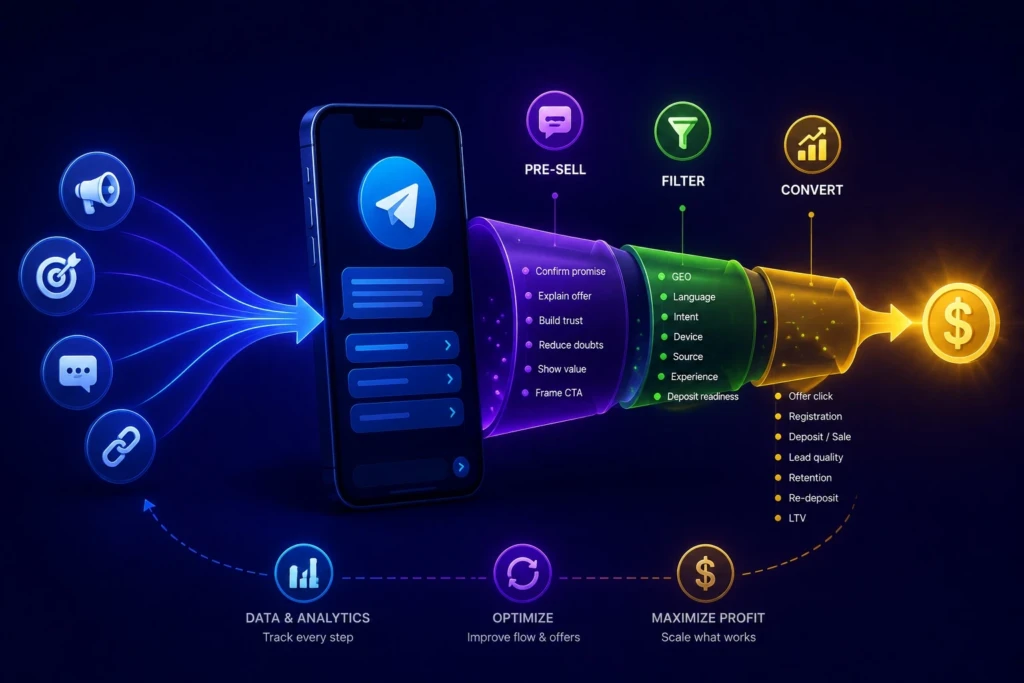
Bot as conversion engine
The bot is not a passive bridge. It is a conversion engine.
Its job is to move the user from “I clicked” to “I understand why I should act.” That means every message, button, delay, CTA, and path should serve conversion logic.
A bot can influence:
- bot start rate;
- first action rate;
- offer click rate;
- registration rate;
- deposit rate;
- lead quality;
- redep;
- retention;
- LTV.
If the bot only forwards users to an offer link, it is not doing enough. That may work in very hot traffic, but most Telegram traffic needs some shaping before the money event.
The bot should turn a cold or semi-warm click into a user who is more likely to take the next step.
Bot as pre-sell layer
Pre-sell is one of the most underrated bot functions.
Telegram traffic often comes from emotional hooks, quick promos, curiosity angles, or community placements. The user needs context before seeing the commercial ask. The bot provides that context.
A strong bot pre-sell can:
- confirm the ad promise;
- explain the offer quickly;
- reduce skepticism;
- show what the user gets;
- frame the next action;
- handle objections;
- create urgency without looking scammy;
- make the CTA feel logical.
Without this pre-sell layer, the user jumps from ad curiosity to offer friction too fast. That is where conversion drops.
For example, in iGaming, sending a user directly from a bonus hook into a registration page may work poorly. A bot that explains the bonus, shows how to claim it, gives a clean CTA, and then moves the user to the offer can produce much stronger intent.
Bot as filter
A bot is also a filter.
Not every click should reach the offer. Some users are low-intent, wrong GEO, wrong language, too cold, or not qualified. Sending all of them directly to the advertiser can hurt approval, EPC, advertiser trust, and long-term caps.
A good bot filters traffic before monetization.
It can segment users by:
- GEO;
- language;
- interest;
- intent;
- product preference;
- experience level;
- deposit readiness;
- device;
- traffic source;
- previous action.
Filtering does not mean adding unnecessary complexity. It means asking only what helps monetization.
A bot that filters correctly can improve backend quality, not just front-end conversion. That is one of the ways telegram bots profit affiliate setups can outperform basic direct-link funnels.
How bots kill profit
Most bad Telegram bots do not look broken. They technically work. Messages send. Buttons open. Links load. But commercially, they are dead.
They kill profit by creating friction, confusion, weak intent, and low trust.
The buyer keeps blaming the traffic, but the bot is the real leak.
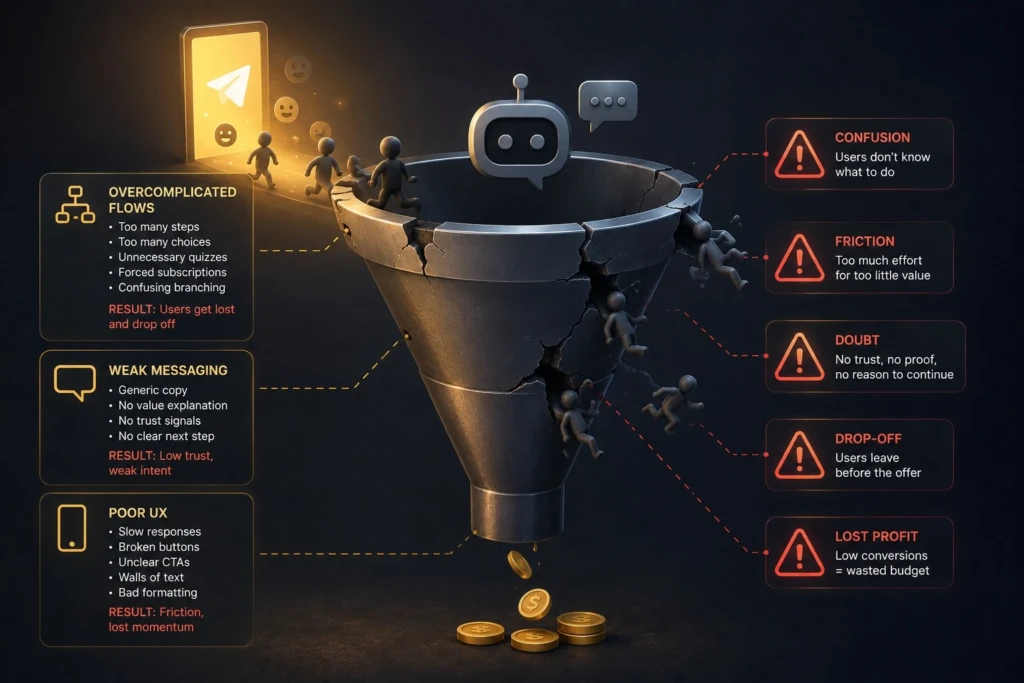
Overcomplicated flows
The fastest way to kill Telegram conversion is to overcomplicate the bot.
Too many messages.
Too many buttons.
Too many branches.
Too many choices.
Too many “steps before access.”
Too much text before the CTA.
Telegram users do not want to solve a puzzle. They clicked because something caught their attention. The bot has to move them forward before that attention fades.
Overcomplicated flows create drop-off because users do not understand what to do next.
Common bad patterns:
- five-button menus at the start;
- unnecessary quizzes;
- long onboarding;
- forced subscriptions before value;
- too many confirmation steps;
- multiple redirects;
- unclear branching;
- repeated “choose your option” screens.
Every extra step must earn its place. If a step does not improve qualification, trust, or conversion, it is probably leaking money.
Weak messaging
Weak messaging is another major profit killer.
A lot of bots use generic affiliate copy:
“Welcome.”
“Click below.”
“Get access now.”
“Best offer.”
“Limited deal.”
“Start earning.”
“Claim your bonus.”
This copy does not build value. It does not explain anything. It does not make the user trust the flow. It just pushes.
The problem is not that the text is short. Telegram copy should usually be short. The problem is that the text is empty.
Strong bot messaging should answer four questions fast:
What is this?
Why should I care?
Why should I trust it?
What should I do next?
If the bot does not answer these questions, the user either leaves or clicks without real intent. Both outcomes are bad. The first one kills volume. The second one kills backend quality.
Poor UX
Bot UX is not design decoration. It directly affects ROI.
Poor UX creates friction. Friction kills momentum. Momentum is everything in Telegram.
Bad UX includes:
- slow bot responses;
- broken buttons;
- unclear CTA labels;
- walls of text;
- bad mobile formatting;
- confusing button order;
- no fallback message;
- dead-end paths;
- poor localization;
- no recovery after inactivity;
- links opening badly;
- repeated prompts.
A user should always know where they are, what they get, and what to tap next.
The best bot flows feel obvious. The user does not need to think. They just move.
How bots multiply conversions
A high-performing Telegram bot does not just avoid mistakes. It actively increases conversion.
It protects the intent created by the ad, amplifies the value proposition, removes doubt, and pushes the user toward the most profitable action.
That is why bot optimization can change the whole campaign economy.
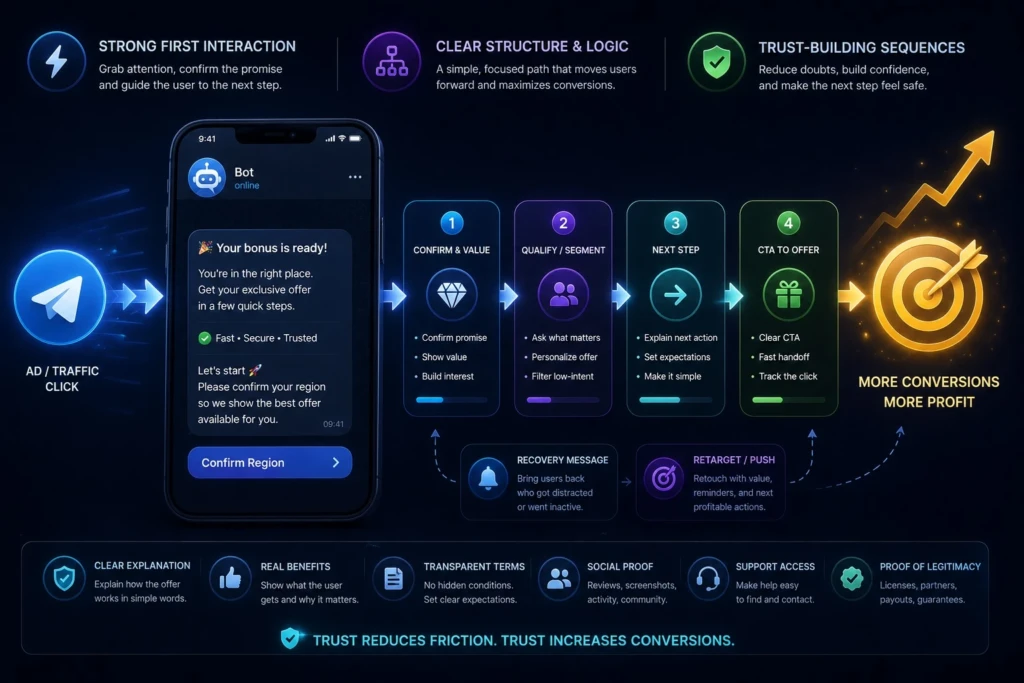
Strong first interaction
The first bot message is one of the highest-leverage parts of the funnel.
This message must immediately confirm that the user landed in the right place. If the ad promised a bonus, the bot should talk about the bonus. If the ad promised access, the bot should explain the access. If the ad created curiosity, the bot should resolve it while pushing the next step.
A strong first interaction should be:
- fast;
- specific;
- connected to the ad;
- easy to understand;
- trust-building;
- action-oriented.
The first message should not feel like a generic welcome screen. It should feel like a continuation of the click.
Bad:
“Welcome to our bot. Choose an option below.”
Better:
“Your bonus access is ready. First, confirm your region so we show the available offer and avoid sending you to a blocked page.”
The second version gives context, explains the step, and reduces friction.
Clear structure and logic
Bots multiply conversions when the path is clean.
A strong structure usually has:
- one main user path;
- short pre-sell;
- simple qualification;
- clear CTA;
- fast offer handoff;
- recovery message;
- retouch logic if the user stops;
- tracking on every meaningful event.
The structure should move users forward in a controlled way.
For example:
Message 1: confirm promise and value.
Message 2: qualify or segment if needed.
Message 3: explain next action.
Message 4: CTA to offer.
Follow-up: remind or retouch inactive users.
Push: bring users back to reg, dep, or redep.
The bot should not be overloaded with random content. It should have a conversion route.
Trust-building sequences
Trust is a major multiplier.
Telegram users are exposed to too many scammy bots, fake channels, copied offers, and aggressive affiliate flows. If your bot looks like another low-effort setup, users will not continue.
Trust-building sequences can include:
- clear explanation of how the offer works;
- realistic benefits;
- transparent terms;
- social proof where allowed;
- support contact;
- active channel connection;
- step-by-step instructions;
- proof of legitimacy;
- FAQ inside the bot;
- consistent tone and branding.
The key is to build enough trust without slowing the user too much.
A good trust sequence is not a huge wall of proof. It is a few well-placed signals that make the next click feel safe.
Key elements of a high-performing bot
A profitable Telegram bot is built around performance architecture.
It is not just “messages plus buttons.” It has entry logic, message flow, CTA structure, personalization, tracking, and optimization loops.
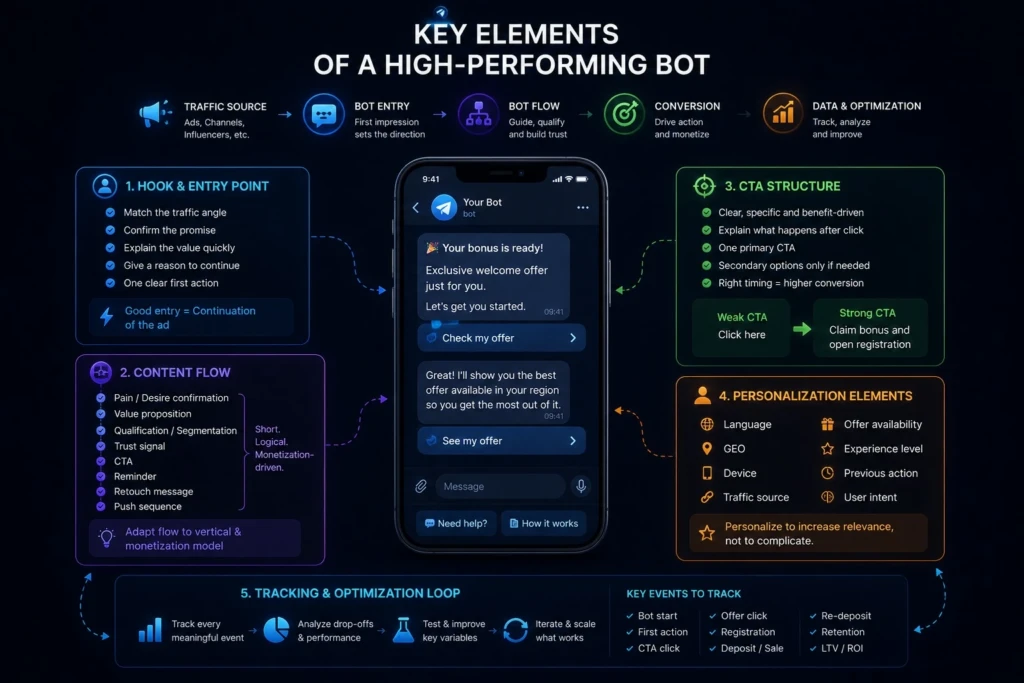
Hook and entry point
The entry point must match the traffic source.
If the user comes from a channel placement, continue the angle from that placement. If they come from an ad, continue the ad promise. If they come from an influencer mention, keep the same language and context.
Mismatch kills conversion.
The bot entry should include:
- promise confirmation;
- short value explanation;
- reason to continue;
- one clear first action.
This is the point where many buyers lose money. The creative does a strong job, but the bot entry is generic. That breaks the flow.
Your first message should feel like the next sentence after the ad.
Content flow
The content flow should be short, logical, and monetization-driven.
Good bot content is not about saying more. It is about saying the right thing at the right time.
A strong flow may include:
- pain or desire confirmation;
- value proposition;
- qualification;
- trust signal;
- CTA;
- reminder;
- retouch message;
- push sequence.
The flow should not overload users before they understand the value. But it should not push the offer too early if the user is still cold.
This balance depends on the vertical.
For iGaming, the bot may need bonus explanation and deposit instruction.
For finance, it may need trust and risk framing.
For nutra, it may need pain-point validation and proof.
For sweepstakes, it may need speed and eligibility confirmation.
For subscriptions, it may need value stacking and urgency.
The bot should match the monetization model.
Call-to-action structure
CTA structure is a big part of telegram bot funnel optimization.
A weak CTA says:
“Click here.”
A better CTA says what happens after the click:
“Claim bonus and open registration.”
“Check available offer for your GEO.”
“Continue to the secure signup page.”
“Get access to today’s picks.”
“Open the app and activate the offer.”
The CTA should reduce uncertainty.
Also, avoid giving users too many equal options. One primary CTA usually converts better than five competing buttons. Secondary buttons can exist, but they should not distract from the money path.
CTA timing matters too. If you ask too early, users are not ready. If you ask too late, users lose attention. Testing is the only way to find the right moment.
Personalization elements
Personalization can improve conversion when it is useful.
This does not mean building a huge chatbot with endless branches. It means adapting the path based on user data that matters.
Useful personalization may include:
- language;
- GEO;
- device;
- traffic source;
- offer availability;
- experience level;
- previous action;
- user intent.
For example, if a user is from a GEO where one payment method is preferred, the bot can mention that payment option. If a user already clicked the offer but did not register, the follow-up should not repeat the first welcome message. It should push the next relevant step.
Personalization should help the user move forward. If it only adds complexity, it hurts.
Common bot mistakes
Most telegram bot mistakes affiliate buyers make are not technical. They are strategic.
The bot is treated as a simple transition tool instead of a performance layer. As a result, the buyer sends paid traffic into a weak flow and then wonders why ROI is dead.
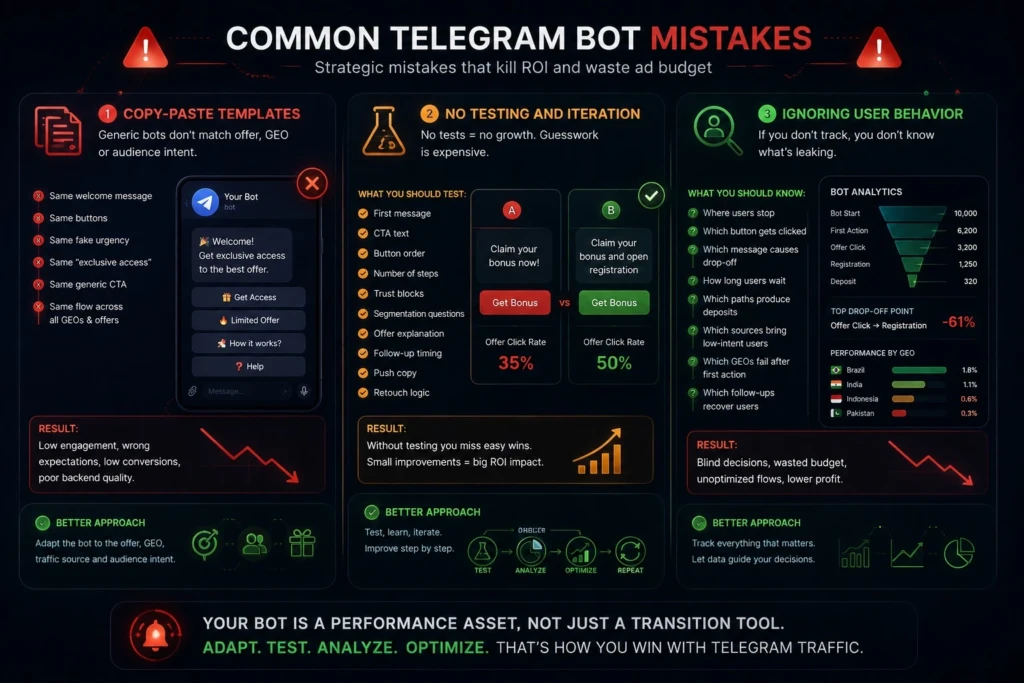
Copy-paste templates
Copy-paste bots are everywhere.
Same welcome message.
Same buttons.
Same fake urgency.
Same “exclusive access.”
Same generic CTA.
Same flow across all GEOs and offers.
This usually fails because users, sources, verticals, and offers are different.
A bot for iGaming should not feel like a bot for nutra. A bot for Tier 1 finance should not feel like a bot for low-cost sweepstakes. A bot for warm channel traffic should not behave like a bot for cold ad traffic.
Templates are fine as a starting point. But if the bot is not adapted to the offer, GEO, audience, and traffic intent, it will leak.
No testing and iteration
Many buyers test creatives aggressively but never test bot logic.
That is a mistake.
The bot should be tested like a landing page. You can test:
- first message;
- CTA text;
- button order;
- number of steps;
- trust blocks;
- segmentation questions;
- offer explanation;
- follow-up timing;
- push copy;
- retouch logic.
A small improvement in bot step conversion can change the whole campaign.
For example, if bot start to offer click improves from 35% to 50%, the same traffic suddenly becomes much more valuable. If offer click quality also improves, backend can improve too.
Bot testing is not optional. It is part of media buying.
Ignoring user behavior
If you do not analyze user behavior inside the bot, you are flying blind.
You need to know:
- where users stop;
- which button gets clicked;
- which message creates drop-off;
- how long users wait;
- which paths produce deposits;
- which sources send low-intent users;
- which GEOs fail after the first action;
- which follow-ups recover users.
Without this, you cannot optimize. You can only guess.
The bot should generate data, not just actions.
Where money is lost inside bots
Money is lost inside bots through invisible micro-leaks.
Each leak may look small, but together they destroy ROI. A few percent lost after the first message, a few more after the CTA, more lost on slow redirects, more lost from weak trust, more lost from wrong segmentation — and suddenly the campaign is unprofitable.
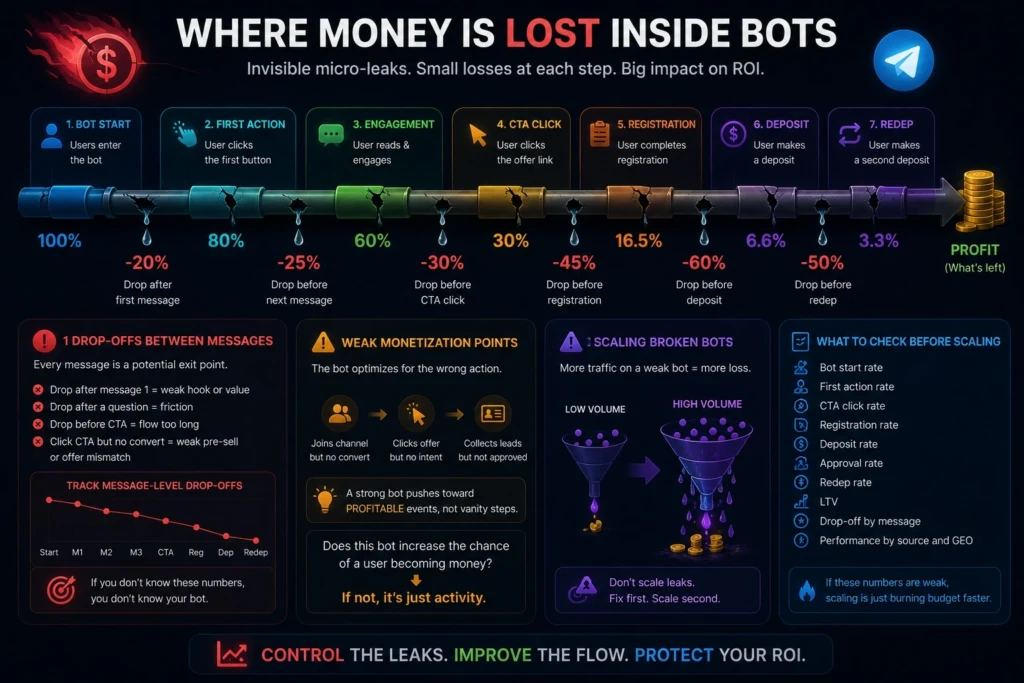
Drop-offs between messages
Every message is a potential exit point.
If users drop after message one, the hook or value confirmation is weak.
If users drop after a question, the question creates friction.
If users drop before CTA, the flow is too long.
If users click CTA but do not convert, the pre-sell or offer match is weak.
Track message-level drop-offs.
A Telegram bot should be analyzed like this:
Bot start → first button click
First button click → next message
Next message → CTA click
CTA click → registration
Registration → deposit
Deposit → redep
If you do not know these numbers, you do not know your bot.
Weak monetization points
Some bots move users but do not monetize them.
This happens when the bot optimizes for the wrong action. For example, it may push users to join a channel, but the channel does not convert. Or it may push users to click the offer, but without enough intent. Or it may collect cheap leads that do not approve.
A strong bot should push toward profitable events, not vanity steps.
The key question:
Does this bot increase the chance of a user becoming money?
If not, it is just activity.
Scaling broken bots
Scaling a broken bot is one of the most expensive mistakes in Telegram buying.
A weak bot may look acceptable at low spend because losses are small. But once you push volume, the leak gets bigger.
If the bot converts poorly, more traffic does not fix it. It only sends more users into the leak.
Before scaling, check:
- bot start rate;
- first action rate;
- CTA click rate;
- registration rate;
- deposit rate;
- approval rate;
- redep;
- LTV;
- drop-off by message;
- performance by source and GEO.
If these numbers are weak, scaling is just burning budget faster.
How to optimize Telegram bots for profit
Telegram bot optimization should be practical, data-driven, and tied to backend value.
The goal is not to make the bot longer, smarter, or more complex. The goal is to make it more profitable.
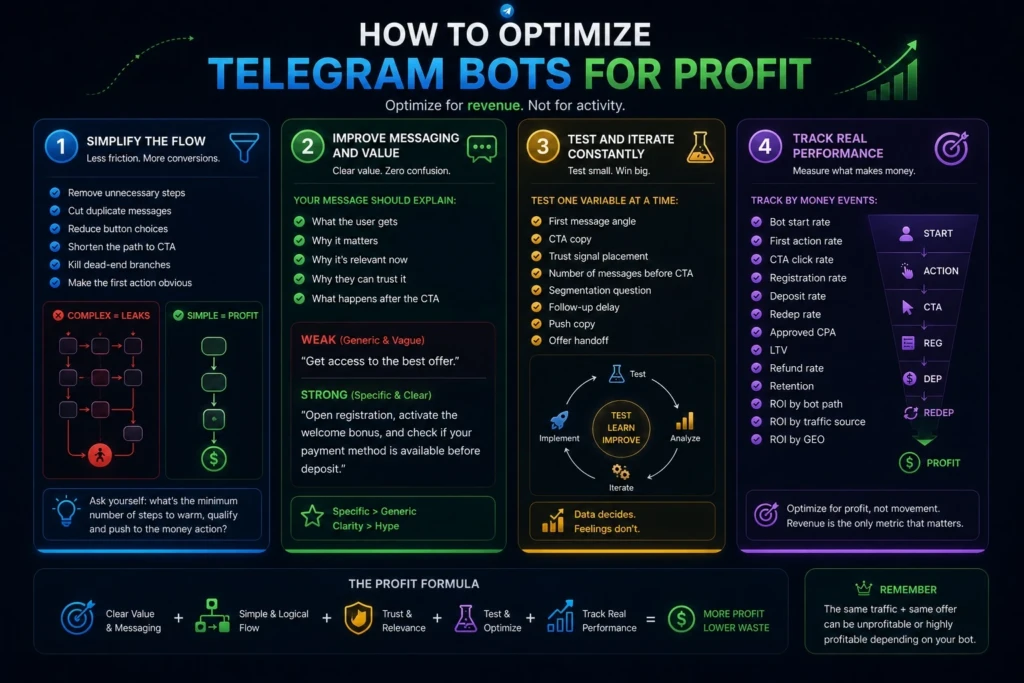
Simplify the flow
The first optimization step is usually simplification.
Remove unnecessary steps.
Cut duplicate messages.
Reduce button choices.
Shorten the path to the CTA.
Kill dead-end branches.
Make the first action obvious.
A simpler bot often converts better because it preserves momentum.
Ask yourself: what is the minimum number of steps needed to warm, qualify, and push the user to the money action?
Everything else is suspect.
Improve messaging and value
Next, improve the message logic.
Your bot should clearly explain:
- what the user gets;
- why it matters;
- why it is relevant now;
- why the user can trust it;
- what happens after the CTA.
Avoid generic hype. Make the value specific.
Instead of:
“Get access to the best offer.”
Use:
“Open registration, activate the welcome bonus, and check if your payment method is available before deposit.”
The second line is more concrete. It tells the user what happens next and reduces uncertainty.
Test and iterate constantly
Run bot tests continuously.
Test one important variable at a time where possible:
- first message angle;
- CTA copy;
- trust signal placement;
- number of messages before CTA;
- segmentation question;
- follow-up delay;
- push copy;
- offer handoff.
Do not rely on personal taste. The user decides.
A bot that feels “better” to the buyer may perform worse. Data wins.
Track real performance
Track the bot by money events, not only bot actions.
Important metrics:
- bot start rate;
- first action rate;
- CTA click rate;
- registration rate;
- deposit rate;
- redep rate;
- approved CPA;
- LTV;
- refund rate;
- retention;
- ROI by bot path;
- ROI by traffic source;
- ROI by GEO.
This is the core of telegram ads bot performance: the bot must be judged by how it affects revenue.
If one bot path creates fewer clicks but better deposits, it may be better. If another path creates many cheap clicks but no money, it is trash.
Optimize for profit, not movement.
FAQ
Why are Telegram bots important for affiliate marketing?
Telegram bots sit right after the click and control the user’s next action. They can warm traffic, build trust, qualify users, and push them toward registrations, deposits, sales, or approved leads.
How can a Telegram bot kill profit?
A bot kills profit when it creates friction, confusion, weak messaging, too many steps, poor UX, slow responses, broken buttons, or bad offer handoff. The traffic may be fine, but the bot leaks users before monetization.
How do Telegram bots multiply conversions?
Bots multiply conversions by continuing the ad promise, creating a strong first interaction, pre-selling the offer, building trust, segmenting users, and guiding them through a clean CTA path.
What should I track inside a Telegram bot?
Track bot start, first action, message-level drop-offs, CTA clicks, registrations, deposits, redeposits, approval rate, LTV, retention, and ROI by source, GEO, and bot path.
What are the most common Telegram bot mistakes affiliates make?
The biggest mistakes are copy-paste templates, overcomplicated flows, generic messaging, no testing, poor UX, weak tracking, and scaling bots before backend performance is validated.
How do I optimize a Telegram bot for profit?
Simplify the flow, improve the first message, make the value clear, use stronger CTAs, add trust signals, test constantly, and optimize based on real backend performance, not just cheap bot starts or clicks.