

Most Facebook campaigns do not really “die” after 48 hours. What usually happens is simpler and more painful: the launch period flatters the setup, the first traffic pocket looks cleaner than it really is, and then the system starts showing you the rest of the inventory. That is why a campaign can look like a winner on day one, hold on day two, and then suddenly turn into a mess of worse CTR, weaker CVR, higher CPM, and a CPA that no longer makes sense.
If you buy traffic long enough, you have seen this pattern over and over again. The first 24–48 hours look promising, then performance drops hard, and most buyers blame “the algorithm” because they do not know where the real break happened. Read this to the end and you will get four practical things: a clear explanation of why campaigns die after launch, a better understanding of how Facebook ads behave after the first learning window, a way to separate creative fatigue from traffic-quality problems, and a practical framework for extending campaign life instead of watching every good setup burn out in two days.
Contents
- Why campaigns die after 24–48 hours
- How Facebook algorithm reacts to new campaigns
- Creative fatigue and audience saturation
- Where performance actually breaks
- How to extend campaign lifecycle
- FAQ
Why campaigns die after 24–48 hours
The first mistake is thinking that a good launch proves long-term stability. It does not. A campaign that works on day one has only proven one thing: it found a usable pocket of traffic under current conditions. That is all. It has not proven that the pocket is large enough, durable enough, or clean enough to hold once delivery widens.
This is where many buyers fool themselves. They see early traction and assume the system has already validated the setup. In reality, a launch is often just a temporary alignment of four things: fresh creative, a receptive audience slice, tolerable auction pressure, and a still-unpolluted delivery pattern. Once any of those shifts, the campaign starts telling the truth.

Initial boost and learning phase
The early window often feels better because Facebook is still testing where the ad belongs and which users are most responsive. That early traffic can be deceptively good. The campaign may initially hit users who are easier to convert, more reactive to fresh creatives, or simply less saturated by similar offers.
This is why early metrics can look much better than what comes next. The system is not promising you stable results. It is sampling. Buyers often mistake that sampling phase for proof of scalability, and that is where the damage starts. In a lot of campaigns, the first 24 hours are not your real average. They are your best-looking version of the setup before the broader market gets involved.
Data stabilization and performance drop
Then the data stabilizes. The campaign stops looking new. Delivery broadens. The algorithm redistributes impressions. Cheaper, cleaner audience pockets get used up first. At that point, the setup starts touching weaker users, colder inventory, and more competitive auction segments.
That is the moment when many “good” campaigns die. Not because Facebook suddenly changed its mind, but because the campaign is now being judged by its real durability instead of its launch momentum.
This is one of the biggest misunderstandings in performance marketing: start does not equal stability. A setup that prints for 24 hours has not earned the right to be called scalable. It has only earned the right to be tested harder.
How Facebook algorithm reacts to new campaigns
Most buyers talk about Facebook’s algorithm like it is one mysterious force. That is lazy thinking. What matters is not mystical algorithm behavior. What matters is how the delivery system reacts as it collects more data and expands beyond the cleanest initial segment.

Learning phase dynamics
At launch, the system is trying to identify who responds, where the ad can win, and what kind of users fit the objective. That means the first strong results are often a mix of genuine signal and temporary advantage. The system has not fully widened distribution yet, so the campaign can look sharper than it really is.
This is why early results are often misleading. Buyers see a low CPA and think the offer is solid. Then 36 hours later the CPA is up 40%, CTR is slipping, and conversion rate is weaker. They call it randomness. It is not. It is the system moving from optimistic sampling to broader delivery.
In plain language: the first results are often too clean. The real campaign begins when Facebook has enough data to stop flattering you.
Budget distribution changes
Budget distribution is another place where campaigns break fast. Even if you do not aggressively scale, the system starts reallocating spend as it learns. It begins testing nearby audience pockets, adjacent placements, and users who look less obviously ideal than the first responders.
That is where performance often starts to soften. The algorithm is not “broken.” It is simply looking for more room to spend. The problem is that more room often means worse traffic.
This matters because many buyers think the only danger is scaling too hard. It is not. Even without a giant budget jump, the campaign can degrade once the system starts buying outside the narrow pocket that carried the launch.
That is why so many ads perform well at first and then stop. The first users were easier. The next users cost more, click worse, convert worse, or both.
Creative fatigue and audience saturation
This is the most common cause of the classic 48-hour death, and in many cases it is the primary one. Not always, but often enough that ignoring it is expensive.
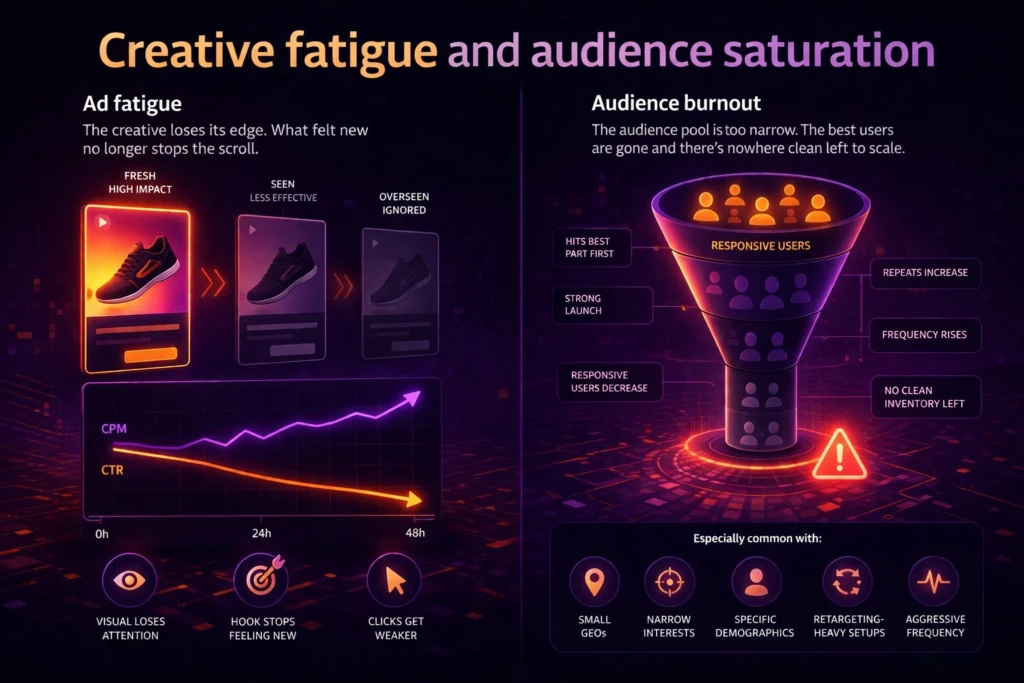
Ad fatigue
Ad fatigue is not just “people got bored.” It means the creative has already spent its strongest psychological advantage. Users who would react quickly have largely reacted. The rest of the audience has either seen the ad, ignored it, or become less sensitive to it.
That usually shows up first in CTR. The angle loses freshness. The visual stops interrupting attention. The hook no longer feels new. When that happens, CPM can rise while clicks get weaker, and the whole math of the campaign gets ugly very fast.
In practical terms, this is where a lot of buyers wait too long. They keep saying, “It’s still okay,” while the creative is already rotting. By the time they rotate it, they have already spent through the best part of the audience.
Audience burnout
Audience burnout is closely related but not identical. Sometimes the creative is still decent, but the audience pool is too narrow. The campaign has simply exhausted the most responsive users inside that segment.
This is especially common with:
- small GEOs
- narrow interests
- highly specific demographic filters
- retargeting-heavy structures
- aggressive frequency
You can get good launch performance because the campaign is hitting the best part of a limited pool. Then, once those users are burned through, the algorithm has no clean place left to go.
That is why some campaigns feel like they “die overnight.” In reality, the audience was just smaller than the buyer thought. The first 48 hours were not proof of scale. They were proof of concentration.
Where performance actually breaks
This is the block most buyers skip, and it is the most important one. If you do not know where the break happened, you will fix the wrong thing.
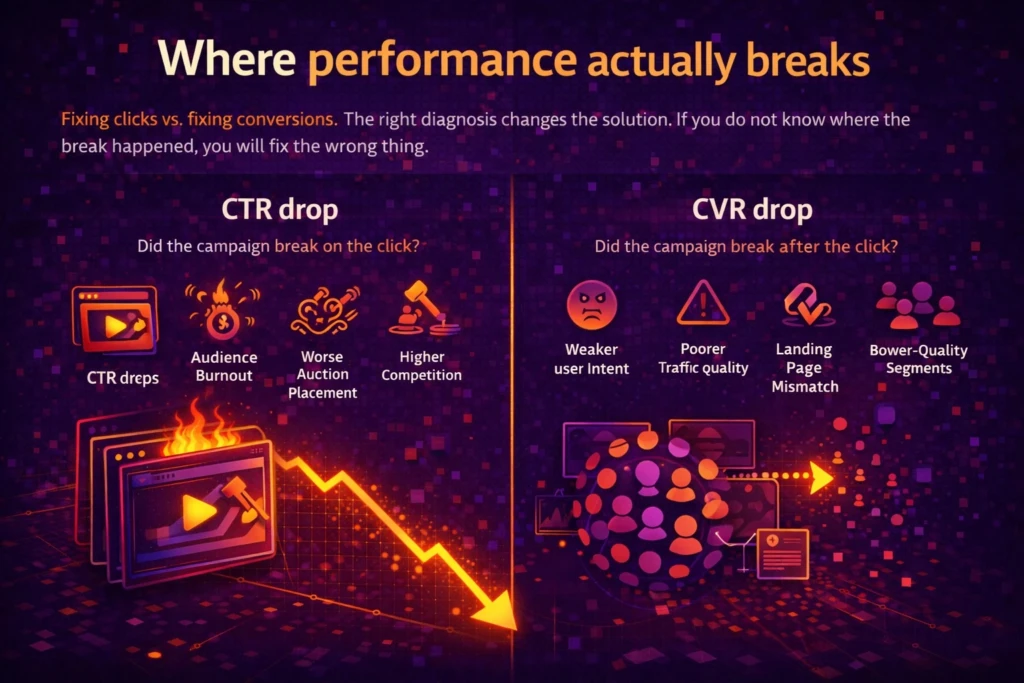
CTR drop vs CVR drop
The first question is simple: did the campaign break on the click or after the click?
If CTR drops hard, the problem is usually one of these:
- creative fatigue
- audience burnout
- worse auction placement
- higher competition
- weaker delivery pockets
If CTR stays healthy but CVR drops, the issue is different:
- weaker user intent
- poorer traffic quality
- landing page mismatch
- backend friction
- lower-quality segments entering the funnel
This distinction matters because many buyers treat every drop like a creative problem. That is a mistake. Sometimes the ad is still doing its job. The traffic behind it is worse, and the landing page is now being tested against users it was never strong enough to convert.
In 80% of bad scaling conversations, the buyer is solving the wrong layer of the problem. They change the ad when the traffic got weaker. Or they blame the landing page when the ad has already burned out.
Traffic quality decline
This is where Facebook starts “looking worse” to the buyer. The truth is harsher: the platform is often just showing the campaign its marginal traffic.
When delivery expands, quality drops. The system starts touching users who click more cheaply but convert more weakly, or users who engage enough to keep spend alive without producing real value. This is how campaigns fake health. Leads still come in. Clicks still happen. But money stops making sense.
This is why buyers often say, “The campaign still has volume, but it feels dead.” That feeling is usually correct. The traffic did not stop. The traffic got worse.
Competition and auction pressure
The third break point is auction pressure. Even a solid campaign can get weaker when competition rises around the same audience, placement, or angle. A creative that felt fresh yesterday is suddenly fighting similar ads today. CPM climbs. Attention gets more expensive. The exact same funnel now needs stronger click quality just to stay flat.
This is another reason why launch performance is misleading. The market you entered on hour one is not necessarily the same market you face on hour 48. More buyers may be competing, and the cost of attention may already be moving against you.
So when a campaign dies after launch, it is usually one of three things:
- the creative lost force
- the audience burned out
- the auction got harsher
And in many cases, it is all three at once.
How to extend campaign lifecycle
You cannot make every campaign live forever. That is fantasy. But you can stop killing them faster than necessary.

Creative rotation strategy
If you wait until the creative is obviously dead, you are already late. The smarter approach is pre-planned rotation. That means building creative families, not single winners.
Instead of one “best ad,” build:
- one core angle
- two or three visual variants
- different openings
- different hooks for the same offer
- slightly different emotional tones
This matters because creative fatigue is not an accident. It is a certainty. If you treat one winning ad like a permanent asset, the campaign will punish you for it.
Audience expansion
A campaign with no audience expansion plan is already fragile. Once the initial pool softens, the algorithm has nowhere clean to go.
That is why you should prepare additional audience paths before the launch dies:
- adjacent interests
- broader demographic versions
- lookalike layers if available
- less saturated GEO slices
- fresh segmentation logic
The point is not to go broad blindly. The point is to have a controlled next step when the first audience starts burning out.
Budget scaling control
Most campaigns do not die because scaling exists. They die because scaling is handled stupidly.
The safest rule is still the boring one: gradual increases, controlled observation, and patience. Once you jump budget too fast, you stress every weak point at once:
- broader traffic
- higher spend velocity
- more auction exposure
- faster audience burnout
- quicker creative fatigue
This is why buyers should think of scaling as pressure, not celebration. If the setup is not stable, more budget does not fix that. It just reveals it faster.
Testing multiple angles
This is where good teams separate themselves from hopeful teams. A campaign lives longer when you are not dependent on one story.
Different angles let you:
- refresh CTR without rebuilding the offer
- reach adjacent user psychology
- avoid over-burning one message
- learn whether the problem is the creative or the market
This is one of the most useful habits in Facebook ads: test multiple interpretations of the same offer early, not only after the winner dies. The buyer who waits until the campaign collapses is already reacting too late.
FAQ
Why do Facebook ads perform well for 2 days and then stop?
Because the first 24–48 hours often reflect the cleanest traffic pocket and the strongest creative freshness. After that, delivery broadens, weaker audience segments enter, and the campaign starts showing its real average.
Is Facebook ad fatigue the main reason campaigns stop performing?
Often yes, but not always. In many cases the drop comes from a mix of creative fatigue, audience saturation, weaker traffic quality, and rising auction pressure — not just one problem.
How do I know if my Facebook campaign is in ad fatigue or getting worse traffic?
Look at where performance breaks. If CTR drops first, the issue is usually fatigue or audience burnout. If CTR holds but CVR falls, the traffic quality or post-click fit is usually getting worse.
How often should I refresh Facebook ad creatives?
There is no fixed universal rule, but you should rotate creatives before the ad is obviously dead. If CTR weakens, frequency rises, or the hook clearly loses force, you are already in the danger zone.
Should I duplicate a Facebook campaign or edit the existing one?
Duplicate when you want a cleaner comparison or a controlled new test. Edit only when the existing campaign still has stable data and you are changing one variable carefully. Too many edits too early often make diagnosis harder.
How long should a Facebook campaign run before scaling?
Long enough to survive the first learning shift without falling apart. A campaign that looks good only in the first 24 hours is not ready for scale. Early results are useful, but they are not proof of durability.
Why does Facebook campaign performance drop after the learning phase?
Because once delivery stabilizes, the system often starts buying broader and weaker traffic. The campaign is no longer being judged by its best launch pocket, but by its actual ability to hold performance across wider inventory.
Can I prevent Facebook ads fatigue completely?
No. You can only delay it and manage it better. The practical tools are creative rotation, audience expansion, angle variation, and tighter scaling control.