

Telegram can send traffic. That is not the issue. The issue is that a lot of Telegram traffic never turns into money. Buyers see clicks, bot starts, channel joins, maybe even cheap leads — but the backend stays dead. No regs, no deps, no approved leads, no buyers, no real ROI. Then everyone starts blaming the source: “Telegram traffic is trash.” In many cases, the source is not the main problem. The funnel is.
Most Telegram funnels break after the click because they are built like traffic tunnels, not conversion systems. The user clicks from an ad or placement, lands in a bot or channel, sees weak messaging, gets confused, loses trust, and drops before the money event. This article breaks down why a telegram funnel is not converting, where users leak out, what common telegram affiliate funnel mistakes destroy ROI, and how to build Telegram flows that actually monetize traffic instead of just collecting empty clicks.
Contents
- How Telegram funnels actually work
- Where funnels break first
- Traffic vs funnel mismatch
- Content and trust issues
- Technical mistakes in funnels
- Where money is lost
- How to build converting Telegram funnels
- FAQ
How Telegram funnels actually work
A Telegram funnel is not just a bot with a button.
At performance level, it is a full user journey from first attention to monetization. The user sees a promo message, ad, channel post, influencer placement, native mention, or direct ad unit. Then they click into a bot, channel, landing page, bridge, PWA, mini app, or offer. Every step either increases intent or kills it.
The problem is that many affiliates treat Telegram as a low-friction shortcut. They assume that if the click is cheap and the bot opens, the funnel is working. But a bot start is not value. A channel join is not value. A click to offer is not value. Value appears only when the user completes a monetized action: registration, deposit, purchase, subscription, approved lead, redep, or another backend event.
That is why telegram ads low conversion usually has nothing to do with one isolated metric. It is about the whole chain.
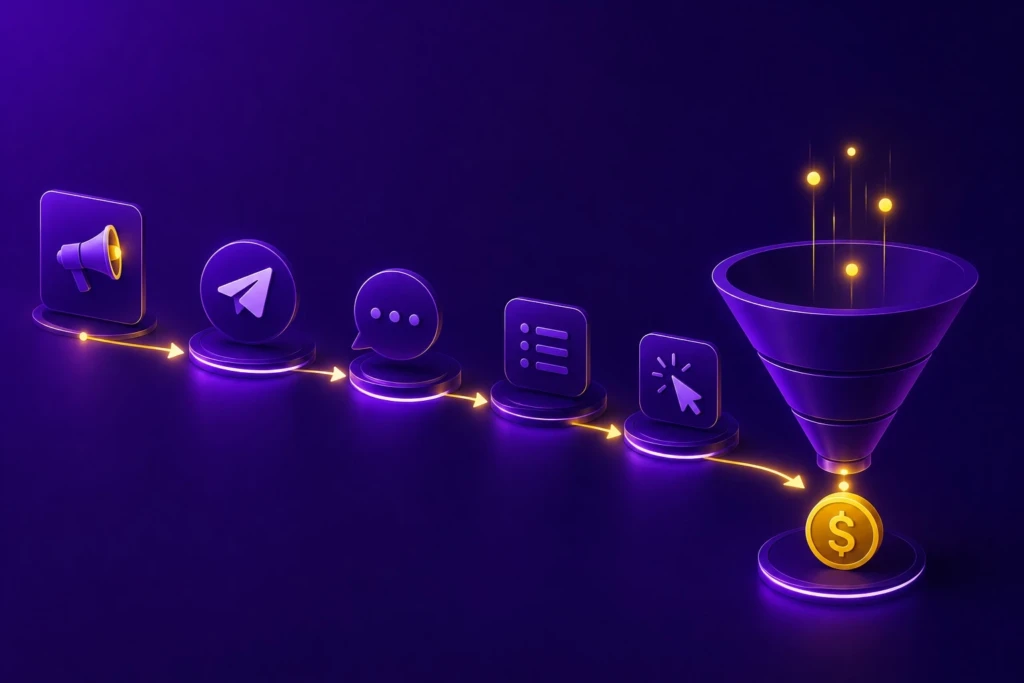
Traffic → bot → offer flow
The classic Telegram affiliate flow looks simple:
Traffic source → Telegram bot or channel → pre-sell → offer → conversion.
Sometimes the chain is longer:
Ad → channel → bot → quiz → lander → offer → reg → dep.
Ad → bot → content warm-up → PWA → registration → deposit.
Placement → private channel → pinned post → bridge → advertiser page.
Each step has a job.
The ad creates the first reason to click.
The bot or channel confirms that the user is in the right place.
The pre-sell explains why the offer matters.
The CTA moves the user forward.
The offer monetizes the intent.
If one step does not match the next, conversion drops.
For example, if the ad promises fast casino bonuses but the bot opens with generic text, users bounce. If the channel looks empty or fake, users do not trust it. If the offer page asks for registration too early, users stall. If the bot has five buttons and no clear path, users disappear.
Telegram funnels convert when every step has a clean purpose.
Role of pre-selling
Pre-selling is the difference between raw traffic and monetizable traffic.
Telegram users often do not arrive with strong buying intent. They click because they are curious, impulsive, bored, entertained, or emotionally triggered. That intent is weak at the beginning. The funnel has to build it.
Pre-selling does three things:
It explains the value.
It reduces doubt.
It makes the next action feel natural.
Without pre-selling, the user goes from a cold click straight into a commercial ask. That is where most funnels die.
A good pre-sell does not need to be long. It needs to be relevant. It should match the promise of the ad, speak in the user’s language, show why the offer is worth attention, and make the next step obvious.
For iGaming, that may mean explaining the bonus, showing social proof, creating a clear onboarding path, and reducing friction before deposit. For finance, it may mean qualification, trust, risk framing, and proof. For nutra or e-commerce, it may mean pain-point validation, result framing, and offer clarity.
Pre-selling is not decoration. It is conversion infrastructure.
Conversion points
A Telegram funnel usually has several conversion points before the final money event.
Common points include:
- ad click;
- bot start;
- channel join;
- first button click;
- quiz completion;
- registration;
- email or phone submit;
- first deposit;
- purchase;
- subscription;
- repeat deposit;
- approved lead.
Each point has its own conversion rate. If you only track the first and last step, you have no idea where the funnel breaks.
For example, a buyer may say, “Telegram traffic does not convert.” But the real issue could be:
- users click but do not start the bot;
- users start the bot but do not press the first button;
- users press the button but do not register;
- users register but do not deposit;
- users deposit once but do not redeposit;
- leads submit but do not approve.
These are different problems. They need different fixes.
Where funnels break first
Most Telegram funnels break early.
The user clicks, opens the bot or channel, and immediately feels one of three things: confusion, distrust, or disappointment. That is enough to kill the flow.
The first interaction is brutal because Telegram users make fast decisions. If the flow does not confirm the promise instantly, they leave. There is no deep patience. There is no brand loyalty. There is no reason to “figure it out.”
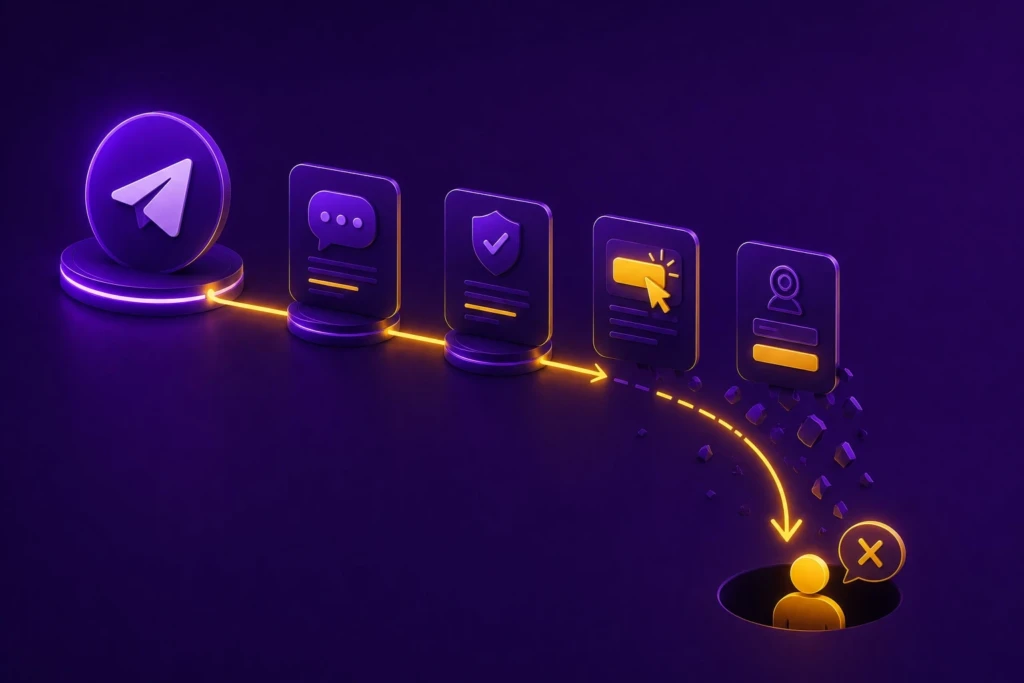
Weak first interaction
The first screen after the click decides a lot.
If the user clicks from a strong ad and lands in a weak bot message, the funnel loses momentum. This is one of the most common telegram ads conversion problems.
Bad first interactions look like this:
- generic welcome text;
- unclear bot command;
- no explanation of what happens next;
- too many buttons;
- no offer context;
- no trust signals;
- broken language localization;
- slow bot response;
- irrelevant first message.
The user should immediately understand:
Where am I?
Why did I click?
What do I get here?
What should I do next?
If the funnel cannot answer those questions in seconds, the user drops.
No clear value proposition
Many Telegram funnels fail because the value proposition is vague.
The buyer knows the offer. The affiliate manager knows the offer. The advertiser knows the offer. But the user does not.
The user does not care that this is a “top-converting iGaming offer” or “high EPC campaign.” They need a simple reason to continue.
A weak value proposition sounds like noise:
“Join now.”
“Get access.”
“Best offer.”
“Start today.”
“Click here.”
A stronger value proposition is specific:
What exactly does the user get?
Why is it useful now?
Why should they trust this flow?
What is the next action?
What happens after they click?
If the value is not clear, the funnel cannot build intent.
This is especially important for Telegram because the environment is full of spammy flows. Users have seen too many bots, fake groups, overhyped posts, and low-quality offers. If your message looks like the same junk, they leave.
Drop-off after first step
A lot of Telegram funnels get bot starts but lose users immediately after.
This usually means the first action is not strong enough or the next step is too confusing.
Common reasons:
- the bot asks for too much too early;
- the CTA is weak;
- users do not understand the benefit;
- the path has too many steps;
- the bot response feels automated and low trust;
- the offer appears before the user is warmed;
- the bot does not create momentum.
For example, if a user clicks from a promo about a bonus and the bot asks them to choose from five options, you just created friction. If the user clicks for a quick solution and you send a long wall of text, you killed speed. If the user expects a direct path and gets a vague channel invite, intent drops.
Telegram funnels need controlled momentum. Every step should make the next click easier.
Traffic vs funnel mismatch
Sometimes traffic is not bad. It is just wrong for the funnel.
A buyer may buy broad Telegram traffic and send it to a funnel built for high-intent users. Or they may use a clickbait ad that attracts curiosity traffic but send users into an offer that needs payment intent. The result is predictable: clicks come in, money does not.
This is why telegram traffic doesn’t convert is often really a mismatch problem.
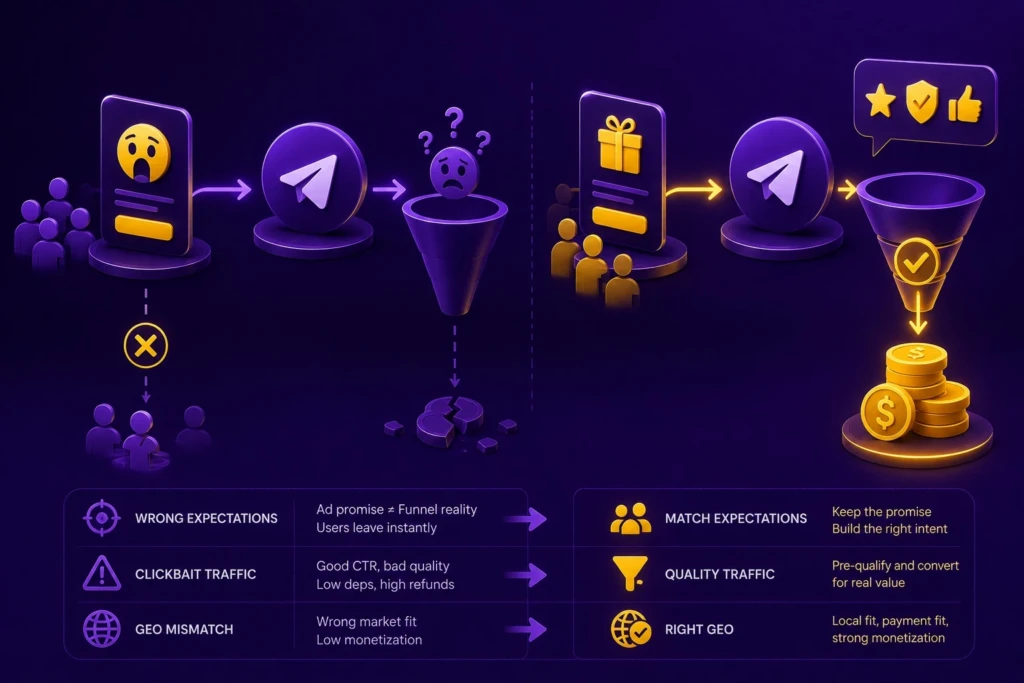
Wrong audience expectations
Every ad creates an expectation.
If the ad promises entertainment and the offer asks for money, there is a mismatch.
If the ad promises free access and the funnel asks for a deposit, there is a mismatch.
If the ad promises fast income and the offer requires verification, there is a mismatch.
If the ad promises a private community and sends users to a hard sales page, there is a mismatch.
Telegram users are sensitive to broken expectations. They click fast, but they also leave fast.
The funnel has to continue the same promise the ad started. Not exaggerate it. Not replace it. Continue it.
If the traffic was attracted by curiosity, the funnel needs to convert curiosity into intent. If the traffic was attracted by a strong bonus, the funnel needs to explain the bonus clearly. If the traffic was attracted by exclusivity, the channel or bot must feel exclusive.
A mismatch means the user feels tricked. Once that happens, conversion is dead.
Clickbait traffic problem
Clickbait can generate cheap traffic, but it usually destroys backend quality.
This is a classic Telegram mistake. The buyer uses an aggressive hook to get clicks:
shocking claim;
fake urgency;
overhyped promise;
misleading teaser;
too-good-to-be-true reward;
vague “secret access” angle.
The click rate looks good. The bot starts look good. The top-funnel looks alive.
But deeper metrics are weak:
- low registration rate;
- low deposit rate;
- low lead approval;
- poor buyer quality;
- weak retention;
- high refund risk;
- bad advertiser feedback.
Why? Because the ad did not attract qualified users. It attracted curiosity.
Curiosity traffic is not always useless, but it needs a strong bridge. If you cannot qualify and convert it properly, it becomes cheap garbage.
Cheap clicks are only useful when they become valuable users.
GEO mismatch
GEO mismatch is another silent killer.
A funnel that works in one GEO may fail in another because user behavior, payment ability, language, regulation, product awareness, and trust expectations are different.
Telegram usage also differs by market. Some GEOs are extremely active on Telegram, but that does not automatically mean users monetize well. A market can have cheap traffic and weak deposits. Another can have expensive traffic but stronger LTV.
GEO mismatch appears when:
- language feels translated, not native;
- payment methods do not fit local habits;
- bonuses or offers do not match the market;
- users are not familiar with the vertical;
- purchasing power is too low;
- the funnel uses the wrong cultural triggers;
- compliance expectations are different.
A buyer should not only ask, “Is Telegram popular in this GEO?” The better question is: “Can this GEO produce monetized users for this offer through this funnel?”
Content and trust issues
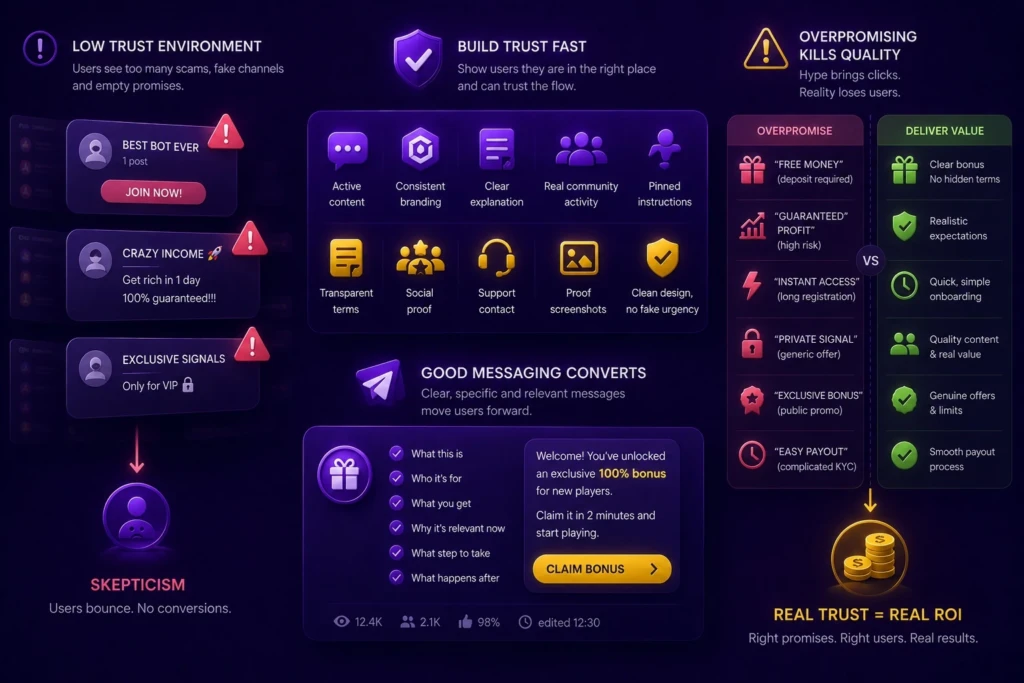
Telegram is full of low-trust funnels.
Users see fake channels, copied posts, aggressive bots, scammy finance claims, overhyped casino promos, low-quality crypto groups, and empty communities. That creates skepticism.
If your funnel does not build trust quickly, users will assume it is just another throwaway affiliate setup.
Lack of trust signals
Trust signals are mandatory in Telegram.
A user entering a bot or channel should feel that the flow is alive, relevant, and safe enough to continue.
Trust signals may include:
- active channel content;
- consistent branding;
- clear explanation;
- real-looking community activity;
- pinned instructions;
- transparent offer terms;
- social proof;
- support contact;
- proof screenshots where allowed;
- clean design;
- no broken language;
- no fake urgency.
A channel with two posts, no history, no clear identity, and a hard CTA will not convert well. A bot that immediately pushes a link with no context feels risky.
Trust does not need to be corporate. It needs to be believable.
Poor messaging
Poor messaging kills conversion even when the traffic is decent.
Many Telegram funnels use generic copy that says nothing:
“Best platform.”
“Exclusive deal.”
“Limited offer.”
“Join now.”
“Make money today.”
“Start winning.”
This kind of copy is dead because users have seen it too many times.
Good Telegram messaging should be specific, direct, and tied to the user’s reason for clicking. It should answer objections before they appear and move users toward the next action without sounding robotic.
The copy should explain:
- what this is;
- who it is for;
- what the user gets;
- why it is relevant now;
- what step to take;
- what happens after the step.
In Telegram, shorter is usually better, but shorter does not mean empty. Every line must work.
Overpromising and underdelivering
Overpromising is a fast way to kill Telegram funnel quality.
Aggressive promises may increase clicks, but they create disappointment after the click. When the user sees the real offer and it does not match the hype, they bounce.
This is common in iGaming, crypto, finance, betting, nutra, and make-money flows.
Examples:
- promise of “free money” but deposit required;
- “guaranteed profit” but risky product;
- “instant access” but long registration;
- “private signal” but generic offer;
- “exclusive bonus” but public promo;
- “easy payout” but complicated verification.
Overpromising may inflate the top-funnel. It destroys backend.
The goal is not to make the biggest claim. The goal is to attract the right user and move them into a monetizable action.
Technical mistakes in funnels
Technical mistakes are boring, but they burn money fast.
A Telegram funnel can have good traffic, strong copy, and a decent offer, but still fail because the flow is slow, broken, confusing, or impossible to track.
Slow or broken flows
Speed matters.
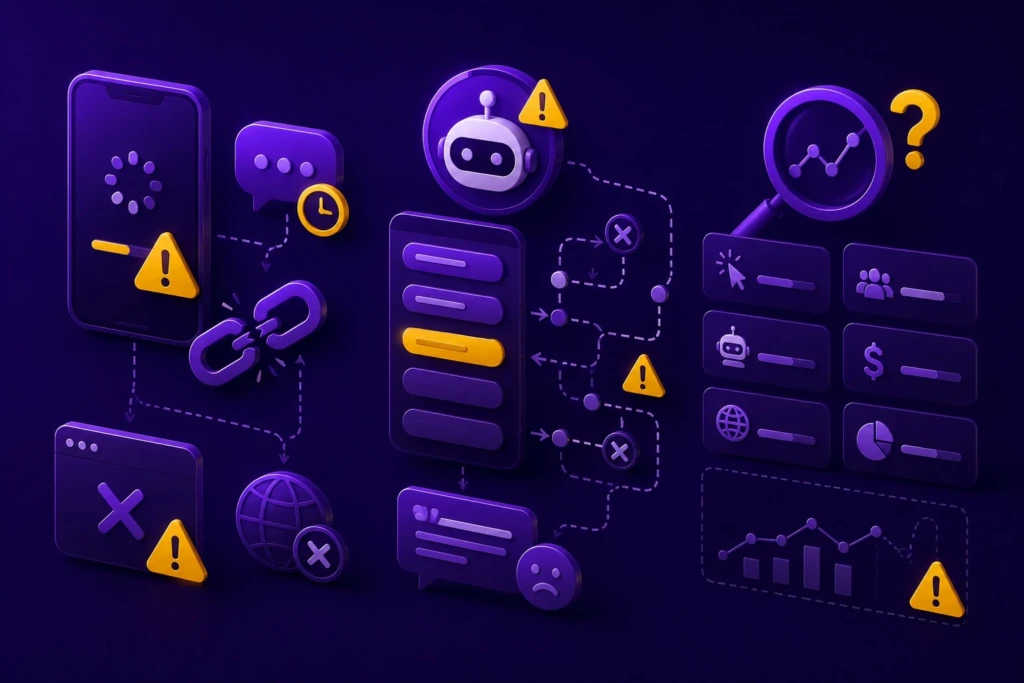
If the bot responds slowly, the page loads badly, the redirect breaks, or the CTA button fails, users leave. Telegram traffic is impatient. A small delay can create a big drop.
Common technical issues include:
- bot response delays;
- broken buttons;
- dead redirect links;
- mobile layout problems;
- slow landing pages;
- incorrect deep links;
- blocked domains;
- failed geo-redirects;
- language version errors;
- offer unavailable in the user’s region.
Every technical break becomes paid leakage.
The buyer pays for the click, but the user never reaches the money step. That is one of the worst types of loss because the dashboard may not show the full damage unless tracking is clean.
Bad bot structure
A lot of bots are built like menus, not funnels.
They give users too many options, too little guidance, and no clear primary path. That creates decision fatigue.
Bad bot structure looks like:
- too many buttons at the start;
- unclear labels;
- no default path;
- no progress logic;
- no segmentation;
- repeated messages;
- confusing navigation;
- dead ends;
- no recovery after inactivity.
A conversion bot should guide the user. It should not make them think too much.
The best Telegram bot funnels usually have:
- one clear first action;
- short sequence;
- logical progression;
- minimal steps;
- segmentation only when useful;
- strong CTA;
- fallback message;
- retouch or push logic;
- clean handoff to offer.
This is the core of telegram bot funnel optimization: reduce confusion, preserve intent, and push users to the next monetized step.
Tracking issues
Without tracking, optimization is blind.
Many Telegram buyers still track only basic events: clicks, bot starts, joins, maybe registrations. That is not enough.
You need to know:
- which traffic source created the click;
- which placement created bot starts;
- which bot path created registrations;
- which message generated deposits;
- which GEO produced approved users;
- which creative brought high-LTV users;
- where users dropped;
- which steps created fake activity.
Tracking issues lead to wrong decisions. You may cut a campaign that produces fewer leads but better deposits. Or scale a placement that produces cheap bot starts but no money.
If you cannot see step-by-step performance, you cannot fix the funnel. You can only guess.
Where money is lost
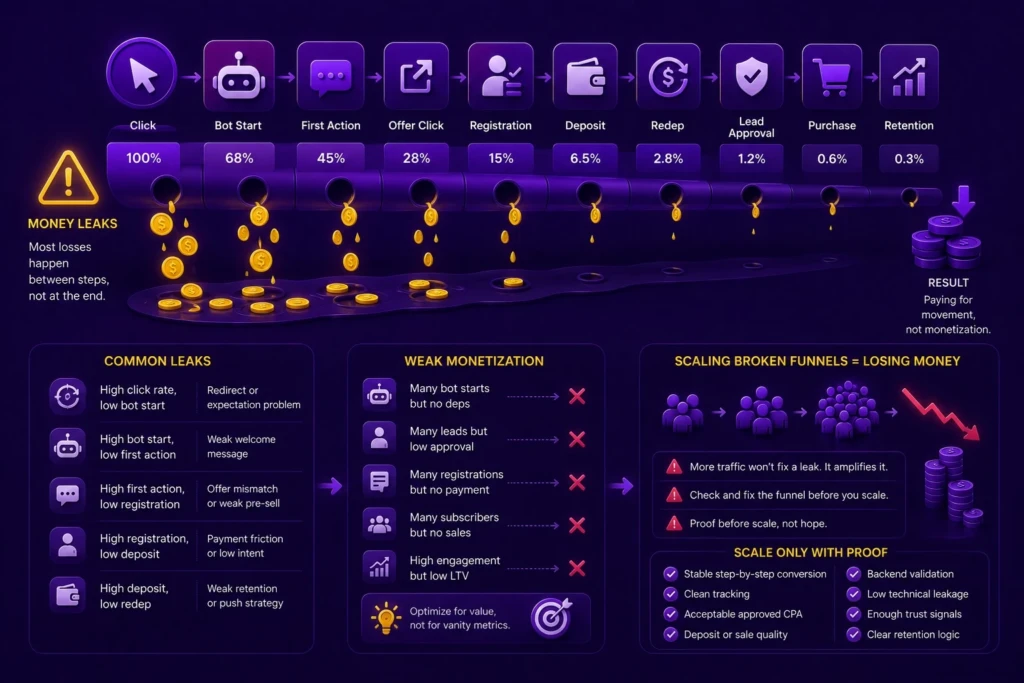
Money is usually lost between steps.
Telegram funnels often look active at the top but weak at the bottom. That means the buyer is paying for movement, not monetization.
The leak can happen anywhere: after click, after bot start, after first message, after channel join, after registration, after deposit attempt, or after first purchase.
Drop-offs between steps
Drop-offs are normal. But uncontrolled drop-offs destroy ROI.
The buyer must measure each step:
Click → bot start
Bot start → first action
First action → offer click
Offer click → registration
Registration → deposit
Deposit → redep
Lead → approval
Purchase → retention
If one step drops too hard, that is where to optimize.
For example:
High click rate, low bot start = redirect or expectation problem.
High bot start, low first action = weak welcome message.
High first action, low registration = offer mismatch or weak pre-sell.
High registration, low deposit = payment friction or low intent.
High deposit, low redep = weak retention or push strategy.
Telegram funnel optimization is not about changing everything randomly. It is about finding the exact leak.
Weak monetization
Some funnels convert, but they do not monetize.
This happens when users complete shallow actions but do not create value. For affiliate buyers, this is dangerous because the top-funnel looks good.
Examples:
- many bot starts but no deps;
- many leads but low approval;
- many registrations but no payment;
- many cheap subscribers but no sales;
- high engagement but low LTV.
Weak monetization usually means the funnel is optimizing for the wrong event.
If the buyer optimizes for bot starts, they get bot starters.
If they optimize for joins, they get joiners.
If they optimize for cheap leads, they get cheap leads.
But the business needs paying users.
The funnel must be built backward from the money event, not forward from the click.
Scaling broken funnels
Scaling a broken funnel is the fastest way to lose money.
If a funnel does not convert at small spend, more traffic will not fix it. It will only reveal the leak faster.
Many buyers make this mistake:
They see cheap traffic.
They increase volume.
They get more clicks.
The funnel still does not monetize.
Losses grow.
Volume does not solve weak intent, bad messaging, broken bots, poor trust, or weak backend. It amplifies them.
Before scaling Telegram traffic, a buyer needs proof:
- stable step-by-step conversion;
- clean tracking;
- acceptable approved CPA;
- deposit or sale quality;
- backend validation;
- low technical leakage;
- enough trust signals;
- clear retention logic.
Without that, scaling is just buying more noise.
How to build converting Telegram funnels
A converting Telegram funnel is simple, but not primitive.
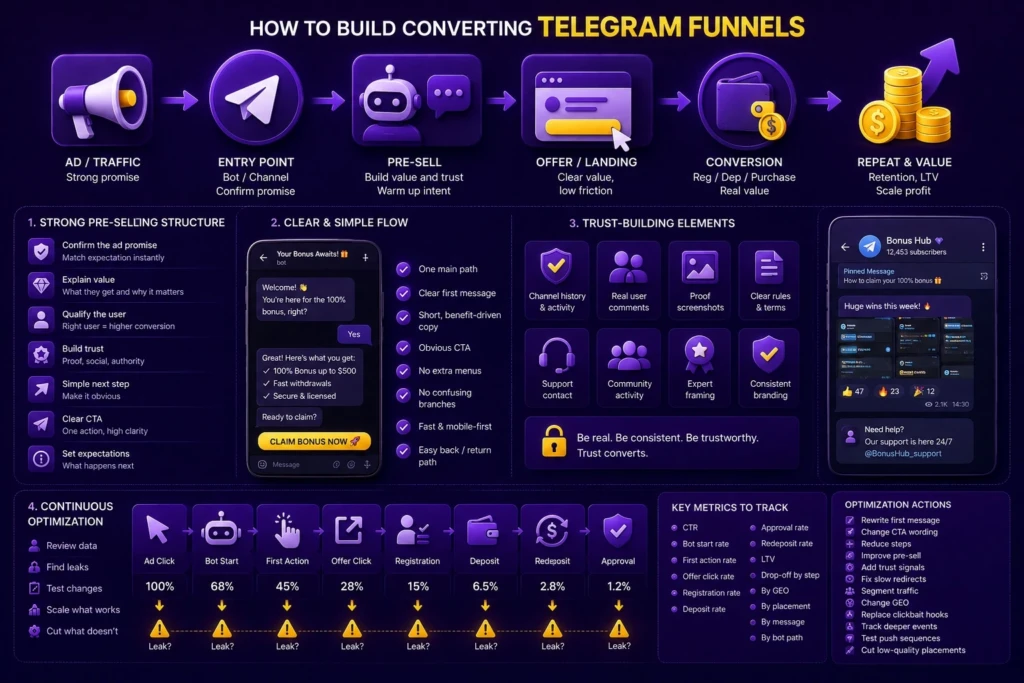
It needs a strong promise, clean path, trust layer, technical stability, and backend-focused optimization. The goal is not to maximize clicks. The goal is to move the right users toward value.
Strong pre-selling structure
Pre-selling should connect the ad to the offer.
A strong Telegram pre-sell flow usually includes:
- confirmation of the ad promise;
- quick explanation of value;
- user qualification;
- trust signal;
- simple next step;
- clear CTA;
- expectation setting before the offer.
For example, if the ad promotes an iGaming bonus, the pre-sell should explain how the bonus works, who can claim it, what action is needed, and why the user should continue now. If the flow is finance-related, it should handle trust and risk before the CTA.
Pre-selling is not about writing a long essay. It is about warming intent before asking for action.
Clear and simple flow
Telegram funnels should be easy to follow.
Every extra step must justify itself. Every button must have a purpose. Every message must move the user forward.
A clean flow should have:
- one main path;
- clear first message;
- short copy;
- obvious CTA;
- no unnecessary menus;
- no confusing branching;
- fast loading;
- mobile-first structure;
- easy return path.
The user should never wonder what to do next.
If the funnel needs segmentation, keep it simple. Ask only what improves conversion or monetization. Do not build a complex bot just because you can.
Trust-building elements
Trust is a conversion asset.
A Telegram funnel should show enough proof to reduce skepticism without looking fake. Depending on the vertical, this can include channel history, user comments, screenshots, clear rules, transparent terms, support contact, community activity, expert framing, brand consistency, or realistic testimonials where allowed.
The key is believability.
Do not overload the user with fake proof. Telegram users can smell low-quality hype. A cleaner, more realistic trust layer often converts better than aggressive fake social proof.
Trust also comes from consistency. The ad, bot, channel, landing page, and offer should all feel like the same flow. If every step looks like a different product, the user loses confidence.
Continuous optimization
Telegram funnels need constant optimization based on data.
The buyer should review:
- CTR;
- bot start rate;
- first action rate;
- offer click rate;
- registration rate;
- deposit rate;
- approval rate;
- redep;
- LTV;
- drop-off by step;
- performance by GEO;
- performance by placement;
- performance by message;
- performance by bot path.
The goal is to identify where intent dies.
Optimization can include:
- rewriting the first bot message;
- changing CTA wording;
- reducing steps;
- improving pre-sell;
- adding trust signals;
- fixing slow redirects;
- segmenting traffic;
- changing GEO;
- replacing clickbait hooks;
- tracking deeper events;
- testing push sequences;
- cutting low-quality placements.
Good Telegram funnels are not built once. They are tuned continuously.
FAQ
Why is my Telegram funnel not converting?
Most Telegram funnels do not convert because the user journey breaks after the click. Common issues include weak first message, unclear value proposition, traffic mismatch, low trust, bad bot structure, technical bugs, and poor tracking.
Why does Telegram traffic click but not buy?
Telegram users often click impulsively. If the funnel does not warm them up, explain the value, and build trust before the offer, they drop before the money event. Cheap clicks do not automatically mean paying users.
How do I improve Telegram bot funnel conversion?
Start by simplifying the bot path. Use one clear first action, short messages, strong pre-sell, trust signals, fast redirects, and clean tracking. Then optimize each step based on drop-off data.
What are the biggest Telegram affiliate funnel mistakes?
The biggest mistakes are clickbait traffic, weak pre-selling, too many bot steps, poor localization, no trust signals, broken tracking, wrong GEO selection, and scaling before backend validation.
Is Telegram good for affiliate marketing?
Yes, Telegram can work well for affiliate marketing, but only with the right funnel. The source can generate attention and volume, but profit depends on traffic quality, pre-selling, conversion flow, backend metrics, and retention.
What should I track in a Telegram funnel?
Track the full chain: click, bot start, first action, offer click, registration, deposit, redeposit, approval, refund, retention, LTV, and real ROI. Without step-by-step tracking, funnel optimization becomes guesswork.