

TikTok can generate clicks fast. That does not mean it generates money. A creative can pull attention, earn a strong CTR, get cheap traffic, and still fail commercially if the users do not continue through the funnel, approve, deposit, buy, or create backend value. In 2026, that gap between “viral” and “profitable” is where most TikTok buyers lose the plot.
The platform is moving deeper into automation with Smart+ and Symphony tools, which can automate parts of targeting, budget allocation, optimization, and creative production. TikTok says Smart+ is built to help deliver the right ad to the right person across campaign, audience, optimization, and creative decisions, while Symphony Automation brings generative AI tools into Smart+ to generate and enhance assets. That makes execution faster, but it does not remove the need for strategy. The campaigns that convert are still built around creative-offer alignment, strong user intent, clean post-click flow, and backend quality — not just high engagement.
Contents
- What actually drives conversions in TikTok ads
- How TikTok algorithm evaluates performance
- Why high CTR doesn’t mean profit
- Key elements of high-converting creatives
- The role of funnel in conversion
- Where conversions are lost
- How to optimize for real results
- FAQ
What actually drives conversions in TikTok ads
The main thing to understand: TikTok conversion is not a creative metric. It is a system metric.
A campaign converts when the whole chain works:
- the creative attracts the right person;
- the hook creates relevant intent, not empty curiosity;
- the offer matches the expectation created in the ad;
- the funnel continues the same promise;
- the landing page loads fast and feels natural on mobile;
- the post-click action is simple;
- the event quality is strong enough for the algorithm to learn;
- the backend supports the payout and scale.
That is why what drives conversions TikTok ads is not one magic hook or one editing style. The creative starts the conversion. The funnel finishes it. The offer economics decide whether it was worth buying.

Alignment between creative and offer
The strongest TikTok ads are not necessarily the loudest. They are the ones where the creative promise and the offer reality match tightly.
Bad alignment looks like this:
- creative promises easy money, offer requires complex verification;
- ad sells instant results, lander introduces a long process;
- video frames the product as free, checkout has hidden friction;
- UGC feels casual, offer page feels corporate and cold;
- hook attracts curiosity users, offer needs high-intent buyers;
- ad sells entertainment, funnel asks for commitment.
This mismatch can still produce clicks. That is the trap. The user clicks because the creative is interesting, but then drops because the offer does not deliver the expected next step.
Good alignment is boring in a profitable way. The user understands what they are clicking into. The lander confirms the same promise. The CTA feels like a natural continuation. The offer does not surprise them in a bad way.
For TikTok affiliate marketing conversion, this is critical. You are not just trying to create attention. You are trying to create qualified attention.
User intent vs entertainment
TikTok is entertainment-first. That creates a conversion problem.
People are not opening TikTok with the same mindset they bring to Google Search. They are not actively typing a problem into a search box. They are scrolling for stimulation, identity, humor, drama, information, and novelty. That means a buyer has to manufacture intent inside the creative.
Entertainment gets attention. Intent gets money.
A viral-style creative might generate:
- high CTR;
- strong watch time;
- many comments;
- cheap CPC;
- high raw lead volume.
But if users clicked because the ad was funny, dramatic, or weird — not because they understood the offer — conversion quality may be weak.
High-converting TikTok ads usually do two things at once:
- They feel native enough to stop the scroll.
- They qualify the user enough to avoid garbage traffic.
That is the balance. Too much entertainment, and you buy low-quality curiosity. Too much direct selling, and users scroll past because it feels like an ad.
How TikTok algorithm evaluates performance
The TikTok algorithm is not just looking at one metric. From a buyer’s perspective, it evaluates a mix of engagement, post-click behavior, and conversion feedback. TikTok’s own advertiser materials position Smart+ as an AI-powered campaign format that can automate optimization across audience, creative, and performance objectives, and its upgraded Smart+ flow gives advertisers options from full automation to manual control.
That means the buyer’s job is no longer only “find the audience.” The buyer’s job is to feed the system better signals.

Engagement signals
Engagement still matters because TikTok is a content platform. The ad has to earn distribution inside a feed where users can leave instantly.
Important engagement signals include:
- thumb-stop;
- watch time;
- completion rate;
- rewatches;
- likes;
- comments;
- shares;
- click behavior;
- negative feedback;
- skip speed.
These signals tell the system whether the ad deserves more attention. But they are not the final business outcome.
A creative with strong engagement can still be weak if it attracts the wrong user. A video can get watched because it is dramatic, not because the viewer is likely to convert. A hook can drive comments because it is controversial, not because it produces approved leads or purchases.
That is why TikTok ads optimization cannot stop at engagement. Engagement is the first filter. Conversion quality is the real test.
Conversion signals
Conversion signals are what separate entertaining ads from money-making ads.
Depending on the setup, conversion signals can include:
- landing page view;
- click-to-lead rate;
- registration;
- checkout start;
- purchase;
- deposit;
- subscription;
- qualified lead;
- approved lead;
- backend event;
- value-based event.
The deeper and cleaner the signal, the better the system can optimize for users who actually matter. If you optimize only for shallow clicks or cheap leads, TikTok may find more users who do exactly that: click or submit low-quality leads.
That is dangerous for affiliates. If the campaign optimizes toward raw conversions while approval or deposit quality is weak, the algorithm may scale the wrong behavior.
A TikTok campaign should not only ask: “Can we get conversions?”
It should ask: “Can we get conversions that survive the business model?”
Feedback loop
The algorithm works through feedback. Strong signals get more delivery. Weak signals lose priority. That is the simplified version, but it is enough for media buying decisions.
If users watch, click, continue, convert, and generate quality events, the campaign gives the system useful feedback. If users scroll, bounce, fail to convert, or produce low-quality events, the system has less reason to keep feeding that asset.
This is why the feedback loop can help or hurt fast.
Positive loop:
- strong hook;
- good watch time;
- relevant clicks;
- smooth landing page;
- quality conversion;
- clean postback;
- stronger delivery.
Negative loop:
- curiosity hook;
- cheap clicks;
- weak continuation;
- poor approval;
- unstable conversion feedback;
- delivery quality drops.
The buyer controls more of this than they think. Not through manual targeting alone, but through creative quality, event quality, funnel consistency, and clean tracking.
Why high CTR doesn’t mean profit
CTR is useful. It is not enough.
A high CTR tells you that the ad is good at earning clicks. It does not tell you whether those clicks are worth buying. In TikTok, this distinction is brutal because the platform can produce a lot of impulse traffic.

Clickbait problem
Clickbait can perform very well at the top of the funnel. That is why it is dangerous.
A clickbait creative may use:
- exaggerated promises;
- fake urgency;
- curiosity gaps;
- vague reward claims;
- shocking visuals;
- misleading “discovery” hooks;
- drama-first storytelling.
This can spike CTR. But after the click, reality arrives. If the landing page does not satisfy the expectation, users bounce. If the offer requires commitment, users drop. If the advertiser validates quality, approvals soften.
Clickbait creates an attention debt. The funnel has to pay it back. Most funnels cannot.
A high-converting creative does not only make people curious. It makes the right people curious for the right reason.
Low-quality traffic
Low-quality traffic often looks good in TikTok Ads Manager before it looks bad in revenue.
The buyer may see:
- low CPC;
- good CTR;
- decent raw CPA;
- stable spend;
- strong click volume.
Then downstream:
- bounce rate rises;
- lead quality drops;
- deposits do not happen;
- approval weakens;
- refunds increase;
- backend value is poor;
- real ROI goes negative.
This is why tiktok ad performance factors need to include more than the ad account. The ad account can tell you what users did inside the platform. It cannot always tell you whether those users became valuable.
Cheap traffic is only good if it becomes qualified action.
Backend mismatch
Backend mismatch happens when the front-end campaign looks good, but the business result is weak.
Examples:
- users register but do not deposit;
- leads submit but fail validation;
- buyers purchase once but refund quickly;
- trials do not rebill;
- users have low LTV;
- advertiser cuts approval after quality review;
- payout does not support actual CPA.
For affiliate teams, backend mismatch is deadly because the tracker can look green while the real economics rot underneath. If the campaign is optimized toward an event that is too shallow, it may scale users who never create backend value.
That is why “conversion” needs to be defined carefully. A raw lead is not the same as an approved lead. A click is not the same as intent. A registration is not the same as revenue.
Key elements of high-converting creatives
High-converting TikTok creatives are not just “native” or “viral.” They create the right kind of attention and push users into a believable next step.

Strong hook in first seconds
The first 2–3 seconds decide whether the ad gets a chance. If the user scrolls, nothing else matters.
A strong hook usually does one of four things:
- names a specific pain;
- shows a concrete result;
- creates relevant curiosity;
- interrupts a familiar pattern.
Weak hooks are generic. They sound like every other ad. They use tired structures without a fresh reason to care.
Strong hooks are specific:
- not “save money,” but “stop paying for unused subscriptions”;
- not “new app,” but “this shows where your budget leaks every month”;
- not “earn more,” but “why your CPA looks profitable but approval kills it.”
Specificity filters the audience. That is good. You do not need every click. You need the clicks that can convert.
Native content style
TikTok users reject obvious ads fast. A native style helps the creative enter the feed without triggering instant resistance.
Native does not mean sloppy. It means the creative understands the language of the platform:
- creator-led delivery;
- natural pacing;
- realistic framing;
- conversational script;
- mobile-first visuals;
- quick context;
- simple scene logic;
- believable reaction;
- low-friction storytelling.
UGC still works when it feels like real communication. It fails when it looks like fake UGC produced by a performance team that thinks users cannot tell the difference.
The best TikTok ads feel like content until the offer becomes relevant. Then they convert like ads.
Clear value proposition
A high-converting creative needs a clear value proposition. Users should understand what is being offered and why it matters.
Bad TikTok ads often hide the offer too long. They chase attention first, then reveal a weak or confusing product. That may keep watch time high, but it damages intent.
A clear value proposition answers:
- what is this?
- who is it for?
- what problem does it solve?
- why should I care now?
- what happens after I click?
The message should be simple enough to understand while scrolling. TikTok is not the place for complicated value architecture. The creative can be emotionally sharp, but the offer must be clear.
Emotional triggers
Emotion drives action on TikTok. But not all emotion converts.
Common triggers include:
- fear of missing out;
- frustration;
- curiosity;
- relief;
- status;
- savings;
- speed;
- control;
- risk reduction;
- social proof;
- personal transformation.
The trigger must match the offer. Fear can work for security or finance. Curiosity can work for discovery and tools. Savings can work for commerce. Social proof can work for apps, beauty, and lifestyle. But if the emotional trigger pulls the wrong type of user, conversion quality suffers.
High-converting creative uses emotion to qualify, not just to attract.
The role of funnel in conversion
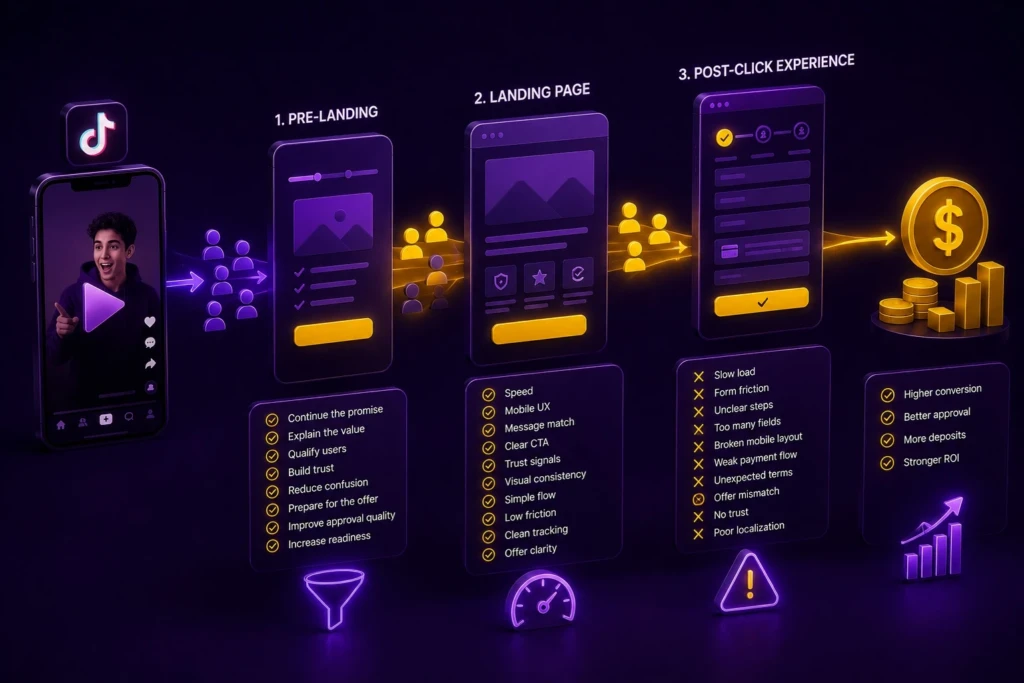
TikTok conversion does not happen only in the ad. The funnel is where attention becomes money.
Pre-landing importance
For many affiliate setups, the prelander is the bridge between entertainment and action. TikTok traffic often needs warming, filtering, and expectation-setting before it reaches the offer.
A good prelander can:
- continue the creative promise;
- explain the value;
- qualify weak users out;
- build trust;
- reduce confusion;
- prepare the user for the offer page;
- improve approval quality;
- increase deposit or purchase readiness.
A bad prelander does the opposite. It overpromises, creates curiosity without intent, or sends users into an offer they are not ready for.
The prelander should not be treated as filler. It is part of the conversion system.
Landing page quality
The landing page must match the ad. If the creative promises one thing and the page delivers another, users leave.
Landing page quality includes:
- speed;
- mobile UX;
- message match;
- clear CTA;
- trust signals;
- visual consistency;
- simple flow;
- low friction;
- clean tracking;
- offer clarity.
TikTok traffic is impatient. If the page is slow or confusing, the click is wasted. If the page feels too different from the creative, the user feels tricked. If the CTA is unclear, the impulse dies.
A good landing page does not need to be beautiful. It needs to be fast, consistent, and persuasive.
Post-click experience
Post-click experience is often where TikTok campaigns lose money.
The user may click with interest, then hit:
- slow load;
- form friction;
- unclear steps;
- too many fields;
- broken mobile layout;
- weak payment flow;
- unexpected terms;
- offer page mismatch;
- no trust;
- poor localization.
Every second and every mismatch lowers conversion intent.
For affiliates, post-click experience also affects event quality. If weak users can submit too easily, raw leads may rise while approval drops. If qualified users face too much friction, real conversions are lost.
The funnel should qualify without killing intent. That is the art.
Where conversions are lost
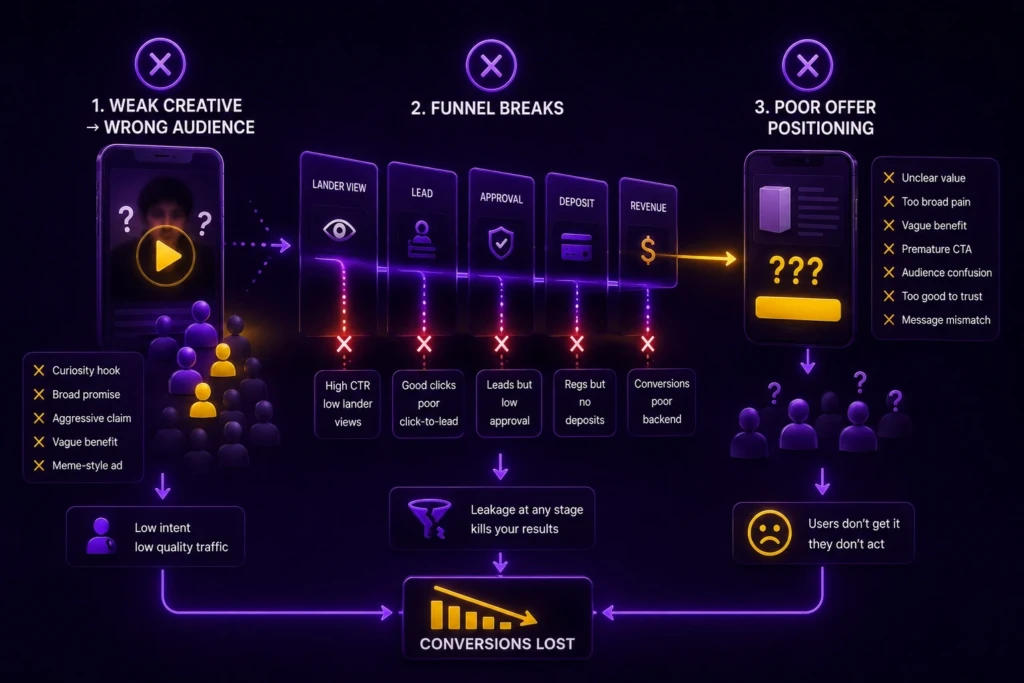
Conversions usually disappear at three points: the creative attracts the wrong audience, the funnel breaks, or the offer is positioned badly.
Weak creative → wrong audience
A weak creative does not always mean low CTR. Sometimes the problem is that it attracts the wrong people.
Examples:
- curiosity hook brings entertainment users;
- broad promise brings unqualified clicks;
- aggressive claim brings low-trust users;
- vague benefit brings poor intent;
- meme-style ad brings engagement but no buyer mindset.
If the creative attracts the wrong audience, optimization becomes polluted. The algorithm may find more of the same low-quality users because that is the signal it receives.
The fix is not always “make the creative more exciting.” Sometimes the fix is making it more specific.
Funnel breaks
Funnel breaks are the silent killer.
They show up as:
- strong CTR but low lander view rate;
- good clicks but poor click-to-lead;
- cheap leads but low approval;
- registrations but no deposits;
- add-to-cart but no purchase;
- trials but no rebill;
- conversions but poor backend.
A buyer who only watches TikTok Ads Manager may miss the break. The platform shows activity. The business sees weak money.
The funnel needs stage-level diagnostics. If the campaign breaks after the click, changing the hook may not solve it. If users submit but do not approve, improving CTR is irrelevant.
Poor offer positioning
Sometimes the offer is not bad. It is positioned badly.
Poor positioning happens when:
- the value is unclear;
- the pain is too broad;
- the benefit is not specific;
- the CTA feels premature;
- the audience does not understand the product;
- the offer sounds too good to trust;
- the creative sells one thing, but the offer page sells another.
TikTok needs fast comprehension. If users need too long to understand why the offer matters, they are gone.
Good positioning compresses the offer into one clear reason to act.
How to optimize for real results
TikTok ads optimization in 2026 should be built around real revenue, not just platform engagement.
Focus on backend metrics
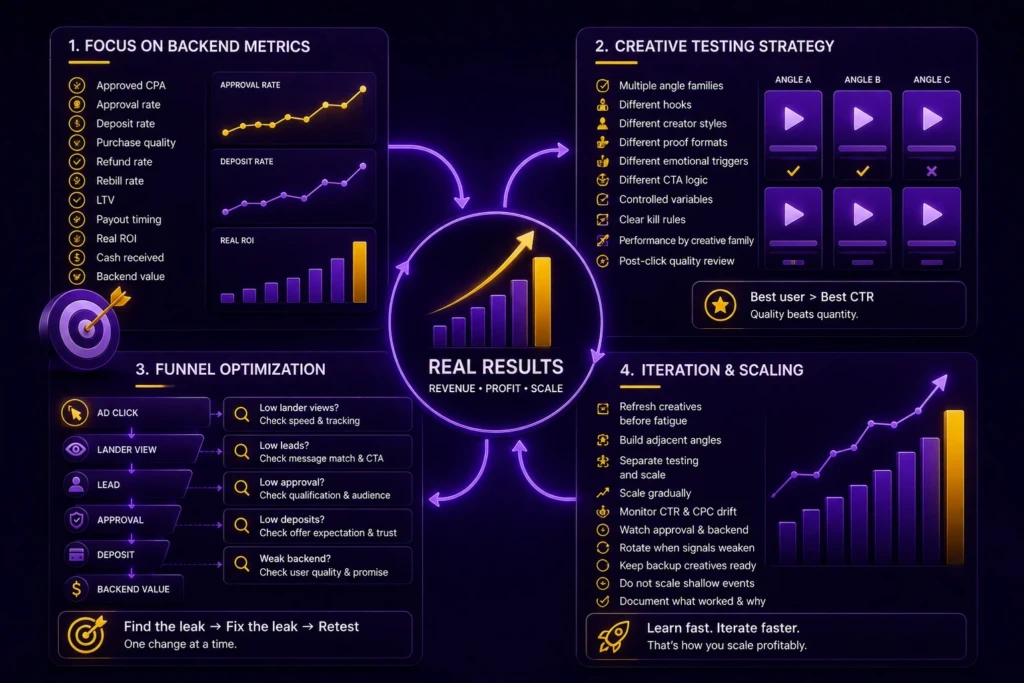
Track the metrics that decide whether the campaign is actually valuable:
- approved CPA;
- approval rate;
- deposit rate;
- purchase quality;
- refund rate;
- rebill rate;
- LTV;
- payout timing;
- real ROI;
- cash received;
- backend value.
This is especially important for affiliate campaigns. If raw conversions are cheap but approval is weak, the campaign is not good. If deposits are low, the traffic is not good. If payout timing kills cashflow, scale is limited.
Backend metrics protect buyers from fake winners.
Creative testing strategy
Test creatives by hypothesis, not random volume.
A strong creative testing plan includes:
- multiple angle families;
- different hooks;
- different creator styles;
- different proof formats;
- different emotional triggers;
- different CTA logic;
- controlled variables;
- clear kill rules;
- performance by creative family;
- post-click quality review.
Do not only ask which creative gets the best CTR. Ask which creative produces the best user.
A lower-CTR creative with better approval can be more profitable than a high-CTR creative that sends garbage.
Funnel optimization
Funnel optimization should be tied to where users drop.
If clicks do not become lander views, check load speed and tracking.
If lander views do not become leads, check message match and CTA.
If leads do not approve, check qualification and audience quality.
If deposits do not happen, check offer expectation and trust.
If backend is weak, check user quality and promise accuracy.
The goal is not to optimize everything at once. Find the leak, fix the leak, then retest.
Iteration and scaling
Scaling TikTok campaigns requires iteration. One winning creative rarely carries the whole operation.
A durable process includes:
- refresh creatives before fatigue;
- build adjacent angles;
- separate testing and scale;
- scale gradually;
- monitor CTR and CPC drift;
- watch approval and backend;
- rotate when signals weaken;
- keep backup creatives ready;
- do not scale shallow events;
- document what worked and why.
TikTok rewards teams that learn fast. Not teams that just launch fast.
FAQ
What drives conversions in TikTok ads in 2026?
Conversions are driven by creative-offer alignment, strong intent, clear value proposition, native content style, clean funnel flow, fast landing pages, and quality conversion feedback.
Why does high CTR not mean profit on TikTok?
High CTR only proves that users click. It does not prove they approve, buy, deposit, retain, or generate backend value. Clickbait can create strong CTR and weak commercial results.
What is the difference between viral and converting TikTok creative?
Viral creative earns attention. Converting creative earns qualified action. The best TikTok ads combine native engagement with a clear offer, relevant intent, and strong post-click continuation.
How should affiliates optimize TikTok ads?
Affiliates should optimize for approved CPA, approval rate, deposit quality, real ROI, and backend value — not just raw leads, CTR, or cheap clicks.
What role does the funnel play in TikTok conversion?
The funnel turns TikTok attention into money. It must continue the creative promise, load fast, qualify users, reduce friction, and guide users to the offer without breaking trust.
How do I improve TikTok ad conversion rate?
Improve message match, test stronger hooks, use more specific creative angles, optimize prelanders, speed up landing pages, track backend metrics, and cut traffic that gets clicks but does not create value.
Final takeaway
TikTok conversions in 2026 are not driven by one metric, one hack, or one viral creative. They are driven by system quality.
The creative creates attention.
The hook creates intent.
The offer sets expectation.
The funnel carries the user.
The backend proves the value.
The algorithm scales the signal it receives.
If the signal is shallow, TikTok will scale shallow traffic. If the creative is clickbait, it will find clickers. If the funnel is weak, the traffic will leak. If the event is too soft, optimization will chase the wrong users.
The buyers who win on TikTok now are not the ones with the highest CTR.
They are the ones who know which clicks turn into money — and build every part of the campaign around that.