

AI is no longer a “nice extra” in affiliate marketing. In 2026, almost every serious team uses AI somewhere: creatives, spy analysis, landing copy, translations, reporting, offer research, data cleanup, or task automation. But here is the problem: saying “we use AI” does not mean the team makes more money. A lot of buyers generate more assets, more reports, more prompts, more dashboards — and still do not improve ROI.
The difference is execution. AI agents can speed up workflows, reduce production cost, and help teams test faster. But they do not magically replace media buying judgment, offer selection, backend analysis, or risk control. This article breaks down ai agents affiliate marketing 2026, what actually works, what is just hype, and how to use AI in traffic arbitrage without turning your operation into an automated mess.
Contents
- What AI agents actually are in affiliate marketing
- Where AI works in 2026
- Where AI doesn’t work
- Key use cases that generate profit
- Common mistakes when using AI
- Where money is actually made with AI
- How to implement AI agents effectively
- FAQ
What AI agents actually are in affiliate marketing
An AI agent is not just ChatGPT writing ad copy.
In affiliate marketing, an AI agent is a system that can take a task, process inputs, perform several steps, and produce an output with minimal manual work. It can analyze data, generate variations, summarize reports, monitor changes, organize tasks, pull insights, or help execute parts of a workflow.
The key word is workflow.
Most teams do not need “AI magic.” They need better operational speed. Faster creative production. Faster report reading. Faster competitor analysis. Faster localization. Faster funnel QA. Faster repetitive task handling.
That is where ai affiliate marketing automation starts making sense.
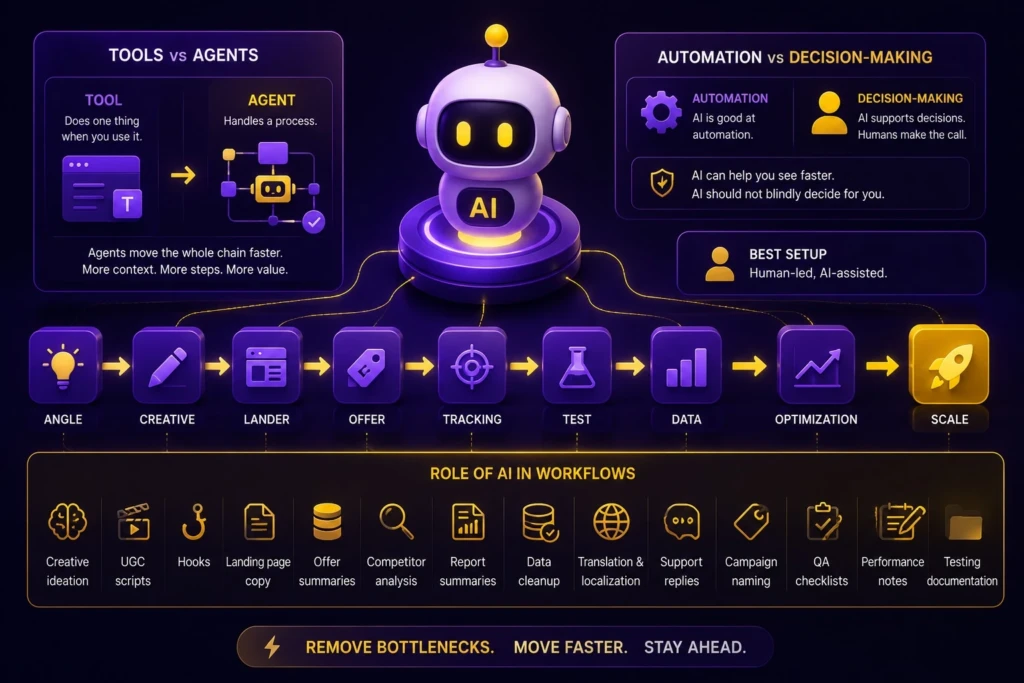
Difference between tools and agents
A tool does one thing when you use it.
An agent handles a process.
For example, an AI copywriting tool can generate ten Facebook ad headlines. That is useful, but it is still just a tool.
An AI agent can take the winning angle, generate multiple hooks, rewrite them for different GEOs, adapt tone by vertical, create landing page sections, prepare UGC scripts, summarize the testing plan, and save everything into the team workflow.
That is a different level of utility.
In performance marketing, the difference matters because money is rarely made from one isolated task. Money comes from the whole chain:
angle → creative → lander → offer → tracking → test → data → optimization → scale.
AI agents become valuable when they help move this chain faster.
Automation vs decision-making
AI is good at automation. It is weaker at final decision-making.
This is where many affiliates get burned. They expect AI to tell them exactly which offer to run, which GEO to scale, which creative will print, and when to kill a campaign.
That is not how it works.
AI can support decisions by organizing data, finding patterns, summarizing reports, generating hypotheses, and flagging anomalies. But the buyer still needs to understand traffic quality, backend metrics, payout logic, compliance risk, funnel friction, and scaling dynamics.
In short:
AI can help you see faster.
AI should not blindly decide for you.
For ai agents media buying, the best setup is human-led, AI-assisted.
Role of AI in workflows
The strongest role of AI in affiliate workflows is not replacing the buyer. It is removing bottlenecks.
AI can help with:
- creative ideation;
- UGC scripts;
- hooks;
- landing page copy;
- offer summaries;
- competitor analysis;
- report summaries;
- data cleanup;
- translation and localization;
- support replies;
- campaign naming;
- QA checklists;
- performance notes;
- testing documentation.
This sounds basic, but it adds up.
If a team can produce 5x more creative concepts, localize faster, read reports faster, and document tests better, it can move faster than competitors. In affiliate marketing, speed is not cosmetic. Speed is edge.
Where AI works in 2026
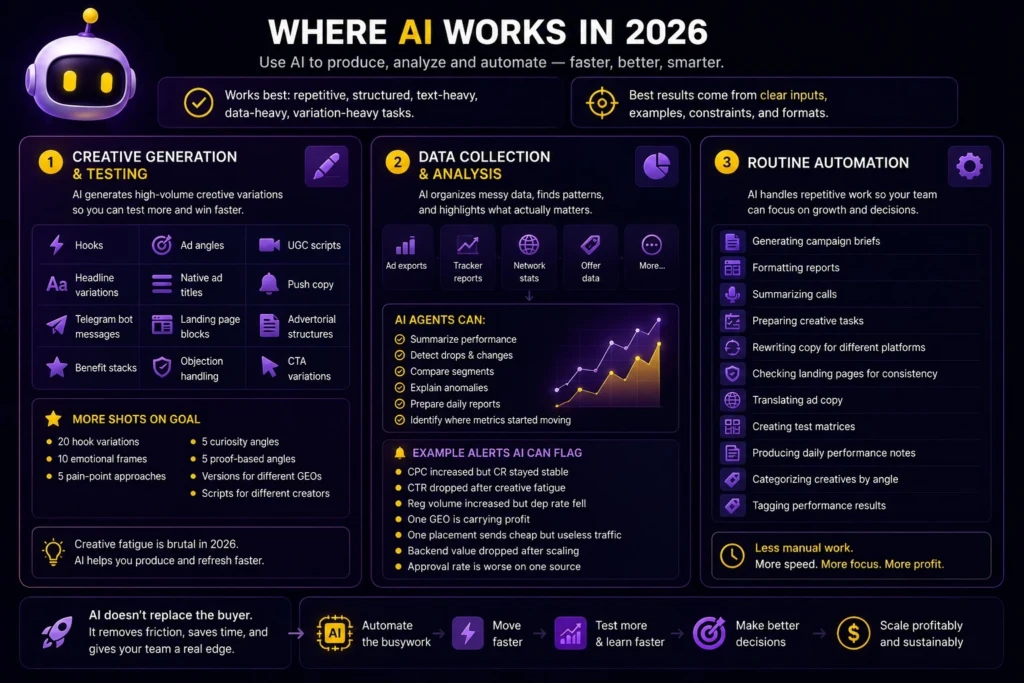
AI works best where the task is repetitive, structured, text-heavy, data-heavy, or variation-heavy.
It works especially well when the buyer already knows what they want and uses AI to produce, analyze, or organize faster.
The worst use of AI is asking vague questions and expecting perfect answers.
The best use of AI is giving it clear inputs, examples, constraints, and a specific output format.
Creative generation and testing
Creative production is one of the strongest use cases for affiliate marketing AI tools.
AI can generate:
- hooks;
- ad angles;
- UGC scripts;
- headline variations;
- native ad titles;
- push copy;
- Telegram bot messages;
- landing page blocks;
- advertorial structures;
- product benefit stacks;
- objection-handling lines;
- CTA variations.
This does not mean every AI creative will work. Most will not. But AI can increase the volume and speed of ideation.
A buyer can take one working angle and quickly produce:
- 20 hook variations;
- 10 emotional frames;
- 5 pain-point approaches;
- 5 curiosity angles;
- 5 proof-based angles;
- versions for different GEOs;
- scripts for different creators.
That gives the team more shots on goal.
And in 2026, creative fatigue is brutal. TikTok, Meta, native, Telegram, and short-form placements burn angles fast. Teams that cannot produce and refresh creative quickly lose.
AI helps solve that bottleneck.
Data collection and analysis
AI also works well with data organization and analysis.
Affiliate teams often sit on messy information:
- ad account exports;
- tracker reports;
- network stats;
- offer data;
- click logs;
- postback data;
- approval reports;
- CRM exports;
- refund data;
- LTV reports;
- channel performance;
- placement notes.
The problem is not only collecting data. The problem is reading it fast enough.
AI agents can help summarize performance, detect drops, compare segments, explain anomalies, prepare daily reports, and identify where metrics started moving.
For example, an AI agent can review campaign stats and flag:
- CPC increased but CR stayed stable;
- CTR dropped after creative fatigue;
- reg volume increased but dep rate fell;
- one GEO is carrying profit;
- one placement sends cheap but useless traffic;
- backend value dropped after scaling;
- approval rate is worse on one source.
This does not replace the buyer. It gives the buyer a faster diagnostic layer.
Routine automation
AI is very strong at routine automation.
This includes tasks like:
- generating campaign briefs;
- formatting reports;
- summarizing calls;
- preparing creative tasks;
- rewriting copy for different platforms;
- checking landing pages for consistency;
- translating ad copy;
- creating test matrices;
- producing daily performance notes;
- categorizing creatives by angle;
- tagging performance results.
This is not sexy, but it saves real hours.
Affiliate teams often lose speed because operations are messy. Buyers waste time writing the same briefs, checking the same naming rules, translating the same copy, and preparing the same reports.
AI can remove a lot of that friction.
Where AI doesn’t work
AI fails when teams expect it to replace market understanding.
Affiliate marketing is not just content generation. It is a messy game of traffic psychology, offer economics, moderation risk, backend feedback, funnel friction, account survival, payment behavior, and timing.
AI can assist, but it does not “know” your real campaign context unless you feed it the data.
Strategy and decision-making
AI should not be the final strategist.
It can help generate strategic options, but it should not decide the strategy without human validation.
Why?
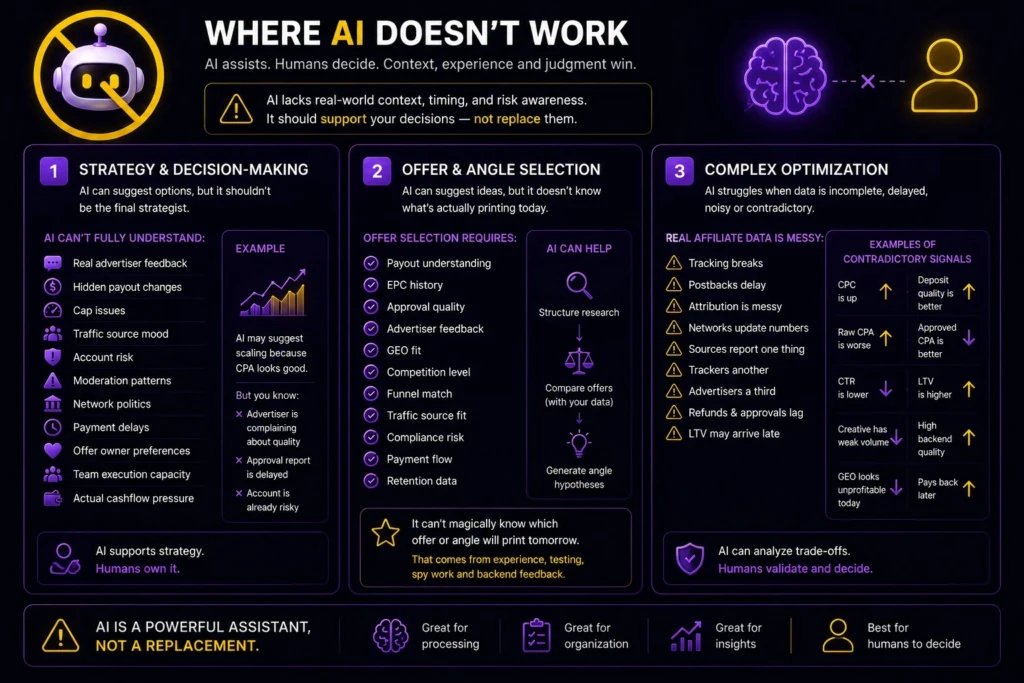
Because affiliate strategy depends on things AI may not fully understand:
- real advertiser feedback;
- hidden payout changes;
- cap issues;
- traffic source mood;
- account risk;
- moderation patterns;
- network politics;
- payment delays;
- offer owner preferences;
- team execution capacity;
- actual cashflow pressure.
For example, AI may suggest scaling a campaign because CPA looks good. But a buyer may know the advertiser is complaining about quality, or the approval report is delayed, or the account is already risky.
That context matters.
AI can support strategy. It should not own it.
Offer and angle selection
AI is weak at choosing winning offers and angles from scratch.
It can suggest ideas, but it does not automatically know what is printing in your market today. It may give generic angles that sound logical but are already burned, non-compliant, too soft, too broad, or disconnected from actual buyer psychology.
Offer selection requires:
- payout understanding;
- EPC history;
- approval quality;
- advertiser feedback;
- GEO fit;
- competition level;
- funnel match;
- traffic source fit;
- compliance risk;
- payment flow;
- retention data.
AI can help structure research. It can compare offers if you give it data. It can generate angle hypotheses. But it cannot magically know which offer will print tomorrow.
That still comes from buyer experience, testing, spy work, and backend feedback.
Complex optimization
AI also struggles with complex campaign optimization when data is incomplete or noisy.
Affiliate data is rarely clean. Tracking breaks. Postbacks delay. Attribution is messy. Networks update numbers. Sources report one thing, trackers another, advertisers a third. Refunds and approvals can lag. LTV may arrive late.
If you feed AI incomplete data, it may produce confident but wrong recommendations.
Complex optimization needs human judgment because performance signals can contradict each other.
For example:
- CPC is up, but deposit quality is better;
- raw CPA is worse, but approved CPA is better;
- CTR is lower, but LTV is higher;
- one creative has weak volume but high backend quality;
- one GEO looks unprofitable today but pays back later.
AI can help analyze these trade-offs, but the buyer has to validate the conclusion.
Key use cases that generate profit
The AI use cases that actually generate profit are usually not dramatic. They are operational.
AI helps teams test more, produce faster, cut manual work, and reduce the time between idea and data.
That is where the money is.
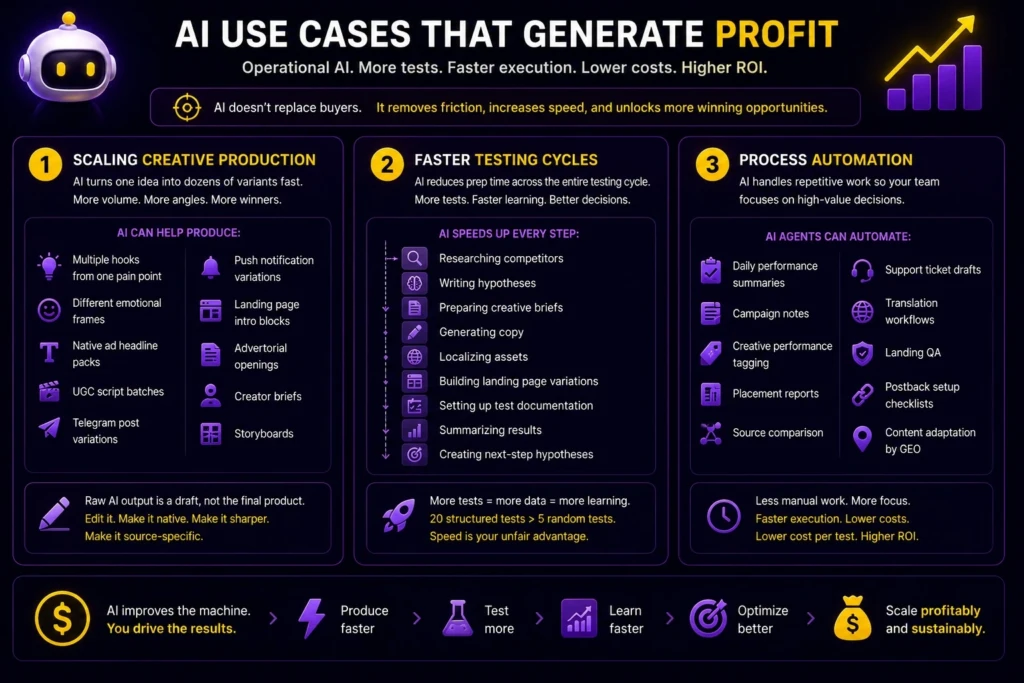
Scaling creative production
The biggest AI advantage is creative scale.
A buyer or creative lead can turn one idea into many variations quickly. This is especially useful in platforms where creative fatigue kills campaigns fast.
AI can help produce:
- multiple hooks from one pain point;
- different emotional frames;
- native ad headline packs;
- UGC script batches;
- Telegram post variations;
- push notification variations;
- landing page intro blocks;
- advertorial openings;
- creator briefs;
- storyboards.
This does not mean publishing raw AI output. Raw AI copy is often too clean, too generic, or too “marketing-ish.” The buyer should edit it, make it more native, sharper, and more source-specific.
But AI gets the team from blank page to testable options much faster.
Faster testing cycles
AI improves testing cycles by reducing preparation time.
A normal testing cycle may include:
- researching competitors;
- writing hypotheses;
- preparing creative briefs;
- generating copy;
- localizing assets;
- building landing page variations;
- setting up test documentation;
- summarizing results;
- creating next-step hypotheses.
AI can speed up almost every step.
The result is not just more creatives. It is faster learning.
A team that runs 20 structured tests while another team runs 5 has a higher chance to find a working angle. In arbitrage, learning velocity is a competitive advantage.
This is one of the most practical forms of ai automation traffic arbitrage.
Process automation
AI also makes money by reducing operational cost.
If a team spends fewer hours on repetitive tasks, those hours can move to higher-value work: offer negotiation, creative review, source testing, funnel optimization, backend analysis, and scaling.
AI agents can automate:
- daily performance summaries;
- campaign notes;
- creative performance tagging;
- placement reports;
- source comparison;
- support ticket drafts;
- translation workflows;
- landing QA;
- postback setup checklists;
- content adaptation by GEO.
This may not look like direct ROI, but it improves team efficiency. Lower operational drag means faster execution and lower cost per test.
Common mistakes when using AI
Most AI failures in affiliate marketing are not caused by AI. They are caused by bad implementation.
Teams either expect too much, give poor inputs, or skip validation.
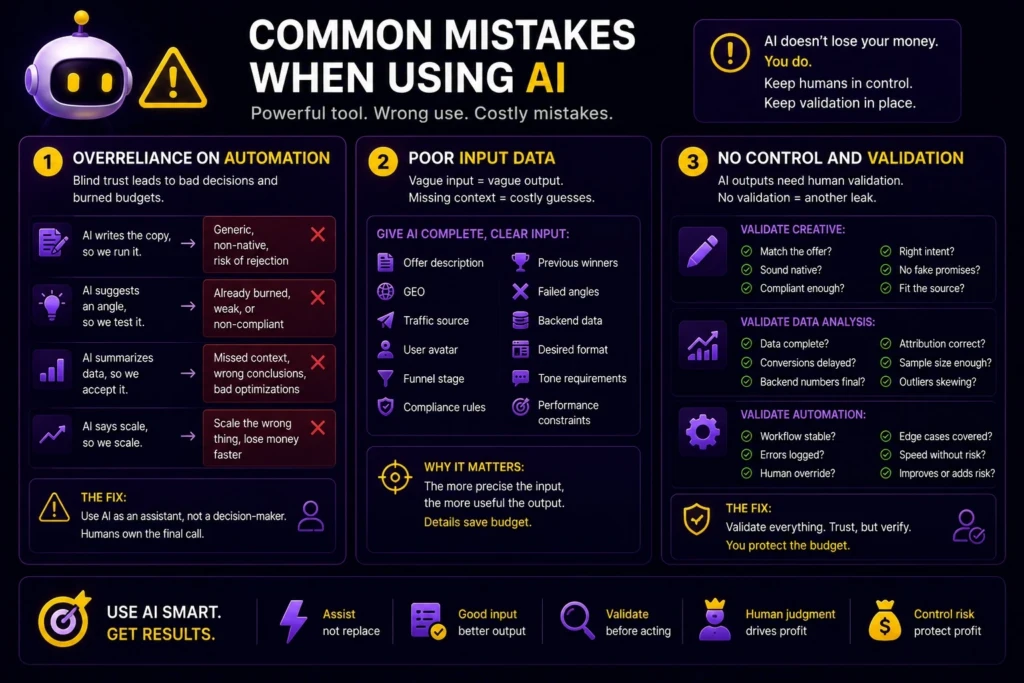
Overreliance on automation
The biggest mistake is blind trust.
AI writes the copy, so the team runs it.
AI suggests an angle, so the buyer tests it.
AI summarizes data, so the team accepts it.
AI says scale, so the buyer scales.
This is dangerous.
AI can produce useful outputs, but it can also produce generic, non-compliant, misleading, or strategically weak ideas. It does not carry financial responsibility for the budget. The buyer does.
Automation should reduce manual work, not remove thinking.
The best teams use AI as a production and analysis assistant. They keep human control over final decisions.
Poor input data
Bad input creates bad output.
If you give AI vague instructions, you get generic content. If you give it messy data, you get messy analysis. If you do not include vertical, GEO, source, offer, audience, compliance limits, and performance goals, it will guess.
And guesses burn money.
Good AI use requires strong input:
- offer description;
- GEO;
- traffic source;
- user avatar;
- funnel stage;
- compliance rules;
- previous winners;
- failed angles;
- backend data;
- desired format;
- tone requirements;
- performance constraints.
The more precise the input, the more useful the output.
No control and validation
AI outputs need validation.
For creative, validate:
- does it match the offer?
- does it sound native?
- is it compliant enough?
- does it create the right intent?
- does it avoid fake promises?
- does it fit the source?
For data analysis, validate:
- is the data complete?
- are conversions delayed?
- are backend numbers final?
- is attribution correct?
- is the sample size enough?
- are outliers affecting the result?
For automation, validate:
- is the workflow stable?
- are errors logged?
- can a human override decisions?
- does it handle edge cases?
- does it improve speed without adding risk?
No validation means AI becomes another leak in the operation.
Where money is actually made with AI
Money is made when AI improves speed, reduces cost, and helps scale operations without destroying quality.
AI does not create profit out of nothing. It improves the machine around profit.
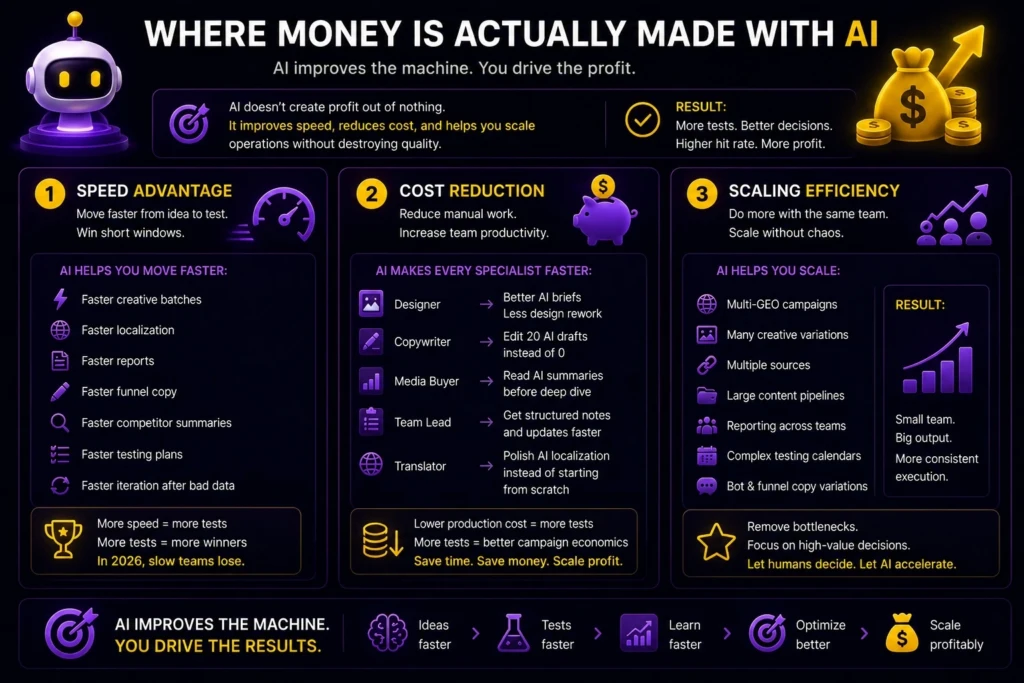
Speed advantage
Speed is the most obvious advantage.
AI helps teams move faster from idea to test. That matters because affiliate windows are short. Creatives burn. Offers cap. Competitors copy. Moderation changes. GEOs get saturated.
If your team can produce, test, analyze, and iterate faster, you get more chances to hit profitable pockets before they disappear.
Speed advantage means:
- faster creative batches;
- faster localization;
- faster reports;
- faster funnel copy;
- faster competitor summaries;
- faster testing plans;
- faster iteration after bad data.
In 2026, slow teams lose even when they have good ideas.
Cost reduction
AI can reduce cost by replacing or speeding up repetitive work.
This does not mean firing the whole team. It means making each specialist more productive.
A designer can work from better AI-generated briefs.
A copywriter can edit 20 AI drafts instead of writing from zero.
A buyer can read AI summaries before opening raw reports.
A team lead can get structured performance notes faster.
A translator can polish AI localization instead of starting from scratch.
Lower production cost means the team can test more angles for the same budget.
That can directly improve campaign economics.
Scaling efficiency
AI helps teams scale operations.
A solo affiliate can act more like a small team.
A small team can produce like a larger team.
A large team can standardize workflows across buyers, GEOs, and verticals.
This is especially useful for:
- multi-GEO campaigns;
- many creative variations;
- multiple sources;
- large content pipelines;
- reporting across teams;
- complex testing calendars;
- bot and funnel copy variations.
Scaling efficiency does not mean letting AI run everything. It means using AI to remove bottlenecks so humans can focus on high-value decisions.
How to implement AI agents effectively
The best AI implementation is boring, specific, and measurable.
Do not start with “we need AI everywhere.” Start with one painful workflow and automate part of it.
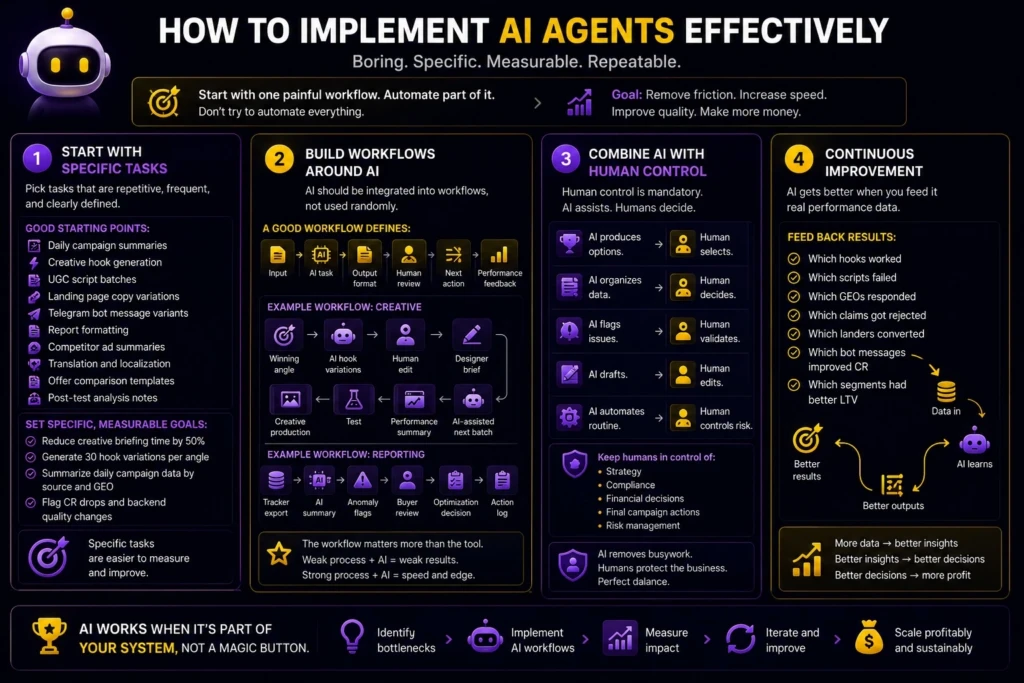
Start with specific tasks
Pick tasks that are repetitive, frequent, and clearly defined.
Good starting points:
- daily campaign summaries;
- creative hook generation;
- UGC script batches;
- landing page copy variations;
- Telegram bot message variants;
- report formatting;
- competitor ad summaries;
- translation and localization;
- offer comparison templates;
- post-test analysis notes.
Avoid starting with vague goals like “AI should improve ROI.” That is too broad.
Start with:
“AI should reduce creative briefing time by 50%.”
“AI should generate 30 hook variations per angle.”
“AI should summarize daily campaign data by source and GEO.”
“AI should flag CR drops and backend quality changes.”
Specific tasks are easier to measure.
Build workflows around AI
AI should be integrated into workflows, not used randomly.
A good workflow defines:
- input;
- AI task;
- output format;
- human review;
- next action;
- performance feedback.
Example creative workflow:
Winning angle → AI hook variations → human edit → designer brief → creative production → test → performance summary → AI-assisted next batch.
Example reporting workflow:
Tracker export → AI summary → anomaly flags → buyer review → optimization decision → action log.
The workflow matters more than the tool.
A weak process with AI is still weak. A strong process with AI becomes faster.
Combine AI with human control
Human control is mandatory.
AI should assist with speed and structure, while humans control strategy, compliance, financial decisions, and final campaign actions.
The best setup is:
AI produces options.
Human selects.
AI organizes data.
Human decides.
AI flags issues.
Human validates.
AI drafts.
Human edits.
AI automates routine.
Human controls risk.
This prevents over-automation and keeps the team from blindly trusting outputs.
Continuous improvement
AI workflows should improve over time.
Feed back results:
- which hooks worked;
- which scripts failed;
- which GEOs responded;
- which claims got rejected;
- which landers converted;
- which bot messages improved CR;
- which segments had better LTV.
The more performance data you feed into the workflow, the better the AI-assisted process becomes.
Do not use AI as a one-time content generator. Use it as a learning layer in the operation.
That is where what AI works affiliate marketing becomes clear: AI works when it is connected to real campaign data and continuous iteration.
FAQ
Do AI agents really work in affiliate marketing in 2026?
Yes, but mostly as workflow accelerators. AI agents work well for creative generation, reporting, localization, data summaries, testing documentation, and routine automation. They do not replace media buying judgment.
Can AI run media buying campaigns automatically?
Not reliably. AI can support campaign analysis and flag optimization opportunities, but final decisions should stay with experienced buyers because affiliate data is messy and backend context matters.
What are the best AI use cases for affiliates?
The best use cases are creative production, UGC scripts, landing copy, Telegram bot copy, competitor summaries, report analysis, translation, campaign documentation, and repetitive task automation.
Where does AI fail in traffic arbitrage?
AI fails when teams expect it to choose winning offers, make complex scaling decisions, understand hidden backend issues, or replace human judgment. It also fails when input data is poor.
How does AI improve affiliate ROI?
AI improves ROI indirectly by increasing testing speed, reducing production costs, improving workflow efficiency, and helping teams analyze data faster. The profit still comes from better execution.
How should an affiliate team start using AI agents?
Start with one specific workflow: creative generation, daily reports, localization, or testing documentation. Define inputs, outputs, human review, and performance feedback before expanding automation.