


Most affiliates do not lose because “there are no working setups.” They lose because the economics are leaking in five places at once and nobody is reading the full chain honestly. The traffic team looks at CTR, the buyer looks at tracker ROI, the AM talks about approvals “coming later,” finance sees payout delays, and by the time someone checks actual net profit, the campaign has already burned through the best part of its runway. That is the real pain in 2026: not a lack of opportunity, but a lack of clean economic discipline. The channel itself is still growing. U.S. affiliate-driven e-commerce sales hit $113 billion in 2024, U.S. affiliate investment reached $13.62 billion, and industry participants are still broadly optimistic about revenue growth in 2026. But channel growth and operator profitability are not the same thing.
That disconnect is exactly why experienced teams still run red without noticing it fast enough. They are not usually getting wrecked by one dramatic mistake. They are getting drained by soft losses: cheap but weak traffic, early scaling, approval collapse, tracking mismatch, attribution theft, hold periods, duplicate commissions, infra sprawl, and wasted test cycles. By the time all of that is added up, a campaign that looked “fine” on the dashboard is often nowhere near fine in the bank account. This breakdown is about those real loss points: where money actually disappears, how to spot the leak before it becomes a blowout, and how to run affiliate economics like a business instead of a dopamine machine.
Contents
- Where most money is lost in affiliate marketing
- Traffic-related losses
- Offer and approval problems
- Tracking and attribution issues
- Hidden operational costs
- How to identify and fix losses
- FAQ
Where most money is lost in affiliate marketing
The first thing to get straight is that money does not disappear in one place. It disappears across the chain. That matters because a lot of buyers still audit campaigns as if there is one master metric that tells the whole story. There is not. A campaign can have acceptable CPM, stable CPC, decent CTR, positive tracker ROI, and still be a weak business because approval, payout timing, attribution, and hidden costs are all telling a different story. In other words, affiliate marketing profit problems are usually cumulative, not theatrical.

Misunderstanding unit economics
This is still the most expensive beginner mistake, and plenty of advanced teams do it too. They run the business “by feel.” They know a campaign spent $2,500 and they know the tracker showed $3,100 in revenue, so the setup gets mentally tagged as “good enough.” But that is not unit economics. Unit economics means knowing your real payout per approved event, your true cost per funded action, your approval haircut, your infra cost allocation, your hold drag, and your cash conversion cycle. If you cannot answer whether a $28 front payout becomes $17 net approved value after rejection and delay, you are not operating on economics. You are operating on vibes.
Focusing on surface metrics
The second leak is surface-metric addiction. CTR, CPC, tracker ROI, raw lead count — all useful, none final. A campaign with 2.1% CTR, $0.42 CPC, and +35% tracker ROI can still be worse than a campaign with 1.4% CTR, $0.68 CPC, and only +12% tracker ROI if the second one has stronger approval, faster payout, and better downstream value. That is why “why affiliate marketing is not profitable” so often has a boring answer: people optimized the visible layer and ignored the paid layer.
Traffic-related losses
Traffic is still where the leak usually starts, even when the campaign dies somewhere else later. The reason is simple: weak traffic poisons everything below it. It makes the offer look worse, the funnel look worse, and the tracker lie more convincingly.

Low-quality traffic
Cheap clicks are not cheap if the user is weak. A lot of buyers still chase low CPM or low CPC as if that automatically means efficiency. It does not. In a lot of cases it just means the platform found low-pressure inventory with weaker intent. Those users click, bounce, half-register, or convert in ways that never hold through approval. That is the classic affiliate trap: traffic looks alive, metrics look active, but the audience is too soft to produce durable money. Fraud and attribution abuse make that worse, because in 2026 more of the damage sits inside the attribution layer itself, not only in obvious bot floods or fake sign-up bursts.
Overpaying for traffic
The opposite problem is paying premium prices for traffic that is not actually premium. This usually happens when buyers confuse competitive inventory with valuable inventory. A higher CPM can be fine if the user quality justifies it. But in many overcooked auctions, the media buyer is simply paying more to rent worse margin. That gets especially ugly when brand bidding, ad hijacking, or coupon hijacking are in the mix, because commissions can end up flowing to the wrong participant in the chain even when a real sale happened. Search industry reporting has been explicit about this: affiliates can hijack branded demand, steal attribution credit, and inflate paid search costs while claiming commissions on value they did not truly create.
Scaling too early
Then there is the classic “proof too shallow, budget too big” mistake. A buyer sees $600 spend, +28% tracker ROI, and thinks the setup has room. Then they push it to $2,500/day before approvals settle, before tracking has been audited, and before the first clean payout window. That is not scaling margin. That is scaling uncertainty. Plenty of campaigns do not become unprofitable because the offer stopped working. They become unprofitable because the buyer demanded certainty from incomplete data and multiplied the error.
Offer and approval problems
A lot of affiliate campaigns look strong right up until the moment the offer starts speaking back. That is where a lot of teams realize they were buying activity, not income.

Low approval rates
This is one of the oldest pain points in the business and still one of the most expensive. The tracker loves raw lead count because it can count instantly. The business only gets paid on what is approved. That gap destroys campaigns every day. If a campaign shows 250 leads at $18 visible payout, the tracker reports $4,500 revenue. On $3,200 spend, that looks like 40.6% ROI. But if approval lands at 54%, approved revenue drops to $2,430, and the campaign is suddenly at -24.1%ROI. Nothing “mystical” happened. The raw lead count just was never the real business metric.
Offer mismatch with traffic
Sometimes approval is weak because the traffic is weak. Sometimes approval is weak because the traffic and offer simply do not belong together. A broad, low-intent audience may register for a finance or lead-gen flow just enough to make the tracker look healthy, but not enough to survive quality checks, call-center validation, deposit requirements, or retention thresholds. That is the kind of mismatch that keeps mediocre campaigns alive too long: surface engagement says yes, commercial value says no.
Partner network risks
Then there is partner-side risk, which too many buyers still pretend is “just part of the game.” Delayed payouts, resold demand, unclear validation windows, rejection spikes, shifting caps, and attribution disputes all hit margin. Industry reporting has also documented a broader structural problem: commissions and credit can move to participants who captured the last measurable touchpoint rather than the one who created the actual commercial lift. That means even when sales are real, the income may still flow to another node in the chain. For affiliates, that is not an abstract attribution debate — it is a direct revenue leak.
Tracking and attribution issues
This is where many teams lose money while still believing their reporting stack is helping them. The stack usually is helping. It is just not telling the full truth.

Postback and tracking errors
Broken postbacks, stripped tokens, retry issues, redirect-chain failures, and bad deduplication logic are still massive sources of quiet loss. Trade coverage in 2026 is full of examples where brands and programs thought they were tracking one thing and were actually tracking something much narrower or much dirtier. One published case described a brand that believed it was tracking both UK and US sales, when in reality it was only tracking the US flow. That is not a “small setup bug.” That is a budgeting disaster.
Attribution conflicts
Attribution is where smart teams still get robbed politely. Last-click bias, assisted-conversion theft, paid-search hijacking, coupon overwrite, and duplicate event paths can all make one campaign look better and another worse than reality. Search industry sources have been blunt about the commercial impact: hijackers can bid on brand terms, capture the final attribution point, and claim commissions on traffic or demand that was already owned by someone else. The result is not just fraud. It is broken optimization, because the wrong campaign gets credited and the wrong campaign gets scaled.
Data mismatch between systems
And then there is the basic, boring mismatch problem: the tracker says one thing, the partner platform says another, and the ad account says something else again. A 5–10% delta might just mean you need an audit. A 20–40% delta is not noise anymore. At that point you are probably misreading the campaign structurally. If the tracker shows 180 conversions, the network shows 133 valid leads, and payout timing means only part of that is actually collectible this cycle, then the campaign is not “profitable pending confirmation.” It is commercially unresolved. Treating unresolved economics as profit is one of the cleanest ways to lose money at scale.
Hidden operational costs
This is the section that turns a lot of “fine” campaigns into weak ones the moment somebody does full accounting. The leak here is not in the ad account. It is in everything around the ad account.

Infrastructure costs
A lot of affiliate operators still calculate campaign profitability as if ad spend were the whole cost base. It isn’t. Full operating cost often includes accounts, proxies, anti-detect, domains, cloakers, hosting, tool stacks, payment friction, and support overhead. A campaign showing $6,250 revenue on $5,000 spend looks like 25% ROI until you add $450 for account and infra, $180 for tools and proxies, $220 for creatives, and $95 for payment friction. Now your true cost is $5,945, your profit is $305, and your real ROI is barely above 5%. Same campaign. Same traffic. Totally different business.
Team inefficiency
The next leak is process quality. Teams lose money when nobody owns the audit, nobody reconciles systems daily, and everyone assumes someone else is checking the ugly stuff. A buyer can be good at traffic and still leak cash through sloppy handoff, weak dedupe checks, poor offer rotation, or late reaction to approval drift. Industry growth does not fix that. In fact, bigger budgets usually punish it harder. Even as affiliate and digital ad budgets rise, profitability still gets wrecked by process immaturity more often than by market size limits.
Time and testing losses
The final hidden cost is time. Failed tests are not just “part of the game” if you never learn from them. They are a real line item. If a team burns 20 tests at $250 each chasing shaky proof, that is $5,000 gone before the “winner” even starts. Add designer hours, QA time, rework, and delayed capital recycling, and the leak gets even bigger. This is why so many operators say affiliate works, but stable profit still feels rare. The channel is growing, budgets are growing, and the opportunity is still very real — but without process discipline, the money gets eaten by system error before it becomes durable margin.
How to identify and fix losses
The fix is not glamorous. It is operational.
Breaking down the funnel
Start by splitting the chain into hard checkpoints: click, lander, prelander action, conversion, approval, payout, cash received, backend value. If the economics only look good when those checkpoints are blurred together, the campaign is probably weaker than it looks. The goal is not to create prettier reports. The goal is to isolate the exact point where value drops.
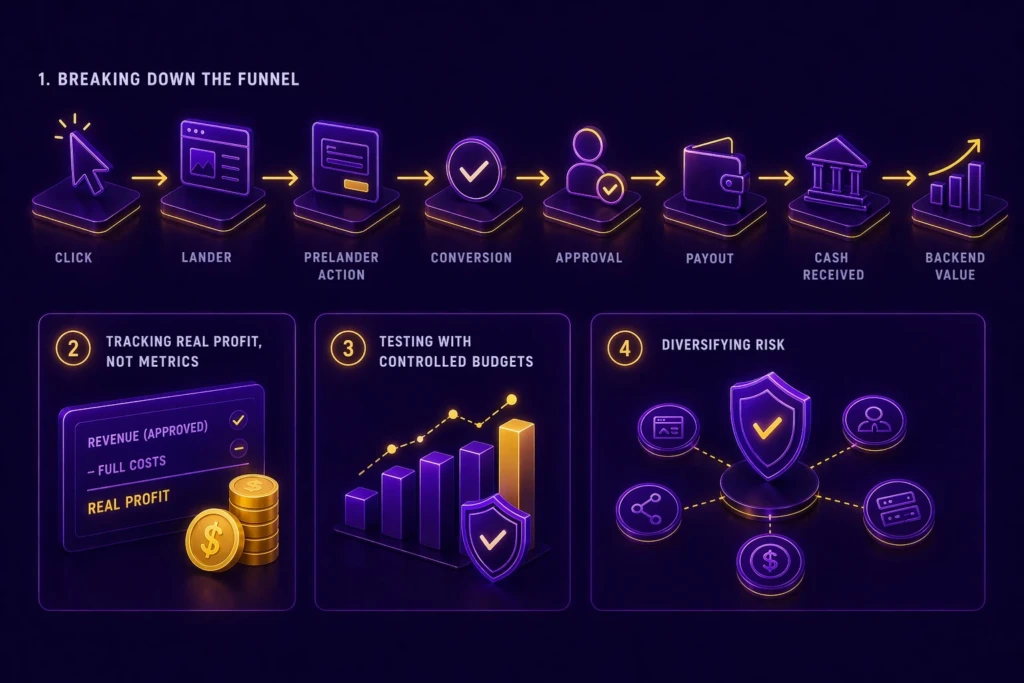
Tracking real profit, not metrics
Next, stop asking whether the dashboard is green and start asking whether the money is real. That means using approved or collectible revenue, not raw postback fantasy, and subtracting full cost, not just ad spend. Real profit should be tied to money you can actually get, not revenue you hope will survive validation.
Testing with controlled budgets
Then get disciplined with test depth. Early green numbers are not enough. If a campaign has only seen $300–$500 in spend and the approval window is still soft, it has not earned scale yet. Controlled budgets protect you from multiplying false positives. They also make it easier to detect whether a campaign is improving, stalling, or simply flattering you early.
Diversifying risk
Finally, stop making one setup carry the whole week. One offer, one traffic source, one attribution model, one network, one payment rhythm — that is not focus, that is concentration risk. Strong teams diversify across offers, infrastructure, and validation windows so one reporting failure or one approval shock does not nuke the whole margin stack. In a market with more attribution abuse, more tracking complexity, and more budget flowing through performance channels, risk concentration is just another hidden cost.
FAQ
Why do affiliate marketers lose money?
Usually because they optimize the visible metrics and ignore the full economics. Weak traffic, low approval, tracking gaps, attribution theft, delayed payouts, and hidden costs can all stack into a losing campaign even when the dashboard looks acceptable.
Where do most losses happen in affiliate marketing?
Not in one place. Most losses happen across the chain: traffic quality, offer mismatch, approval, attribution, tracking, and operating cost. The expensive part is that each leak looks small until they are added together.
Can you be profitable with low approval rates?
Sometimes, but the margin has to be strong enough to absorb it. In most leadgen flows, weak approval is a direct threat to profitability because raw conversion volume does not pay the bills — approved revenue does.
How do you track real profit in affiliate marketing?
Use full-funnel reconciliation: ad platform, tracker, affiliate network, payout sheet, and backend data where relevant. Base your calculations on approved or collectible revenue and subtract full operating cost, not just spend.
What is the biggest mistake beginners make?
Treating early positive metrics as proof of profitability. A green tracker, a nice CTR, or a low CPA can all be misleading if approval, attribution, payout timing, and hidden costs are not checked.