
The rapid decay of creative assets and high volatility in account stability remain primary challenges for media buyers operating within the Meta* advertising ecosystem.
This operational analysis evaluates a recent deployment in the Philippines market, focusing on structural methods to extend campaign lifecycles well beyond standard industry benchmarks.
The subject of this case study is Bin, a China-based independent media buyer with six years of digital marketing experience. Transitioning from a software engineering background in 2020, he adopted a highly structured, data-first methodology regarding testing protocols and optimization loops.
Over the last 24 months, his operations have centered on scaling Facebook* traffic channels, utilizing Zeydoo as his core infrastructure platform.
Operating as an independent media buyer requires distinct risk management protocols. Without institutional capital backstops, operational errors directly impact bottom-line profitability, leading to a highly pragmatic approach to campaign longevity.
Bin defines his strategic objective through a sustainable operational lens:
«In this industry, what really matters is not how much you make from a single campaign, but how long what you build continues to generate value.»
Consequently, this case study does not focus on an isolated high-yield campaign sequence. Instead, it provides an enterprise framework for converting media buying configurations into durable digital assets, mitigating the need for continuous, low-sustainability campaign restarts.
Why Zeydoo + Facebook* is a Cheat Code for Long-Term Scaling
The publisher initially partnered with Zeydoo in 2023 and returned more recently with a clearer, more structured strategy. He selected the Zeydoo and Facebook* combination deliberately, as this setup enables long-term scaling.
Zeydoo plays a key role due to its exclusive product ecosystem:
- Interactive offers – re-engineered, ready-to-deploy, simple interactive flows like quizzes or playable ads that drive user conversions. They include optimized, compliant pre-landers, eliminating the need to build funnels from scratch. This allows buyers to focus entirely on creatives and traffic – the two core drivers of performance.
- Operational support – stable payouts, responsive account management, and traffic-quality feedback, which is highly important for solo affiliates.
Zeydoo’s interactive offers show high performance with Facebook* traffic. They align well with high-engagement creatives, making them a strong fit for this strategy.
MIX | TOP OFFERS | SMART ROTATION
This mix funnel allows affiliates to automatically route traffic across top-performing offers: it simplifies testing and accelerates the identification of scalable combinations.
Facebook*, conversely, provides extensive reach and targeting, alongside an algorithm that rewards consistency. Extended campaigns accumulate data, improve audience matching, and gradually reduce CPM metrics.
«On Facebook*, time is not a cost – it’s an investment.»
Performance Snapshot
Here is an operational performance overview for February 2026:
| Operational Metric | Performance Metric |
| GEO | Philippines |
| Traffic Channel | Facebook* |
| ROI | 62.27% |
| Expenditure | $5,033 (capital allocated to traffic acquisition) |
| Gross Revenue | $8,241 (revenue yielded via the Zeydoo product offering) |
| Net Profit | $3,134 (net financial yield generated by the publisher) |
| Offer | Zeydoo Fixed CPL (Playable | Click Box 19037) |
The primary significance of these results lies in their specific operational source.
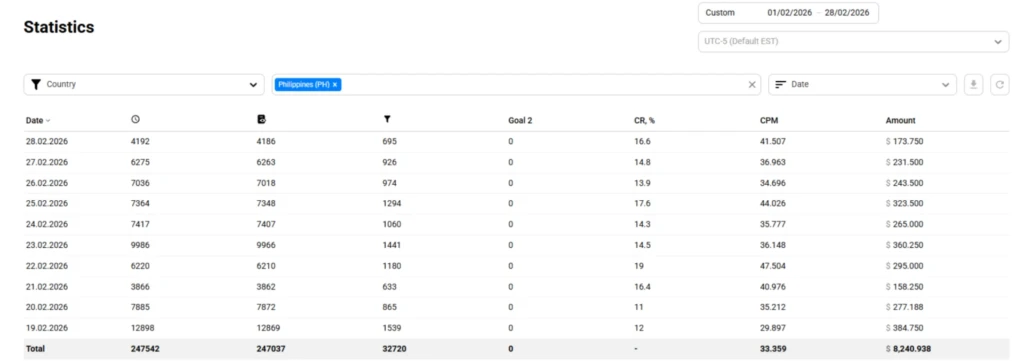
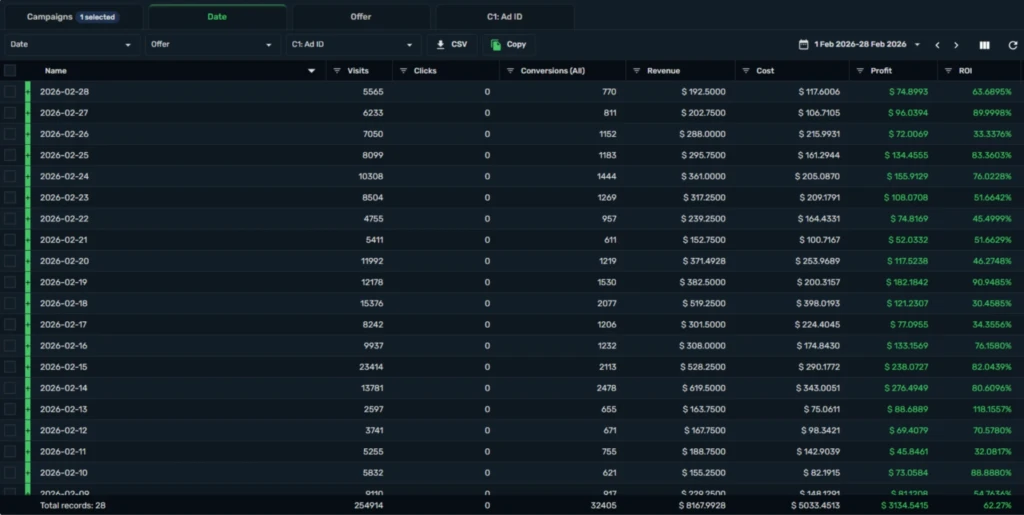
The bulk of the revenue was generated by a mere three Facebook* campaigns – all of which have maintained continuous deployment for nearly five months.
This runtime is highly atypical for Facebook* campaigns. In most scenarios, media buying teams encounter regular disruptions from creative decay, policy compliance enforcement, or account restrictions, forcing them into a continuous cycle of campaign redeployments.
In this instance, however, the campaigns sustained performance because they were engineered using an alternative strategy from inception.
Asset Thinking vs. Short-Term Thinking
Historically, many affiliates deployed aggressive, attention-grabbing creatives for Interactive offers. This methodology often secured high CTR and immediate results.
However, for long-term sustainability, maintaining campaign clarity and consistency is critical. Straightforward messaging and a transparent value proposition typically yield better performance over time.
Concurrently, Facebook’s* moderation protocols have become more stringent. The system now evaluates not only textual content but also visual elements and the comprehensive message. This shift became highly apparent following the March 2026 update, which resulted in widespread restrictions on ad accounts and campaigns.
For a significant number of affiliates, these changes led to the immediate loss of accumulated data and stable revenue streams.
What Makes an Ad a Long-Term Asset
Transitioning from short-term optimization to long-term performance stability fundamentally redefines creative strategy.
The underlying principle is straightforward: maintain absolute policy compliance and prioritize authentic user engagement.
When a campaign aligns cleanly with platform guidelines, the system is highly likely to sustain continuous traffic distribution over extended periods.
Rather than deploying aggressive claims, the operational focus shifts to cultivating genuine consumer interest.
Practical operational adjustments include:
- Prioritize interest over forced actions: While clickbait tactics may yield immediate traffic metrics, they lack durability. Creatives that foster authentic engagement exhibit greater long-term stability.
- Prioritize social engagement metrics: User interactions—such as likes, comments, and shares—directly enhance campaign performance and scaling efficiency.
- Deploy precise communication: Maintain straightforward messaging structures that actively encourage user interaction.
- Utilize informational asymmetry: Retaining a degree of mystery within the creative asset drives higher CTR and engagement.
According to the publisher, his methodology centers on interactive mechanics. However, because the campaign remains active, the specific creative assets cannot be disclosed at this time.
Nevertheless, the structural concept remains transparent. His approaches align precisely with the operational logic of Interactive offers: they stimulate curiosity, encourage user participation, and generate organic engagement.
Most critically, this framework provides a highly sustainable path for long-term scalability.
However, tactical concepts are rarely universal across markets:
«Some creatives work very well in Southeast Asia, but in other regions like Africa or Latin America, different cultural elements perform better. The right approach always comes from testing.»
This emphasizes the necessity of strategic localization, which requires adapting visual assets and messaging frameworks to the specific cultural context of the target demographic.
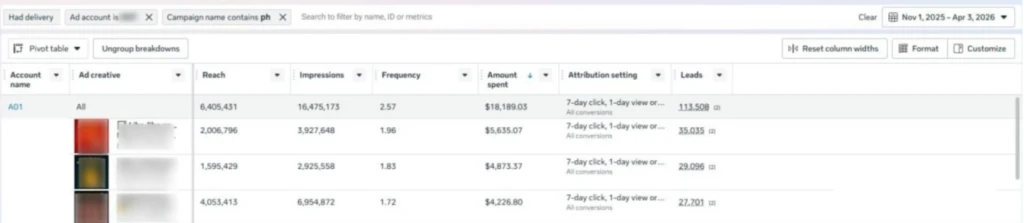
The performance data of the primary creatives over their entire lifecycle—spanning from November 2025 to early April 2026—is illustrated above.
This data was analyzed to evaluate long-term campaign viability. While initial performance snapshots focused exclusively on February, these campaigns maintained profitable delivery for multiple months.
The metrics confirm that a consolidated selection of creatives generated the vast majority of conversions and ad spend over time. This validates the framework of managing campaigns as long-term operational assets rather than transient tests.
The publisher also identified an issue regarding attribution tracking:
«Perhaps due to technical reasons, the number of leads reported by Facebook* is around 10,000 lower than the actual figure.»
How Creatives Are Built
The creative production workflow relies on comprehensive market research, artificial intelligence, and continuous testing matrices.
Prior to deployment, he analyzes active advertisements via the Meta* Ad Library and auxiliary monitoring tools. The primary objective is to identify creative assets with extended runtimes, which serves as a reliable indicator of operational viability.
AI instruments assist in generating conceptual frameworks, hooks, and interactive mechanics. However, all assets are subsequently refined manually and calibrated to match the target audience profile.
Upon campaign activation, optimization decisions are driven exclusively by empirical data. User behavior, engagement statistics, and conversion metrics indicate performance efficiency.
Over time, this methodology establishes a proprietary creative approach that is difficult to replicate without access to identical datasets.
From Testing to Scaling
During the exploratory phase, multiple creative assets are deployed under strictly controlled budget baselines. While CTR metrics are monitored, primary analytical priority is assigned to engagement quality, specifically user comments and organic interactions.
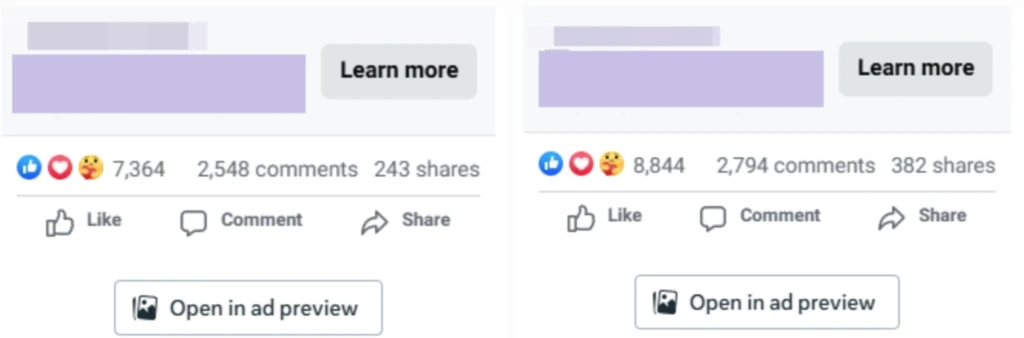
«When users start interacting naturally – not just clicking – that’s usually the first sign of long-term potential.»
Once a high-performing creative is verified, the strategy transitions toward consolidation.
Rather than distributing capital across multiple campaigns, Bin focused on scaling the most viable setup. Running multiple ad sets utilizing the identical post ID allows engagement metrics to accumulate, strengthening social proof and optimizing delivery performance.
Concurrently, bidding frameworks such as Cost Cap and Bid Cap preserve acquisition efficiency while scaling traffic volume. Lookalike audiences further expand reach parameters by identifying new users closely matching existing converters.
This generates a compounding effect: as engagement grows, relevance metrics increase, CPM decreases, and overall performance stabilizes.
At this operational stage, the campaign transcends standard advertising mechanics—evolving into a durable, long-term asset within the platform ecosystem.
Final Thoughts: Playing the Long Game
Affiliate marketing operations have historically been associated with transient performance yields and aggressive tactical deployments. However, as platform compliance policies continuously evolve, this transactional approach becomes increasingly unstable.
The strategic alternative requires engineering frameworks optimized for structural longevity.
«Every compliant campaign adds value: to your account, your creatives, and your overall strategy.»
Unlike low-sustainability, short-term tactics, these compliant campaigns remain resilient against sudden platform core updates. Consequently, they establish a durable competitive advantage within the market.
Zeydoo’s product ecosystem—specifically its interactive funnel architectures—integrated with Facebook*’s machine-learning algorithm, provides a robust foundation for this operational methodology.
For media buying teams seeking to transition away from continuous campaign cycles and construct scalable models, this framework provides a definitive operational roadmap.
👉 https://app.zeydoo.com/offers/22839
👉 https://app.zeydoo.com/offers/19037
👉 https://app.zeydoo.com/offers/top/20418
Long-term digital assets are not established immediately; rather, their strategic value compounds over extended lifecycle timelines.