

TikTok can give you clicks fast. That is the good news and the trap. A campaign can show strong CTR, cheap CPC, active comments, decent watch time, and still produce zero real money. The ad gets attention, the tracker looks alive, the buyer feels there is “signal,” but sales, deposits, approvals, rebills, or real ROI never arrive.
That is why so many TikTok setups die after beautiful top-of-funnel numbers. The problem is not always traffic volume. It is traffic quality, creative intent, funnel continuity, offer fit, and backend economics. This article breaks down why clicks do not equal profit, where TikTok campaigns lose money, why high CTR can mislead buyers, and how to rebuild campaigns so TikTok traffic turns into revenue instead of empty activity.
Contents
- Why clicks don’t equal profit
- Where money is lost in TikTok campaigns
- Traffic quality vs traffic volume
- Creative problems that kill conversions
- Funnel issues that block revenue
- Offer mismatch and expectations
- How to fix low-converting campaigns
- FAQ
Why clicks don’t equal profit
Clicks are only the first layer of the funnel. They tell you that someone reacted to the creative strongly enough to leave the feed. They do not tell you whether that person understood the offer, trusted the promise, had buying intent, could complete the flow, or would create backend value.
That distinction is brutal on TikTok because the platform is built for fast reactions. Users click out of curiosity, impulse, entertainment, confusion, or emotional stimulation. Some of those clicks are valuable. Many are not.
A TikTok campaign becomes profitable only when the full chain works:
- the creative attracts the right user;
- the click carries real intent;
- the prelander continues the same promise;
- the landing page feels natural and trustworthy;
- the offer matches expectation;
- the user completes a valuable action;
- the event approves, deposits, purchases, or retains;
- the payout supports the CPA;
- backend quality justifies scale.
If one of those links breaks, you can still get clicks. You just do not get money.

CTR illusion
CTR is useful, but it is one of the easiest metrics to overrate.
A high CTR means the ad is good at generating clicks. That is all. It does not prove offer fit, funnel quality, approval, purchase intent, deposit quality, or real ROI.
A campaign can show:
- strong CTR;
- cheap CPC;
- solid click volume;
- decent raw CPA;
- active engagement;
- good early tracker numbers.
Then the backend shows:
- low approval;
- no sales;
- weak deposits;
- high bounce rate;
- poor purchase quality;
- zero rebill;
- negative ROI.
That is the CTR illusion. The buyer sees attention and reads it as intent. But attention is not intent. TikTok is full of attention. Money comes from qualified action.
A high-CTR creative can be worse than a lower-CTR creative if it attracts curiosity users instead of buyers. In affiliate, the winning creative is not the one that gets the most clicks. It is the one that sends the best users into the offer.
TikTok = entertainment first
TikTok users are not usually in buying mode. They are scrolling for entertainment, identity, drama, novelty, humor, inspiration, or quick information. That means the platform can generate very cheap attention, but that attention often starts cold.
This is different from search traffic. On Google, the user may already be problem-aware and solution-aware. On TikTok, the creative often has to create the problem, build the curiosity, qualify the user, and push them toward action in seconds.
That is hard.
A user might click because:
- the video is funny;
- the hook is dramatic;
- the claim is strange;
- the story feels personal;
- the visual is unusual;
- the promise sounds easy;
- the creator feels native.
None of that guarantees commercial intent.
This is one of the biggest affiliate marketing TikTok mistakes: buyers optimize for reaction instead of intent. They build ads that make users click, but not ads that make the right users continue.
Where money is lost in TikTok campaigns
TikTok campaigns usually lose money after the click, not before it. The ad does enough to generate traffic, but the traffic does not survive the commercial journey.

Pre-click vs post-click gap
The pre-click experience is the ad: hook, creator, visual, promise, emotion, CTA. The post-click experience is everything after: prelander, landing page, form, checkout, deposit flow, call-center validation, approval, and backend.
Money disappears when those two worlds do not match.
Example:
The ad says: “This app shows how to save money instantly.”
The landing page says: “Complete a long registration and wait for verification.”
The ad feels native and casual.
The offer page feels cold and corporate.
The hook creates curiosity.
The funnel requires commitment.
The creative sells a simple outcome.
The product requires explanation.
That mismatch kills conversion. The user clicks because the ad made sense in the TikTok feed, then drops because the next step feels like a different promise.
A strong TikTok setup does not treat the click as the win. It treats the click as a handoff. If the handoff is weak, revenue dies.
Weak backend metrics
Backend metrics are where fake winners get exposed.
A campaign may look decent on the surface:
- CPC: low;
- CTR: high;
- leads: coming in;
- raw CPA: acceptable;
- tracker ROI: green.
But backend metrics may tell a different story:
- approval rate is weak;
- deposit rate is low;
- customers refund;
- users do not rebill;
- LTV is poor;
- payout is delayed;
- advertiser quality score drops;
- offer gets capped or cut.
This is why tiktok ads low ROI can appear even when platform metrics look fine. The issue is not always the ad account. The issue is that the campaign is optimizing toward shallow action, while the business needs deeper value.
For affiliates, raw conversions can be dangerous. A lead is not money until it approves. A registration is not money if nobody deposits. A sale is not strong if refunds wipe out value. A trial is not strong if rebill never happens.
Scaling weak setups
The worst mistake is scaling a weak setup because the top-of-funnel numbers look pretty.
A campaign gets strong clicks on Day 1. The buyer sees cheap CPC and a few conversions. Budget goes up. Then the real economics show up:
- CPC rises;
- CTR softens;
- lead quality drops;
- approval gets worse;
- CPA becomes unstable;
- backend value stays weak.
The buyer did not scale a winner. They scaled a misunderstanding.
TikTok scaling is especially dangerous because early performance can come from a responsive pocket of users. Once budget increases, the platform expands into broader traffic. If the setup is not built for that broader audience, profit disappears fast.
A campaign should not scale because it gets clicks. It should scale because those clicks become approved, paid, valuable events.
Traffic quality vs traffic volume
Many TikTok buyers confuse traffic volume with campaign health. They see the ad account moving and assume the setup has life. But volume without quality is just faster spend.

Cheap traffic problem
Cheap traffic feels good because it makes the dashboard active. Low CPC gives the buyer confidence. Low CPM makes testing feel efficient. High click volume makes the campaign look alive.
But cheap traffic can be expensive if it fails after the click.
Cheap traffic often brings:
- curiosity users;
- low-intent users;
- poor lead quality;
- weak deposit behavior;
- low trust;
- fast bounce;
- bad approval;
- low LTV.
A click at $0.20 is not cheap if it never turns into money. A click at $0.80 can be cheaper in real terms if it produces qualified action.
This is the real question: not “how much did the click cost?” but “what did the click become?”
Audience mismatch
Audience mismatch happens when the campaign reaches people who react to the creative but do not fit the offer.
For example:
- entertainment users click on a finance offer;
- bonus hunters click on an iGaming funnel but never deposit;
- students click on a premium product they cannot afford;
- broad curiosity users click on a form-heavy leadgen offer;
- low-trust users click on aggressive income claims but fail validation.
The creative may be strong at attracting attention, but weak at filtering. That creates polluted traffic. The algorithm receives engagement and conversion signals, but the business receives bad users.
A good TikTok creative does not only attract. It qualifies.
Sometimes the fix is not making the ad more viral. Sometimes the fix is making the ad more specific, more honest, and slightly less clickable — because the remaining clicks are better.
Algorithm learning wrong signals
TikTok optimizes toward the signals you give it. If you feed it shallow signals, it can learn shallow behavior.
If the campaign optimizes for clicks, it finds clickers.
If it optimizes for raw leads, it finds form-fillers.
If it optimizes for cheap registrations, it may find users who register but never pay.
If postbacks include low-quality events as wins, the algorithm may scale low-quality users.
This is one reason why tiktok traffic not converting becomes a repeating problem. The buyer thinks the algorithm is failing. In reality, the campaign may be teaching the algorithm the wrong definition of success.
For affiliate campaigns, the cleanest optimization signal is often not the easiest one to generate. Deeper events are harder to collect, but they create better learning. If possible, optimize toward quality actions, not vanity actions.
Creative problems that kill conversions
Creative is usually where the problem starts. Not because the video is ugly, but because the message attracts the wrong intent.
Clickbait creatives
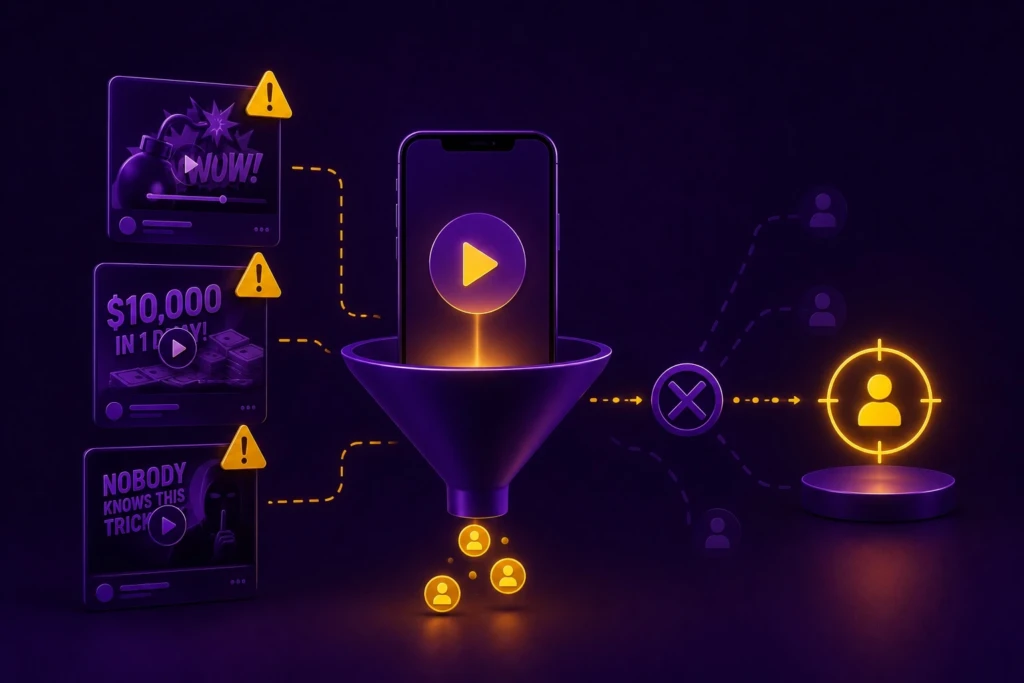
Clickbait creatives can produce great numbers and terrible economics.
They use:
- exaggerated claims;
- fake urgency;
- vague curiosity;
- shock hooks;
- misleading discovery angles;
- “too good to be true” promises;
- drama-first storytelling.
These structures can spike CTR because they create tension. But after the click, users expect the same emotional payoff. If the funnel cannot deliver it, they bounce. If the offer is more serious than the hook, they do not continue. If the advertiser validates quality, approvals drop.
Clickbait creates attention debt. The funnel has to pay it back. Most funnels cannot.
The problem is not curiosity itself. Curiosity is powerful. The problem is curiosity without qualification.
Wrong messaging
Wrong messaging happens when the creative sells one thing and the offer delivers another.
Examples:
- ad sells speed, offer requires patience;
- ad sells simplicity, offer requires verification;
- ad sells free access, offer requires payment;
- ad sells entertainment, offer requires financial action;
- ad sells easy results, offer requires effort;
- ad sells broad benefit, product solves a narrow problem.
This kills trust fast. TikTok users are impatient. If the next step feels different from what they expected, they leave.
The creative must prepare the user for the offer, not just pull them into the click.
Overhyped hooks
Overhyped hooks are common because they work at the attention layer.
Examples:
- “Nobody is talking about this.”
- “This changed everything.”
- “I can’t believe this is real.”
- “This app pays you instantly.”
- “Do this before it gets banned.”
- “People are making money with this trick.”
These hooks may drive clicks, but they can poison conversion quality. The user arrives with inflated expectations. The landing page feels weaker than the promise. The offer feels less exciting than the ad. Trust collapses.
A profitable hook should create enough interest to click, but not so much distortion that the funnel cannot satisfy it.
Funnel issues that block revenue
Even with good traffic, a weak funnel can kill revenue. TikTok traffic is fast and emotional, so the funnel must be simple, consistent, and mobile-native.
Weak pre-landing
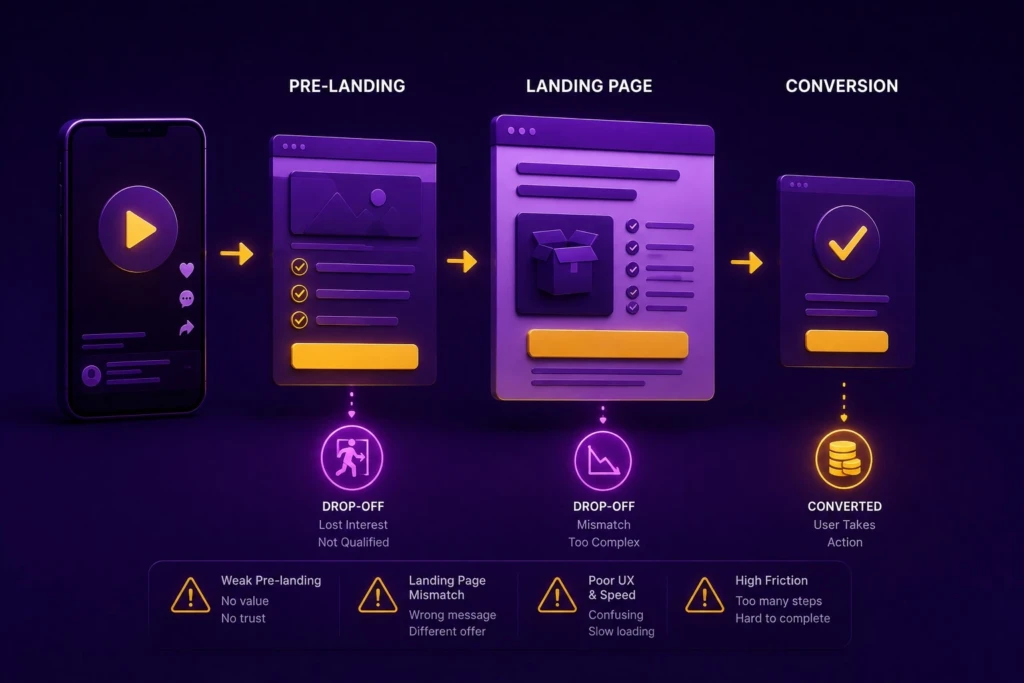
The prelander is not filler. It is the bridge between TikTok attention and the offer.
A weak prelander fails to:
- continue the creative promise;
- explain the value;
- build trust;
- qualify the user;
- reduce confusion;
- prepare the next step;
- filter weak users;
- create action intent.
A bad prelander sends cold users directly into an offer they do not understand. That can still produce raw clicks, but it usually weakens conversion quality.
A good prelander warms and filters. It helps users understand why the offer matters and whether it is for them.
Landing page mismatch
Landing page mismatch is one of the fastest ways to lose TikTok traffic.
Mismatch appears when:
- visual style changes too much;
- the promise changes;
- the offer feels more complicated than expected;
- the CTA is different from the ad;
- the page looks less trustworthy than the creative;
- the language does not match the audience;
- the product benefit is unclear.
The user should feel continuity. They clicked for a reason. The landing page must confirm that reason immediately.
If the ad says one thing and the lander says another, the click was wasted.
Poor UX and loading speed
TikTok traffic is mobile-first and impatient. Bad UX kills money.
Common issues:
- slow load;
- heavy scripts;
- poor mobile layout;
- unclear CTA;
- too many fields;
- weak localization;
- confusing steps;
- broken buttons;
- bad tracking;
- payment friction.
Every second matters. Every extra field matters. Every mismatch matters.
A page does not need to be beautiful to convert. It needs to be fast, clear, trustworthy, and consistent with the creative.
Offer mismatch and expectations
Sometimes the traffic and funnel are not the main issue. The offer itself does not fit the angle, GEO, price point, payment behavior, or user expectation.
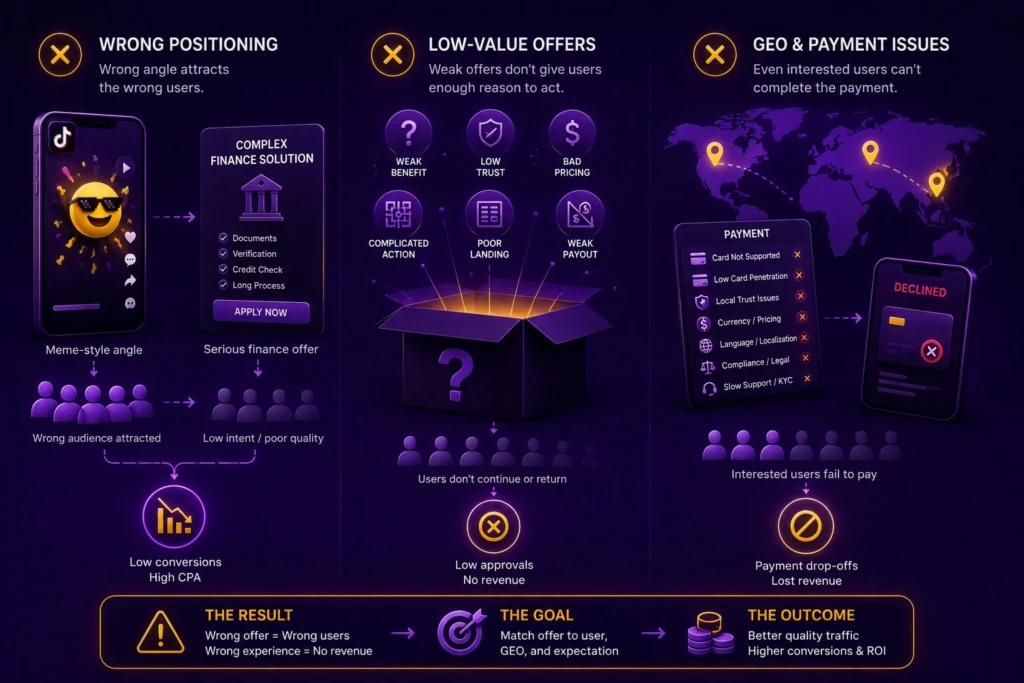
Wrong positioning
Wrong positioning means the product may have value, but the campaign frames it badly.
Examples:
- selling a serious product with a meme-style angle;
- selling a complex finance offer with a simple curiosity hook;
- selling a premium service to discount-driven traffic;
- selling a trust-heavy offer with aggressive hype;
- selling a localized product with generic global messaging.
Positioning decides what kind of user enters the funnel. If the angle is wrong, the traffic quality will be wrong even if the offer is good.
Good positioning compresses the offer into one clear reason to act.
Low-value offers
Some offers simply do not give users enough reason to continue.
Low-value offers often have:
- weak differentiation;
- unclear benefit;
- poor landing experience;
- low trust;
- bad pricing;
- complicated action;
- weak payout economics;
- poor advertiser backend;
- bad approval conditions.
A great creative can temporarily hide a weak offer. It cannot fix it long term.
If users click but never buy, deposit, approve, or return, the offer may not be strong enough for the traffic source.
GEO and payment issues
TikTok performance depends heavily on GEO and payment behavior. A campaign can look strong in clicks and still fail because the audience cannot or will not complete the money event.
Problems include:
- payment method mismatch;
- low card penetration;
- weak local trust;
- poor localization;
- offer not adapted to local culture;
- wrong language tone;
- pricing mismatch;
- legal or compliance friction;
- slow support or validation;
- call-center mismatch.
For affiliate teams, GEO fit matters as much as creative fit. A strong angle in one market may produce dead traffic in another because the payment and trust environment is different.
How to fix low-converting campaigns
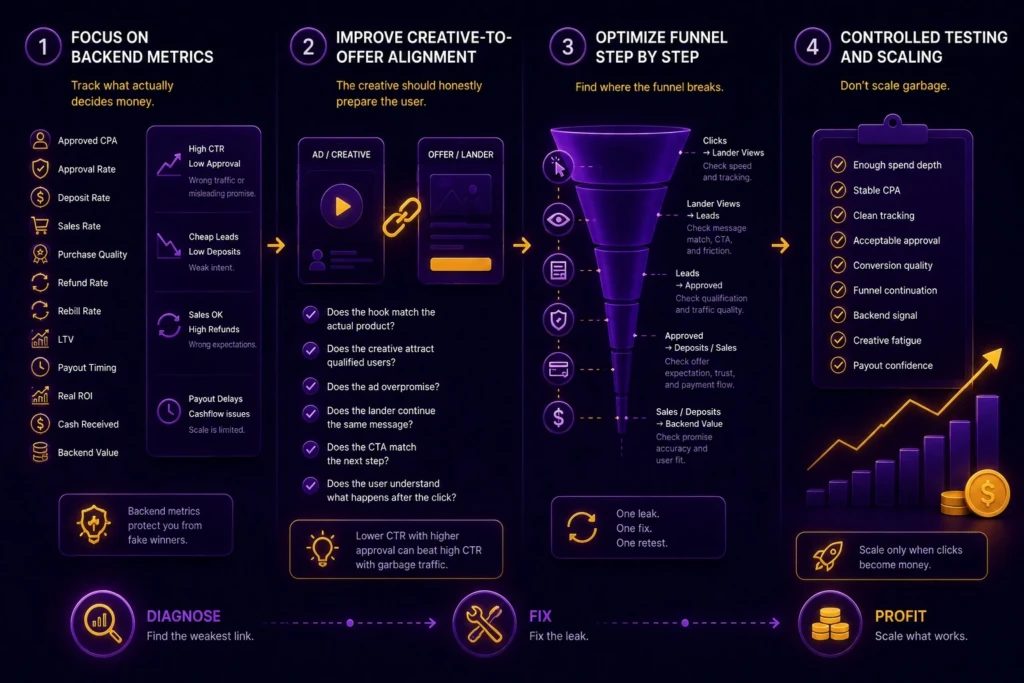
Fixing a low-converting TikTok campaign starts with diagnosis. Do not change everything at once. Find the weakest link.
Focus on backend metrics
Start by checking the metrics that actually decide money.
Track:
- approved CPA;
- approval rate;
- deposit rate;
- sales rate;
- purchase quality;
- refund rate;
- rebill rate;
- LTV;
- payout timing;
- real ROI;
- cash received;
- backend value.
If CTR is high but approval is weak, the traffic is wrong or the promise is misleading.
If leads are cheap but deposits are low, intent is weak.
If sales happen but refunds are high, expectations are wrong.
If payout timing kills cashflow, scale is limited.
Backend metrics protect you from fake winners.
Improve creative-to-offer alignment
The creative should honestly prepare the user for the offer.
Improve alignment by asking:
- does the hook match the actual product?
- does the creative attract qualified users?
- does the ad overpromise?
- does the lander continue the same message?
- does the CTA match the next step?
- does the user understand what happens after the click?
Sometimes you need a less aggressive hook to get better users. Lower CTR with higher approval can beat high CTR with garbage traffic.
Optimize funnel step by step
Find where the funnel breaks.
If clicks do not become lander views, check load speed and tracking.
If lander views do not become leads, check message match, CTA, and friction.
If leads do not approve, check qualification and traffic quality.
If deposits do not happen, check offer expectation, trust, and payment flow.
If backend value is weak, check promise accuracy and user fit.
Do not optimize everything at once. One leak, one fix, one retest.
Controlled testing and scaling
Do not scale garbage.
Before scaling, check:
- enough spend depth;
- stable CPA;
- clean tracking;
- acceptable approval;
- conversion quality;
- funnel continuation;
- backend signal;
- creative fatigue;
- payout confidence.
Scale only when the setup proves that clicks become money.
A TikTok campaign with good CTR has not earned scale. A TikTok campaign with profitable approved value has.
FAQ
Why do my TikTok ads get clicks but no conversions?
Because the creative may attract curiosity users instead of qualified buyers, or the funnel may break after the click. High CTR does not guarantee intent, trust, approval, purchase, or backend value.
Why are my TikTok ads not profitable?
TikTok ads are often not profitable when buyers optimize for clicks or raw leads instead of approved revenue, deposit quality, LTV, and real ROI. The campaign may look active but fail commercially.
Why do TikTok ads get no sales?
TikTok ads get no sales when the audience is wrong, the offer is unclear, the landing page does not match the creative, the UX is weak, or the user does not trust the next step.
Is cheap TikTok traffic good?
Cheap TikTok traffic is good only if it converts into valuable action. Low CPC can be a trap if users bounce, fail approval, do not deposit, or create poor backend value.
How do I fix TikTok traffic not converting?
Check the funnel step by step: click-to-lander, lander-to-lead, lead-to-approval, approval-to-sale, sale-to-LTV. Then fix the weakest link instead of changing everything randomly.
What metrics matter more than CTR?
Approved CPA, approval rate, deposit rate, purchase quality, refund rate, rebill rate, LTV, real ROI, payout timing, and backend value matter more than CTR for profitability.