


Most affiliate teams do not die early. They get stuck. They find a couple of working setups, hit a decent spend level, maybe reach $1,000–$5,000/day, build some confidence, hire a few people, and then the growth just stops. Revenue moves up and down, buyers keep testing, owners keep talking about “scaling,” but the team never becomes a real machine. It stays a group of people pushing traffic manually and hoping the next winner fixes the system.
That is the main problem: affiliate team scaling is not just buying more traffic. More budget only works if the team has enough structure, infra, creative volume, analytics, offer depth, and decision discipline to carry that pressure. A lot of teams think they have a traffic problem when they actually have a process problem. They think they need one more strong buyer, one more fresh offer, or one more Facebook account pack. Sometimes they do. But in most cases, the ceiling is inside the team itself. This breakdown explains why affiliate teams fail to scale, where the bottlenecks usually sit, and what a scalable media buying operation actually needs.
Contents
- Why teams stop growing
- Structural problems inside teams
- Traffic and scaling limitations
- Operational bottlenecks
- Where money and efficiency are lost
- How to build a scalable team
- FAQ
Why teams stop growing
Growth in affiliate is not automatic. A team can have buyers, offers, accounts, creatives, and still be structurally unable to scale. The reason is simple: the first stage of growth can be carried by hustle, instinct, and one or two strong hands. The second stage needs systems.
At the beginning, chaos can look productive. Everyone is testing fast. The owner is close to every decision. The best buyer knows what works. The designer understands the usual angles. The tech guy fixes things on the fly. That can get a team to a certain level. But after that, the same chaos becomes a ceiling.

Plateau after initial success
The classic plateau usually appears after the team has already proven it can make money. That makes it harder to diagnose. If a team was losing from day one, the problem would be obvious. But when it has a few winning months, the owner often assumes the model is validated.
Then the numbers flatten.
A team might run:
- $20,000–$40,000/month in spend comfortably
- 3–5 active buyers
- 2–4 working offers
- 1 main traffic source
- 1–2 creative formats that usually work
- 10–20% tracker ROI on good weeks
On paper, that looks like a base for scale. In reality, it may already be the ceiling. The team can repeat what worked, but it cannot multiply it. Every extra dollar of spend creates more stress than output: more account burn, more creative demand, more QA, more reporting, more communication, more failed tests.
That is the difference between a working affiliate setup and a scalable affiliate business.
Lack of scaling strategy
The second reason teams stop growing is that they confuse activity with strategy. They test more. They launch more. They duplicate more. They raise budgets. But there is no clear system behind the scaling attempt.
A real scaling strategy answers basic questions:
- Which offers deserve more capital?
- Which buyers can handle bigger budgets?
- Which GEOs are ready for horizontal expansion?
- Which creatives are being recycled too hard?
- Which accounts are stable enough for spend growth?
- What is the maximum acceptable CPA drift?
- How much test burn is allowed per week?
- When do we kill, pause, duplicate, or scale?
Most teams do not have those answers written down. They make decisions in chats, calls, and “gut feeling” moments. That works at small volume. At scale, it becomes expensive very fast.
Structural problems inside teams
A team that cannot scale usually has structural problems long before traffic breaks. The warning signs are internal: unclear roles, weak ownership, bad handoffs, and too much dependency on individual people.

Weak team roles and responsibilities
One of the biggest affiliate team problems is role blur. Everyone is “helping,” but nobody owns the full outcome.
A buyer launches campaigns but does not own analytics. A designer produces creatives but does not know which hooks actually converted. A tech person sets up tracking but does not audit postback discrepancies. An owner gives strategic comments but still jumps into micro-decisions. The AM shares offers, but nobody builds a proper offer comparison sheet.
That creates a messy structure where tasks are done, but responsibility is diluted.
In a scalable team, every major function needs ownership:
- media buying
- creative production
- offer research
- account and infra management
- tracking and analytics
- finance and payout reconciliation
- testing documentation
- performance review
Without clear ownership, the same problems repeat every week. A campaign dies and nobody knows whether the issue was traffic, creative, tracking, approval, infra, or timing. Everyone has an opinion. Nobody has the full picture.
Dependence on single media buyer
A lot of teams are not really teams. They are one strong buyer with helpers.
This is dangerous because the whole system depends on one person’s memory, intuition, and energy. If that buyer is active, the team looks alive. If that buyer burns out, leaves, gets distracted, or hits a bad streak, performance drops immediately.
Typical symptoms:
- only one person knows why a setup worked
- only one person knows which offers are worth testing
- only one person has relationships with managers
- only one person understands the account structure
- decisions wait for one person’s approval
- other buyers copy but do not really understand
This is not media buying team scaling. This is key-person risk with a payroll.
A scalable team should not depend on one “wizard.” Strong individual buyers matter, but the process must survive without them. If knowledge lives only in one head, the business is fragile.
Poor knowledge transfer
The third structural issue is weak knowledge transfer. Teams test hundreds of angles, landers, offers, and audiences, but learn almost nothing in a reusable way.
The same mistakes come back:
- old failed angles get tested again
- creatives are remade without knowing why the previous batch failed
- new buyers repeat the same weak GEOs
- offer notes are buried in chats
- approval problems are remembered too late
- winning logic is never converted into templates
This is where many affiliate teams waste serious money. They are not just paying for traffic. They are paying for the same lesson multiple times.
A scalable team needs internal memory. Not a huge corporate wiki. Just a clean system where buyers can see:
- what was tested
- what failed
- why it failed
- what worked
- under which conditions
- what should not be repeated
- what deserves a second test
Without that, every new buyer starts almost from zero.
Traffic and scaling limitations
Even if the team structure is decent, growth can still get capped by traffic-side limitations. This usually happens when the business relies on too few setups, too few sources, or too little creative output.

Limited working setups
One working setup is not a business. It is a temporary edge.
A lot of teams get comfortable when they find a profitable campaign. The setup spends $500/day, then $1,500/day, maybe $3,000/day for a while. Everyone starts thinking the team has cracked the vertical.
But if the whole month depends on one angle, one offer, one GEO, or one ad account cluster, the team is not scaling. It is balancing on a thin branch.
Working setups die for normal reasons:
- creative fatigue
- offer cap
- approval drop
- account instability
- payout change
- competitor pressure
- policy review
- audience saturation
- CPM growth
A scalable team needs a pipeline, not a miracle. At any moment, there should be fresh tests behind the current winner. If there are no backup angles, no adjacent offers, and no second traffic path, growth will stop the moment the main setup softens.
Over-reliance on one traffic source
Many teams are basically Facebook teams, TikTok teams, Google teams, or push teams pretending to be affiliate businesses. That is not always bad. Deep channel specialization can be powerful. But over-reliance becomes dangerous when the entire operation depends on one platform’s mood.
If Facebook tightens review, the team freezes. If TikTok CPMs jump, the team panics. If Google disapproves a landing approach, the month collapses. If one ad account supply route dries up, buyers sit idle.
That is not diversification. That is platform dependency.
A stronger model can still have one core source, but it should usually have:
- secondary traffic tests
- backup account routes
- alternate creative formats
- multiple offer types
- at least one experimental channel
- separate budgets for channel diversification
The goal is not to do everything. The goal is to avoid dying because one source got worse.
Creative production bottleneck
Creative is often the hidden ceiling in scaling affiliate business. Buyers want to launch more. Owners want to scale more. But the creative pipeline cannot feed the spend.
This shows up fast:
- buyers wait two days for new angles
- designers make visuals without performance feedback
- winning hooks are not multiplied fast enough
- UGC, static, video, and advertorial assets are not planned together
- creative fatigue is noticed only after CTR already drops
- new tests reuse old visual logic
A campaign can burn through creative much faster at scale. At $300/day, one good ad may survive for days. At $3,000/day, the same concept may fatigue in 24–48 hours. If the team does not produce variations ahead of the drop, the buyer becomes reactive. Reactive creative production is expensive because it always arrives late.
Operational bottlenecks
Operations are where affiliate teams either become scalable or stay chaotic. This is not glamorous, but it is usually the difference between a real business and a group chat with spend.

Infrastructure issues
Infrastructure problems are one of the most common reasons teams fail to scale. The buyer wants more budget, but the stack cannot hold more pressure.
Common infra blockers:
- not enough stable accounts
- weak BM structure
- unreliable payment methods
- proxy inconsistency
- anti-detect setup conflicts
- slow account replacement
- poor domain rotation
- tracking setup errors
- landing pages loading too slowly
At small spend, those problems look annoying. At scale, they become business blockers.
If a team wants to move from $1,000/day to $10,000/day, account supply, billing, proxies, domains, and tracking cannot be handled manually and emotionally. They need capacity planning. How many accounts are needed? How many can burn? How fast can replacements go live? What happens if 30% of the stack gets restricted in one day?
Most teams do not answer that until after the crash.
Lack of automation
Manual work is fine at low volume. It becomes a tax at scale.
If buyers are manually pulling reports, manually checking approvals, manually updating sheets, manually naming campaigns, manually copying landers, and manually reconciling spend, they are not spending enough time on decisions.
Automation does not need to be fancy. It can start with:
- automatic cost imports
- daily performance sheets
- alert rules for CPA spikes
- approval rate monitoring
- naming conventions
- creative tracking
- offer status dashboards
- spend and payout reconciliation
The goal is simple: remove repeated manual work so the team can focus on interpretation. A team that spends three hours collecting numbers has less energy to understand them.
Inefficient workflows
Workflow inefficiency is the silent killer. It does not look dramatic. It just slows everything down.
Examples:
- buyer requests creative with no clear brief
- designer sends assets without source files
- tech setup waits for missing domain info
- AM shares offer updates in private chat
- finance discovers payout issues too late
- no one knows which campaign version is live
- reports use different naming logic
Each delay looks small. Together, they create friction everywhere. A team with inefficient workflows can have strong people and still produce weak output.
Scale requires clean handoffs. If creative, buying, tech, and analytics do not move together, the team will always be slower than the market.
Where money and efficiency are lost
Most teams do not lose money because of one obvious disaster. They lose it through bad scaling decisions, weak analytics, and hiring mistakes that compound over time.

Scaling without control
The fastest way to burn money is scaling without guardrails. A campaign looks good for two days, the buyer gets excited, the owner wants more volume, and budget jumps too hard.
Then the setup starts cracking:
- CPM rises
- CTR drops
- CPA drifts
- approval softens
- account pressure increases
- creative burns faster
- payout timing gets worse
If the team does not define scale rules in advance, every decision becomes emotional. That is how a campaign with +25% expected ROI becomes a breakeven mess after two bad budget jumps.
Scaling needs thresholds. For example:
- no scale before minimum spend depth
- no scale before approval signal
- no budget jump above a fixed percentage
- no scaling tired creatives
- no scaling if tracking mismatch exceeds 10–15%
- no scaling when account stability is already weak
Without rules, scale is just gambling with nicer dashboards.
Poor tracking and analytics
Poor analytics can make a team look much better than it is. This is one of the most expensive media buying team scaling problems.
Bad tracking creates bad decisions:
- winners get underfunded
- losers stay alive
- creatives are judged on wrong metrics
- offers are compared incorrectly
- approval problems are detected late
- payout gaps get ignored
- buyer performance is misread
If the tracker says one thing, the ad account says another, and the network says a third, the team needs reconciliation before scaling. A 5–10% mismatch may be manageable. A 20–30% mismatch is decision risk. Scaling on that is asking for pain.
Hiring mistakes
Hiring does not automatically create scale. It can create more overhead.
A weak hire costs more than salary. They burn accounts, waste test budgets, misread data, slow down strong team members, and create management drag. If a new buyer spends $3,000 testing weak angles, burns 5 accounts, and needs 20 hours of senior support, the real cost is far above payroll.
Common hiring mistakes:
- hiring buyers without a clear testing framework
- hiring designers without performance feedback loops
- hiring ops too late
- promoting a strong buyer into a weak manager
- adding people before processes exist
- measuring staff by activity instead of output
A scalable affiliate marketing team structure does not mean “more people.” It means the right people inside a system that makes them useful.
How to build a scalable team
A scalable team is not the biggest team. It is the team where decisions, data, assets, and responsibility move cleanly.
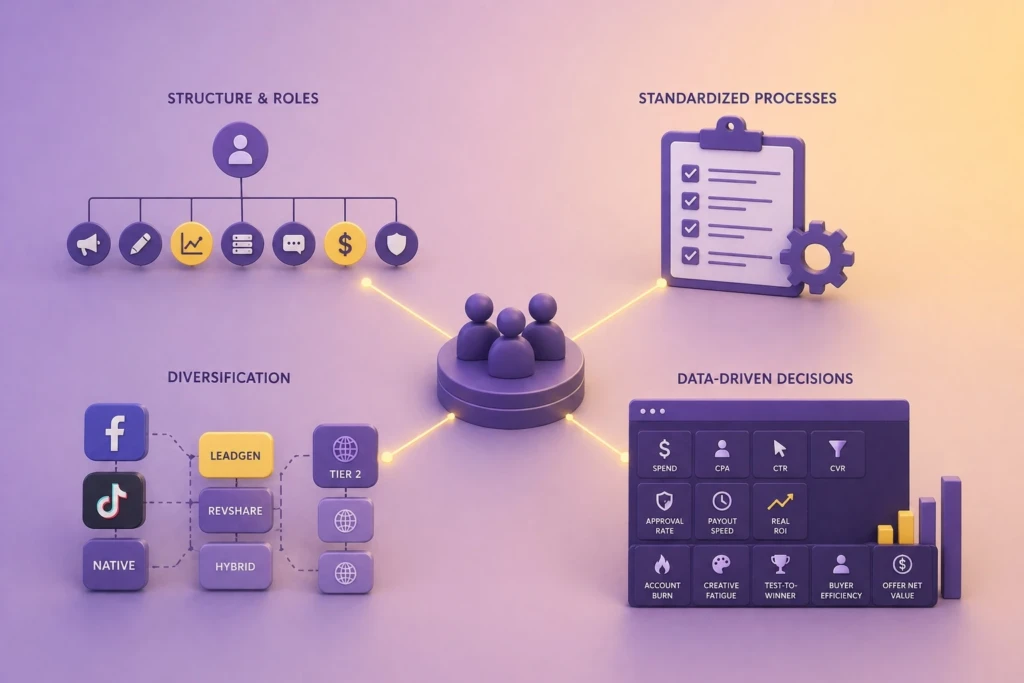
Clear structure and roles
Start with role clarity. Every core function should have an owner.
A basic scalable structure may include:
- media buyer
- creative strategist or designer
- tracking / analytics owner
- account and infra manager
- offer / AM communication owner
- finance / payout reconciliation owner
- team lead or performance owner
In smaller teams, one person can own multiple functions. That is fine. But every function still needs clear responsibility. “Everyone checks it” usually means nobody checks it properly.
Standardized processes
Standardization does not mean corporate bureaucracy. It means not reinventing the same workflow every week.
Teams need standards for:
- campaign naming
- test launch format
- creative briefs
- offer comparison
- approval tracking
- kill rules
- scale rules
- reporting cadence
- post-test review
- account usage
This is how knowledge becomes reusable. Without standardization, every buyer creates their own small universe, and the owner spends all week translating chaos.
Diversification of traffic and offers
Scale needs diversification. Not random diversification, but controlled risk spread.
A stronger team avoids having all profit tied to:
- one offer
- one source
- one GEO
- one account supplier
- one creative format
- one buyer
- one payout model
This does not mean launching everything everywhere. It means building backup paths before the main one breaks.
For example:
- core source: Facebook
- secondary test source: TikTok or native
- core offer type: leadgen
- secondary offer type: revshare or hybrid
- core GEO: Tier 2
- backup GEOs: adjacent markets with similar funnel behavior
The point is not variety for the sake of variety. The point is survival and optionality.
Data-driven decision making
The final requirement is decision discipline. Scalable teams do not make every call by mood. They define what matters and review it consistently.
Key numbers usually include:
- spend
- CPA
- CTR
- CVR
- approval rate
- payout speed
- real ROI
- account burn
- creative fatigue speed
- test-to-winner ratio
- buyer-level efficiency
- offer-level net value
The important part is not collecting more data. It is using it to make faster and cleaner decisions. If a team has dashboards but still argues from vibes, the dashboards are decoration.
FAQ
Why do affiliate teams fail to scale?
Most affiliate teams fail to scale because they rely on chaos, one strong buyer, one traffic source, or one working setup instead of building repeatable systems. Scaling needs structure, infra, creative output, analytics, and clear decision rules.
What is the biggest problem in affiliate team scaling?
The biggest problem is usually not traffic itself. It is the lack of a scalable operating system: unclear roles, weak reporting, poor knowledge transfer, no standard processes, and reactive creative or account management.
How should an affiliate marketing team be structured?
A scalable affiliate marketing team should cover media buying, creative production, tracking and analytics, account infrastructure, offer management, and finance reconciliation. In small teams, one person can own multiple roles, but every function needs clear responsibility.
How do you scale a media buying team?
Start by standardizing testing, reporting, creative production, and scaling rules. Then add buyers only when the process can support them. Hiring before structure usually increases chaos instead of increasing profit.
Why does adding more buyers not always increase profit?
More buyers create more tests, more account pressure, more creative demand, and more management overhead. Without clean processes and analytics, new buyers can burn budget faster than they create useful output.
What should affiliate teams track before scaling?
Teams should track spend, CPA, CTR, CVR, approval rate, payout timing, account burn, creative fatigue, real ROI, and test-to-winner ratio. Scaling without these numbers usually means scaling uncertainty.