

There was a time when affiliate marketing looked almost stupidly simple: open a spy tool, find an ad that has been running for weeks, copy the creative, clone the lander, plug in the same offer or a similar one, and push traffic. In a slower market, that could work. Not always cleanly, not forever, but often enough to make money.
In 2026, that play is mostly dead. Not because spy tools are useless, but because the market moved faster than the copy-paste mindset. Auctions are tighter, algorithms are smarter, creatives burn faster, attribution is messier, and every half-decent angle gets duplicated by dozens of buyers within days. If you still treat competitor research as a place to steal ads, you are late before you even launch. This article explains why copying competitors in affiliate marketing no longer works, what spy tools actually show, where buyers lose money, and how to turn competitor data into a real creative strategy instead of another burned clone.
Contents
- Why copying used to work
- What changed in affiliate marketing
- Why copied campaigns fail today
- How spy tools actually work
- Where most affiliates lose money
- How to use competitor data correctly
- FAQ
Why copying used to work
Copying used to work because the market had more delay in it. A winning creative could stay alive longer. Fewer buyers had access to the same intelligence tools. Platforms were less aggressive with moderation and auction optimization. Audiences were less saturated with the same hooks. A strong ad could survive long enough for latecomers to grab part of the upside.
That does not mean copying was ever a professional strategy. It was always fragile. But in the old environment, fragility could still print money for a while.
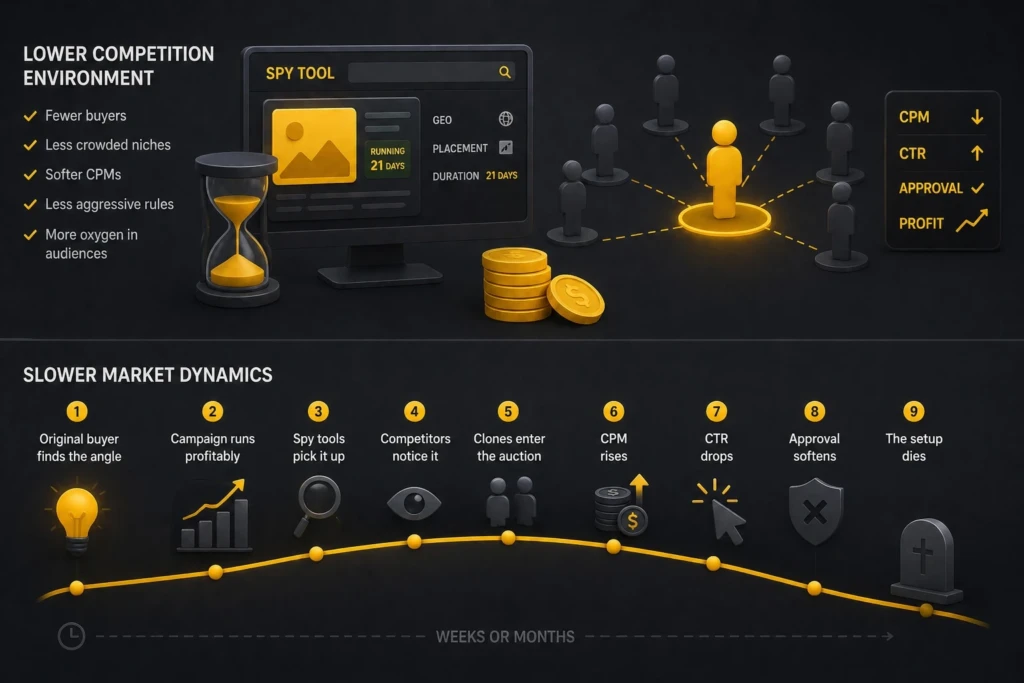
Lower competition environment
In earlier affiliate cycles, the number of buyers chasing the same angles was smaller. Many niches were not as crowded, especially in Tier 2 and Tier 3 GEOs. If someone found a working casino prelander, nutra angle, leadgen promise, or sweepstakes hook, that setup could stay profitable for weeks or even months before the market fully crowded it.
The spy tool showed an ad that had been running for 14, 21, or 30 days. That was a useful signal. If the buyer moved fast, adapted the funnel, and had decent account supply, they could still catch the tail of the campaign.
The math was simpler too. CPMs were often softer, approval rules were less aggressive, and many advertisers tolerated broader traffic. A copied campaign did not need to be perfect. It just needed enough margin to survive.
Slower market dynamics
The second reason copying worked was slower market movement. Creative fatigue did not hit as fast. Competitors did not clone everything instantly. Algorithms did not redistribute traffic as aggressively. Landing pages could stay fresh longer. Audience pockets had more oxygen.
A campaign might have time to go through this cycle:
- Original buyer finds the angle.
- Campaign runs profitably.
- Spy tools pick it up.
- Competitors notice it.
- Clones enter the auction.
- CPM rises.
- CTR drops.
- Approval softens.
- The setup dies.
In 2026, that whole cycle can compress into days. Sometimes less. By the time the average buyer sees a “winning” ad in a spy tool, it may already be in the crowded phase, not the discovery phase.
What changed in affiliate marketing
The market did not kill copying overnight. It became more hostile to lazy copying layer by layer. More buyers entered. Platforms automated more. Users became more exposed. Networks tightened approval. AI made creative cloning easier, which ironically made raw copying less valuable.
Faster competition cycles
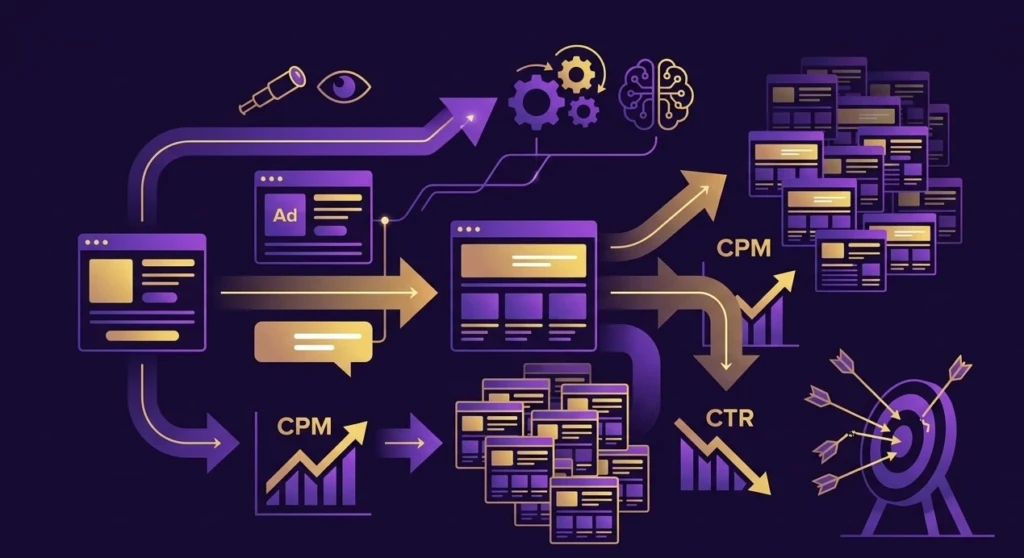
The first big shift is speed. Everyone has access to spy tools now. Everyone can rip a visual, rewrite copy, generate variants, clone a lander, and launch a test in hours. That means any visible winner becomes public property fast.
If a creative appears in a spy tool and looks obviously profitable, you are not the only person seeing it. You are probably one of dozens of buyers thinking the same thing.
That creates a brutal effect:
- the original angle gets copied fast
- auction pressure increases
- CPM rises
- CTR drops because users see similar ads repeatedly
- the offer gets lower-quality traffic
- approval may decline
- networks tighten caps or validation
- the “winner” becomes less valuable for everyone
This is why ad spy tools effectiveness has changed. They still show useful market signals, but they no longer give you private edges. They give you public clues.
Algorithm evolution
Algorithms are also much better at detecting patterns and optimizing delivery. This is good for strong setups and bad for lazy clones.
Modern ad platforms do not just show your copied ad to the same people in the same way. Delivery depends on account history, creative quality, engagement prediction, landing page behavior, conversion feedback, budget structure, and post-click signals. Two buyers can launch nearly identical creatives and get completely different results because the system reads the whole setup differently.
A copied ad without the original context is not the original campaign.
The platform may see:
- weaker account trust
- lower engagement quality
- worse landing page behavior
- lower conversion feedback
- worse creative originality signals
- stronger competitor overlap
- poor early user response
Then delivery gets expensive or low-quality. The buyer blames the creative, the source, or the spy tool. But the real issue is that copying the visible asset did not copy the system behind it.
Market saturation
Saturation is the third killer. Users have seen too much.
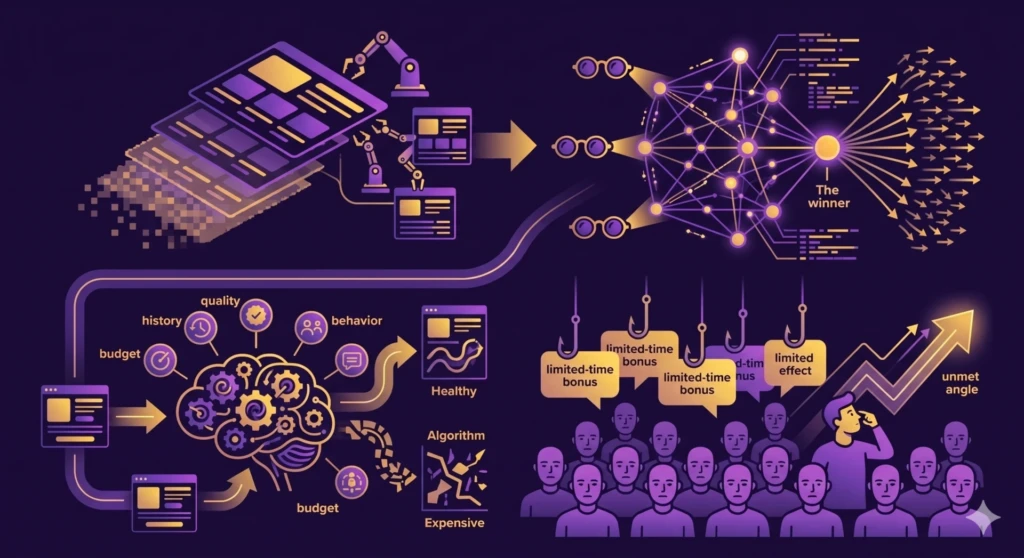
The same hooks keep rotating:
- “one simple trick”
- “people in your area”
- “secret payout”
- “AI made this possible”
- “banks hate this”
- “limited-time bonus”
- “before they ban it”
- “this app is changing everything”
Some of these still work when executed well. But raw repetition gets weaker. Audiences become numb. Platforms see lower engagement. Advertisers see worse quality. The buyer pays more to get less attention.
In affiliate marketing strategy 2026, the question is no longer “Which ad should I copy?” The question is “What unmet angle can I build from what the market is already reacting to?”
That is a very different skill.
Why copied campaigns fail today
Copied campaigns usually fail because they enter the market too late, with too little context, and with no real differentiation. The buyer sees the visible front end and assumes that is where the money lives. It rarely is.
Creative fatigue already happened
If an ad is visible in spy tools for long enough to look like a winner, it may already be close to fatigue. Especially in competitive GEOs and high-volume traffic sources.
The original buyer may have already:
- tested 20 variations before finding that ad
- rotated the best audience pockets
- warmed accounts
- optimized the lander
- negotiated payout
- learned approval patterns
- prepared the next creative batch
- started exiting the angle
You see the ad. They see the lifecycle.
That is a massive difference.
A copied creative often launches right when the original team is already preparing replacements. So the clone starts with less freshness, worse timing, and more auction competition.
Audience already exposed
The second problem is audience exposure. If the audience has already been hit by the original creative and several clones, your version is not entering a clean room. It is entering a tired conversation.
This affects:
- CTR
- CPC
- conversion rate
- lead quality
- approval rate
- backend value
- creative lifespan
A user who sees the first version may be curious. A user who sees the seventh version may ignore it or click with weaker intent. That matters because affiliate profit depends on intent, not just clicks.
This is one reason why copying ads doesn’t work the way beginners expect. They assume they are copying a winner. In reality, they may be buying the leftover attention after the best audience has already been harvested.
Late entry problem
The late entry problem is the core issue. Spy tools are usually retrospective. They show what has been running, not what is about to work next.
By the time you copy:
- the auction may be more expensive
- the audience may be warmer but tired
- competitors may have launched clones
- the offer may be capped
- the advertiser may have tightened approval
- the original buyer may have moved on
- the creative may have lost novelty
You are entering after the signal became obvious. Obvious signals are rarely cheap.
That does not mean competitor research is useless. It means copying the final visible artifact is the weakest way to use it.
How spy tools actually work
Spy tools are research tools, not profit machines. The problem is that many affiliates use them like cheat codes. Then they get surprised when the copy dies.
What spy tools really show
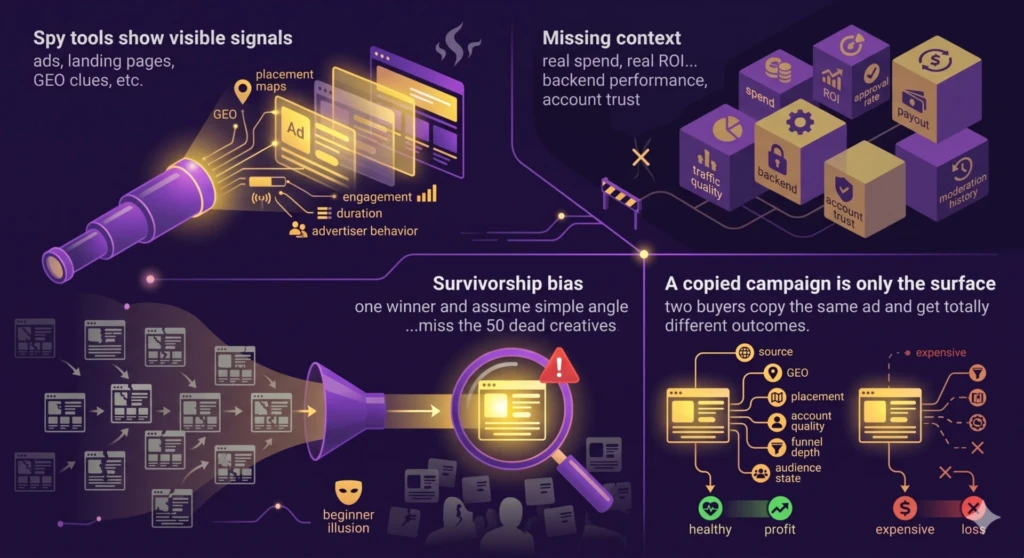
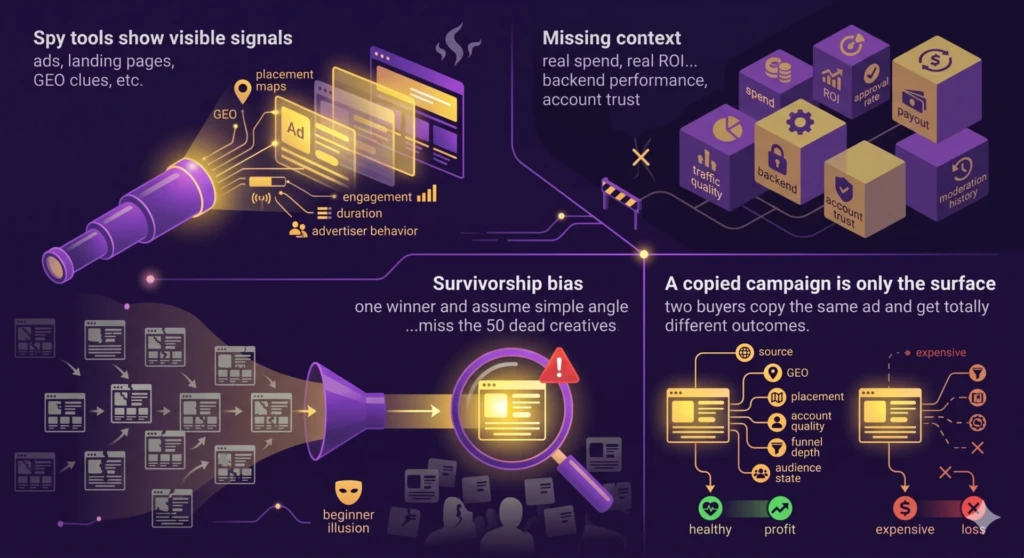
Spy tools show visible market activity: ads, landing pages, sometimes duration, placements, GEO clues, engagement signals, and advertiser behavior. That is valuable. But it is not the full campaign.
Spy tools usually do not show:
- real spend
- real ROI
- approval rate
- payout terms
- traffic quality
- backend performance
- account trust
- moderation history
- audience logic
- budget structure
- creative test history
- why the buyer launched that variation
- when the campaign started dying
So when a buyer says “this ad is working because it has been running for 20 days,” that is a guess. A useful guess, maybe. But still a guess.
An ad can run for many reasons:
- it is profitable
- it is being tested by a brand
- it has a large budget but weak economics
- it is part of retargeting
- it is running on a different payout
- it is collecting data
- the buyer has better approval terms
- the campaign is already declining but not stopped yet
Spy tools show smoke. They do not always show fire.
Survivorship bias
Survivorship bias is huge in spy tools affiliate marketing. You mostly see ads that survived long enough to be captured and noticed. You do not see all the failed tests that died before becoming visible.
That distorts how buyers think.
They see one winner and assume the angle is simple. They do not see the 50 dead creatives behind it. They see the polished lander and miss the test history. They see the hook and ignore the funnel learning. They see the visible success but not the cost of finding it.
This creates a beginner illusion: “If I copy the survivor, I skip the testing.”
Not really. You skip the learning. And without the learning, you do not know how to adapt when the clone underperforms.
Missing context
Context is where profit hides. A creative is only one part of the setup.
A full campaign context includes:
- source
- GEO
- device
- placement
- account quality
- funnel depth
- prelander logic
- offer terms
- payout
- approval rate
- compliance level
- audience state
- budget pacing
- creative rotation
- backend quality
Spy tools rarely give you all of that. So a copied campaign is usually a copy of the most visible layer, not the real business mechanism.
That is why two buyers can copy the same ad and get totally different outcomes. One understands the context and adapts it. The other just uploads the asset and hopes.
Where most affiliates lose money
Most affiliates do not lose money because competitor research is bad. They lose money because they misunderstand what research is supposed to do.
Blind copying without understanding
Blind copying is expensive because it creates false confidence. The buyer thinks they are launching something “proven,” so they give it more trust than it deserves.
They may:
- overspend on the first test
- skip proper tracking QA
- ignore audience differences
- launch without adapting the lander
- use the wrong offer variant
- judge too quickly
- scale too early
- keep the clone alive because “it worked for someone”
That is how copying competitors affiliate marketing becomes a budget trap. The buyer is not just copying the ad. They are copying an assumption.
Ignoring funnel and backend
The funnel is often the part that makes the campaign work. The ad is just the door.
A competitor’s creative may look simple, but behind it there may be:
- a prelander that filters weak users
- a landing page tuned for a specific GEO
- a stronger payout deal
- a call-center flow that approves better
- a retargeting layer
- a faster mobile experience
- better domain trust
- a backend monetization model
- higher approval tolerance from the advertiser
If you copy the ad without copying or improving the funnel logic, you may buy clicks without buying the economics.
This is especially painful with leadgen, finance, dating, iGaming, nutra, and sweepstakes. Raw conversion volume can look good while approval or backend quality destroys the real ROI.
Overpaying for outdated ideas
The final leak is overpaying for yesterday’s angle. This happens when a buyer sees an old winner, launches late, and pays current auction prices for a decaying concept.
Example:
- original buyer launched at $8 CPM
- audience was fresh
- CTR was 2.4%
- CPA was $18
- approval was stable
A month later, clones enter:
- CPM is $14
- CTR drops to 1.2%
- CPA rises to $34
- approval softens
- payout stays the same
The copied campaign is not failing because the idea never worked. It is failing because the buyer bought it after the economics changed.
That is one of the most common affiliate marketing mistakes in 2026: paying premium auction prices for exhausted creative logic.
How to use competitor data correctly
Competitor data is still valuable. The mistake is treating it as a finished answer instead of raw material.
Extracting patterns, not copying ads
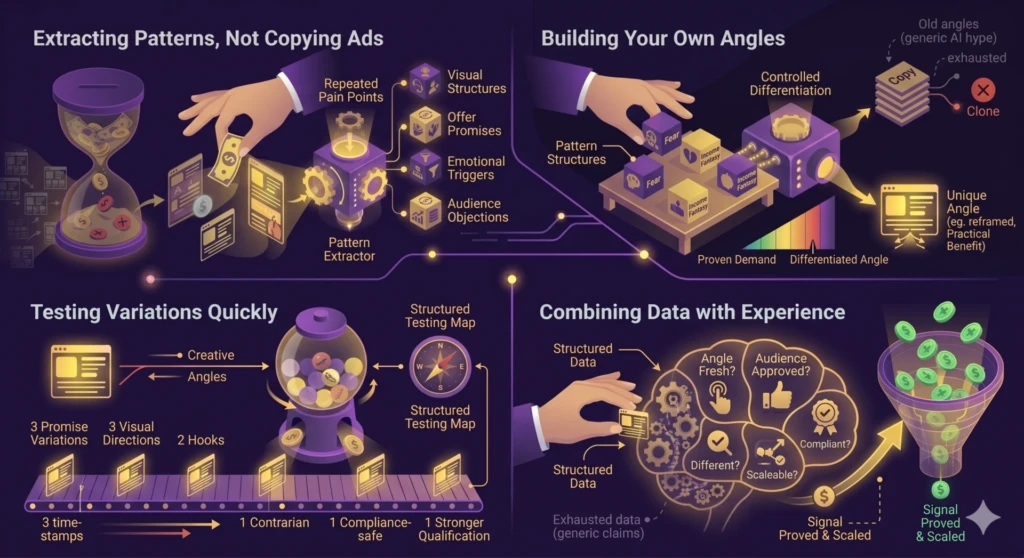
Top buyers do not copy ads. They extract patterns.
They look for:
- repeated pain points
- recurring visual structures
- offer promises
- compliance boundaries
- funnel styles
- emotional triggers
- audience objections
- CTA logic
- GEO-specific language
- proof elements
- format trends
The goal is to understand what the market is responding to, not to upload the same creative with a new logo.
Instead of copying a single ad, study 20–50 ads in the same vertical. Ask:
- what promise keeps repeating?
- what angle is becoming saturated?
- what visual pattern appears often?
- what objections are being handled?
- which formats are common?
- what is missing?
- what can be reframed?
That is real research.
Building your own angles
Once you understand the pattern, build your own angle. Do not just rewrite the headline. Change the framing.
If competitors are using fear, test control.
If they are using urgency, test clarity.
If they are using income fantasy, test practical benefit.
If they are using broad curiosity, test qualification.
If they are using generic AI hype, test specific use case.
If they are using a big promise, test a smaller but more believable promise.
Creative strategy affiliate marketing is about controlled differentiation. You want to stay close enough to proven demand, but different enough to avoid being just another clone.
That is where many buyers miss the mark. They either copy too closely or invent something completely detached from market signals. The skill is in building adjacent angles.
Testing variations quickly
Good competitor research should feed fast variation testing.
A useful test batch might include:
- 3 variations of the core promise
- 3 visual directions
- 2 hooks based on competitor patterns
- 1 contrarian angle
- 1 compliance-safe version
- 1 stronger qualification angle
The goal is not to find a perfect ad in one shot. The goal is to find which direction has signal, then iterate.
Speed matters, but clean speed matters more. If you test ten random things at once, you learn nothing. If you test structured variations, you build a map.
Combining data with experience
Spy tools give data. Experience tells you what that data probably means.
An experienced buyer can look at a competitor ad and ask:
- is this angle fresh or already tired?
- is the creative pulling curiosity or intent?
- would this audience approve?
- does the funnel need a prelander?
- is the payout likely enough to support this CPA?
- is the GEO too saturated?
- what would make this compliant?
- what would make this different?
- what signal would prove this is worth scaling?
That is the difference between using spy tools and being used by spy tools.
FAQ
Why does copying competitor ads not work anymore?
Because by the time an ad is visible in spy tools, the audience may already be saturated, the creative may be fatigued, and competitors may already be cloning it. You are often entering late.
Are spy tools still useful for affiliate marketing?
Yes, but not as copy-paste machines. Spy tools are useful for spotting patterns, angles, funnel styles, GEO activity, and market direction. They should guide research, not replace strategy.
What do spy tools actually show?
They show visible ads, landers, duration, placements, and sometimes engagement clues. They usually do not show real ROI, approval rate, payout terms, backend quality, budget structure, or full funnel context.
How should affiliates use competitor research in 2026?
Use it to extract patterns: common hooks, pain points, visual formats, promises, objections, and funnel logic. Then build your own variations instead of cloning the exact ad.
Why do copied affiliate campaigns fail?
They usually fail because of late entry, creative fatigue, audience exposure, missing funnel context, weak approval, or outdated economics. The visible ad is only one part of the real setup.
What is the best creative strategy for affiliate marketing in 2026?
The best strategy is controlled differentiation: stay close to proven market demand, but create your own angles, formats, hooks, and funnel logic. Copy patterns, not assets.