

A cheap CPM looks sexy in the dashboard. It makes the media buyer feel smart, the campaign feel “efficient,” and the first screenshots look easy to flex in chat. You see low impression cost, cheap reach, maybe even cheap clicks, and the brain immediately goes: great, I found a pocket of easy traffic. That’s exactly why so many buyers get trapped by it.
The problem is simple: cheap CPM is not a profit metric. It is only a media cost signal. And in affiliate marketing, especially on Facebook Ads, cheap traffic is often cheap for a reason. It can mean weak audience quality, weak intent, dead auction pockets, poor engagement, and users who are happy to scroll, click, and disappear without ever becoming money. Read this to the end and you’ll get the real picture: why low CPM affiliate marketing setups often underperform, how cheap traffic quietly wrecks the funnel, how to tell “cheap” from “worth it,” and how to judge traffic the way buyers who actually stay profitable do.
Contents
- Why cheap CPM looks attractive
- What low CPM actually means
- How cheap traffic destroys conversion
- Where money is really lost
- How to evaluate traffic correctly
- FAQ
Why cheap CPM looks attractive
Cheap CPM sells a dream. The dream is simple: if impressions are cheap, traffic is cheap; if traffic is cheap, I can buy more clicks; if I buy more clicks, I’ll get more leads or FTDs; if I get more leads at lower cost, I win. On paper that logic looks clean. In real buying, it breaks all the time.
Lower cost = more clicks illusion
This is the first trap. Buyers see low CPM and assume it automatically means scale with upside. More impressions for the same money sounds like free edge. And yes, sometimes it helps. But only if the people behind those impressions are worth touching in the first place.
That’s where the illusion kicks in. Cheap CPM can absolutely produce more clicks. It just doesn’t guarantee the clicks are any good. A campaign can throw cheap impressions at a low-value audience, inflate click volume, and still lose money harder than a campaign with a more expensive CPM but a stronger user base.
That’s the thing too many people miss: media cost and user quality are not the same layer of the game. Cheap reach does not automatically mean efficient acquisition. Sometimes it just means Facebook found a low-pressure pocket where nobody valuable is competing hard.
Beginner mindset trap
This is especially brutal for newer buyers. Beginners love dashboard numbers that move fast and look positive early. Cheap CPM is one of the easiest stats to fall in love with because it makes the setup feel “healthy” before the funnel has even had a chance to tell the truth.
A junior buyer sees:
- low CPM
- cheap CPC
- decent spend pace
- maybe a few early leads
And starts thinking the campaign is cooking.
An experienced buyer looks at the same setup and asks:
- do these clicks hold intent?
- is CTR real or just curiosity?
- what’s the CVR?
- what’s the lead quality?
- what happens after the click?
- does this traffic make money or just movement?
That difference is massive. Cheap CPM usually seduces the buyer who wants proof fast. Profit usually goes to the buyer who waits for the whole funnel to speak.
What low CPM actually means
A low CPM is not automatically good or bad. It is a market signal. The real skill is reading what kind of market signal it is.

Low competition or low-quality audience
In a lot of cases, low CPM means one of two things:
- competition is low for that audience or placement
- the audience is weak, low-intent, or commercially unattractive
People love to assume it’s the first one. Very often it’s the second.
If good buyers are avoiding that segment, there is usually a reason. Maybe the users don’t convert. Maybe the placements are noisy. Maybe the audience clicks but doesn’t commit. Maybe the traffic looks active on the surface but dies in the funnel. Cheap CPM Facebook Ads setups often live in exactly these zones.
That’s why cheap traffic problems are so annoying. They don’t always show up immediately. The campaign can look “alive” because the media is cheap enough to keep feeding the top of funnel. But the further you go down the pipe, the uglier it gets.
Weak auction segments
Facebook does not hand out cheap impressions as a reward for being clever. Usually it is allocating you inventory that is cheaper because it is less contested, less responsive, or less likely to drive valuable downstream action.
That does not mean every cheap auction segment is trash. But it does mean you should stop romanticizing low CPM like it’s proof of edge.
A weak segment can look attractive because:
- impressions are cheap
- click volume comes fast
- spend pace is easy to maintain
- early testing feels less painful
But weak segments often carry hidden problems:
- soft user intent
- worse ad attention
- lower trust
- weaker purchase behavior
- more accidental or low-commitment engagement
So when people ask “why low CPM is bad,” the real answer is: it’s not bad by definition, but it is dangerous when the buyer reads it as a win before checking what kind of audience the auction is actually delivering.
How cheap traffic destroys conversion
This is the core of the whole article. Cheap CPM doesn’t kill profit at the impression level. It kills profit by poisoning what happens after the impression.
Low intent users
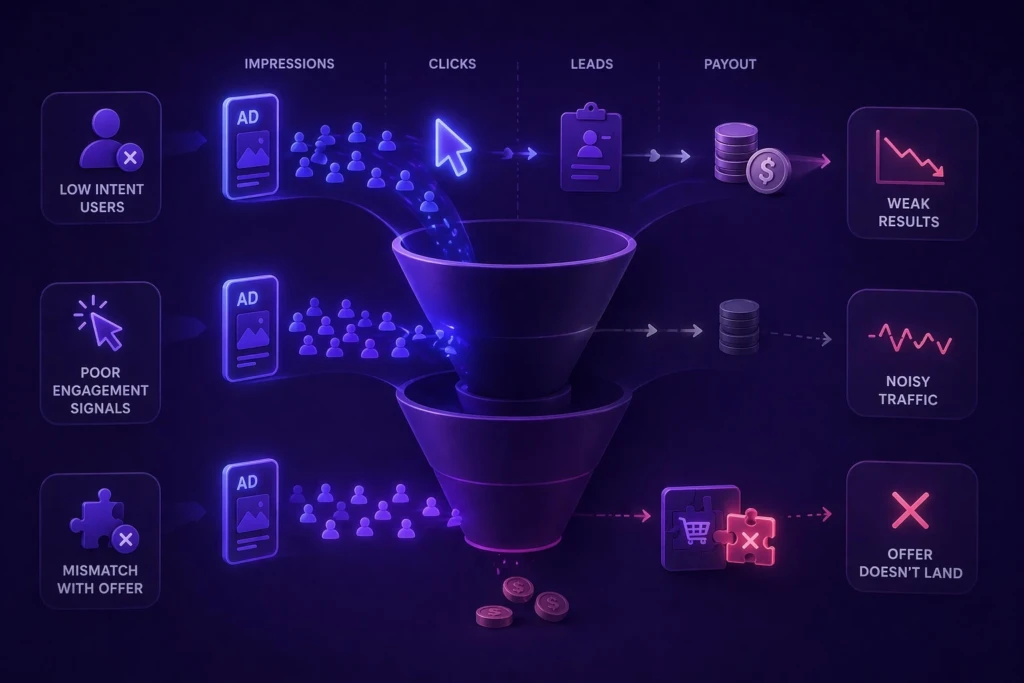
A lot of cheap traffic is cheap because the users are passive. They scroll, react, maybe click, but they are not in buying mode. They are not problem-aware enough, motivated enough, or commercially sharp enough for the offer you are pushing.
This is where the funnel starts lying to you.
You get users.
You maybe get clicks.
You might even get leads.
But the intent is weak.
Weak intent users are expensive in a sneaky way. They make the campaign feel active without creating meaningful output. They flood the top of funnel and starve the bottom of funnel.
That is why a cheap CPM campaign can end up with:
- weak registrations
- weak deposits
- poor lead quality
- low approval rates
- terrible FTD efficiency
The dashboard says “cheap traffic.” The payout says “bad business.”
Poor engagement signals
Cheap traffic also tends to produce weaker engagement quality. Not always lower CTR, by the way. Sometimes the CTR looks fine. Sometimes cheap segments click a lot because the curiosity threshold is low. That’s even more dangerous.
What matters is whether the engagement is commercially useful.
If the traffic gives you:
- shallow clicks
- short sessions
- weak landing page engagement
- poor continuation after the first step
- low commitment behavior
then the campaign is not strong. It is just noisy.
This is one of the most common cheap traffic problems in affiliate marketing. Buyers optimize toward surface engagement because the media is cheap enough to make the top numbers look good. But those numbers don’t survive contact with the real funnel.
Mismatch with offer
Sometimes the traffic itself is not even “bad.” It’s just wrong for the offer.
That’s another reason cheap CPM can mislead. The platform may be giving you a cheap audience because that audience is perfectly reachable, but not because it is well matched to the thing you are selling.
This is where low cpm affiliate marketing setups blow up:
- dating angle pushed to a cold, passive audience
- finance offer shown to users with zero urgency
- nutra product shown to people who react to visuals but don’t commit
- lead-gen funnel pushed into broad curiosity traffic
The ad gets seen.
The click may happen.
The offer does not land.
When traffic and product don’t line up, the low CPM just makes it easier to buy more of the wrong people.
Where money is really lost
Most buyers think the damage happens when spend gets too high. Usually the real damage starts much earlier — when the campaign starts teaching the buyer the wrong lesson.

High spend with no ROI
This is the classic failure mode. Cheap impressions let you spend comfortably. That comfort is dangerous. Because the campaign never feels painful enough to force a hard diagnosis early.
You keep spending because:
- CPM is low
- CPC is acceptable
- traffic keeps coming
- the account looks stable
But ROI stays weak or goes negative.
That’s the real killer: the campaign can consume budget smoothly while producing garbage economics. High-spend, no-ROI setups are often built on exactly this kind of cheap traffic foundation.
Fake performance metrics
Cheap traffic creates fake confidence because it makes weak metrics look “good enough.”
Examples:
- a solid CTR that doesn’t turn into a solid CR
- cheap clicks that don’t turn into deposits
- lead volume with weak approval
- traffic spikes with no real monetization
- decent CPA on paper with awful downstream value
This is where Facebook ads CPM vs profit becomes the real question. A buyer who optimizes for CPM can feel successful while losing money. A buyer who optimizes for profit sees the lie much faster.
That’s why good buyers are way less impressed by cheap media than beginners are. They’ve already been burned by dashboards that looked beautiful and paid like garbage.
Hidden costs of cheap traffic
Cheap traffic doesn’t only burn ad spend. It also burns time, testing bandwidth, and decision quality.
Hidden costs include:
- extra days wasted on low-value tests
- false confidence in dead audience pockets
- delayed scaling of stronger segments
- creative misreads
- broken optimization logic
- budget exhaustion before real winners get proper room
This is the part that hurts serious teams. Cheap traffic doesn’t only lose money directly. It steals attention from the traffic that might have actually worked.
How to evaluate traffic correctly
If cheap CPM is not the answer, what is? Not a single magic metric. The answer is better traffic judgment.
Focus on ROI, not CPM
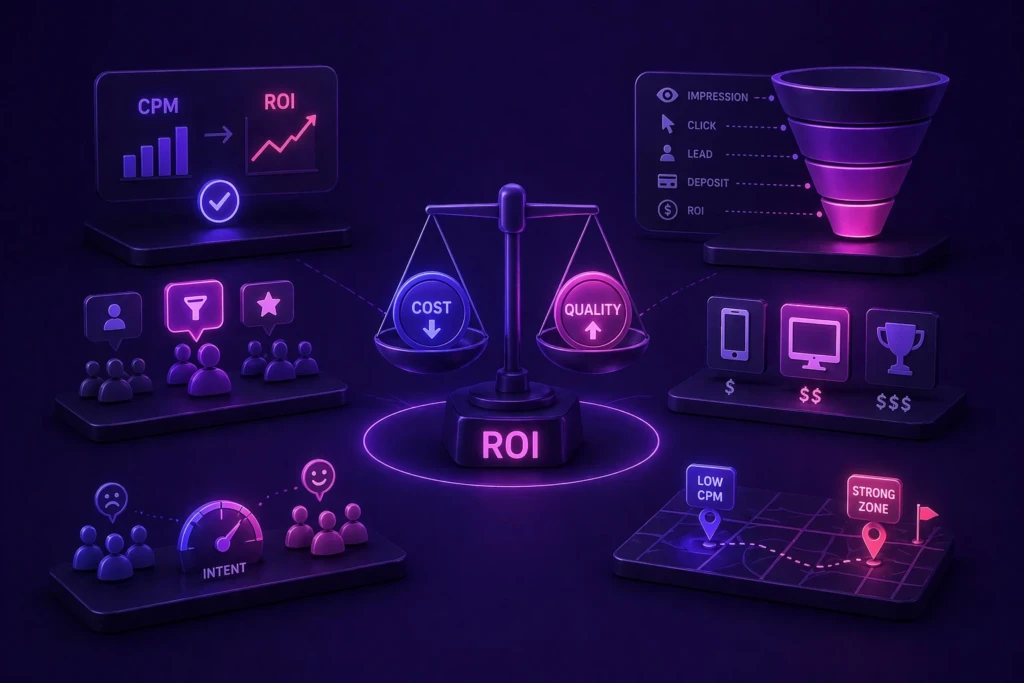
This is the big reset. CPM is a cost input, not the final truth. The campaign only deserves respect if the economics work.
If you have to choose one north-star mindset, it’s this:
buy profit, not cheap impressions.
That means a higher CPM can still be great if:
- CTR holds
- CR holds
- lead quality is strong
- FTDs come through
- the margin survives scale
And a low CPM can still be garbage if:
- clicks are soft
- funnel continuation is weak
- deposits don’t land
- quality drops after the first step
- ROI never stabilizes
Track full funnel metrics
A professional buyer does not judge traffic on CPM alone. They track the funnel end to end.
At minimum, you want to understand:
- CPM
- CTR
- CPC
- CR
- CPA
- lead quality
- FTD / deposit rate
- backend value
- ROI
This is where cheap traffic gets exposed. It often survives one or two layers. It usually dies once the full funnel gets measured honestly.
Test multiple traffic segments
A lot of buyers get trapped because they judge one cheap segment in isolation. The smarter move is side-by-side comparison.
Test:
- broad vs filtered audiences
- cheaper placements vs premium placements
- lower-pressure segments vs more competitive ones
- cheap CPM zones vs stronger commercial zones
That’s how you stop getting hypnotized by one cheap dashboard line. You start seeing what actually holds through the full flow.
Balance cost and quality
The goal is not to buy the cheapest traffic.
The goal is not to buy the most expensive traffic either.
The goal is to find the point where cost and quality make sense together.
That is the whole game.
A lot of profitable campaigns live in the middle:
- not ultra-cheap
- not overcooked
- not vanity-premium
- just strong enough in quality that the higher CPM still makes money
This is what separates pros from tourists in affiliate marketing. Tourists chase low CPM. Pros chase the best quality-per-dollar ratio.
FAQ
Should the CPM be low?
A low CPM is not always better; it simply means your ads are inexpensive to display. Very low CPMs may indicate low-quality traffic or irrelevant audiences that don’t convert. Focus on ROI and CPA rather than just lowering the cost per thousand impressions.
What’s a good CPM for FB ads?
A good CPM typically ranges from $5 to $15, but this varies significantly by industry, season, and target audience. For high-intent niches like real estate or finance, a CPM of $20-$50 can still be profitable. Benchmark your costs against your historical data and industry averages for the specific objective.
How much is CPM per 1000 views?
CPM stands for ‘Cost Per Mille,’ which literally means cost per 1,000 views or impressions. If your CPM is $10, you are paying exactly $10 for every 1,000 times your ad is shown. This metric is used to measure the cost-efficiency of an ad campaign’s reach.
Is low CPM always good in Facebook Ads?
No. A low CPM only means impressions are cheap. It does not mean the traffic is qualified, the clicks will convert, or the campaign will be profitable.
Why can cheap CPM kill profit in affiliate marketing?
Because cheap impressions often come from weaker audiences, low-intent users, or soft auction pockets. The traffic looks efficient on the surface but breaks deeper in the funnel.
Why do cheap clicks from Facebook Ads not convert?
Cheap clicks often come from users who are curious enough to click but not motivated enough to register, deposit, or buy. The problem is usually traffic quality, not just landing page performance.
What is more important in Facebook Ads: CPM or ROI?
ROI is more important. CPM is only a media cost metric. If the traffic does not hold through the funnel, a cheap CPM can still lose money.
What does low CPM actually mean in Facebook Ads?
Usually one of two things: either competition is lower, or the audience quality is lower. In many cases, cheap CPM means Facebook is giving you easier but weaker inventory.