

In 2026, everyone in affiliate marketing is talking about the same fear: AI will replace media buyers. Every month there is a new AI tool for creatives, reporting, landing pages, campaign setup, audience research, data analysis, translation, automation, and optimization. So the question sounds logical: does AI replace media buyers?
The answer is more complicated. AI does not fully replace strong media buyers. But it does replace parts of the team around them. Routine production, repetitive execution, basic reporting, first-draft creatives, translation, and data processing are getting automated fast. The buyer does not disappear. The buyer becomes more like a strategist, operator, analyst, and system manager. This article breaks down ai vs media buyer affiliate marketing, what AI actually replaces, why humans still matter, and how to survive the shift in ai in media buying 2026.
Contents
- What AI actually replaces
- Why media buyers are still needed
- Tasks that moved from humans to AI
- How team structure changes in 2026
- Where money is made: human vs AI
- Common misconceptions about AI
- How to adapt as a media buyer
- FAQ
What AI actually replaces
AI replaces tasks before it replaces people.
This is the main thing many teams misunderstand. AI is not walking into the office and becoming a senior buyer with market sense, network relationships, risk control, offer intuition, and backend understanding. But it is already taking over a lot of work that used to require assistants, junior creatives, translators, analysts, copywriters, content operators, and reporting managers.
That is why ai automation affiliate teams matters more than the dramatic “AI vs human” debate. The real shift is operational. Teams need fewer people to produce the same amount of output, and sometimes much more output.
AI replaces low-context, repeatable, process-heavy work first.
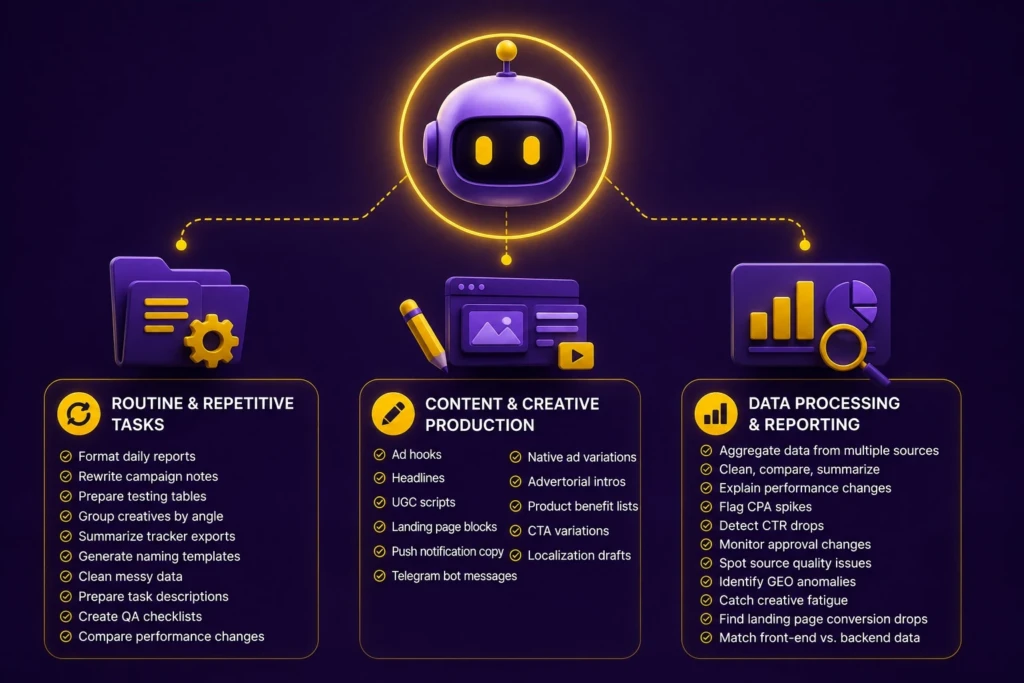
Routine and repetitive tasks
Routine work is the easiest layer to automate.
In affiliate teams, this includes:
- formatting daily reports;
- rewriting campaign notes;
- preparing testing tables;
- grouping creatives by angle;
- summarizing tracker exports;
- generating naming templates;
- cleaning messy data;
- preparing task descriptions;
- creating basic QA checklists;
- comparing simple performance changes.
These tasks are necessary, but they do not require deep strategic judgment every time. They are time-consuming and repetitive.
AI handles this well when the input is structured and the workflow is clear.
A buyer no longer needs to spend hours preparing the same type of report or briefing. The AI can create the first draft, summarize the numbers, flag obvious anomalies, and organize the data. The human checks, corrects, and decides.
This reduces the need for large support teams around the buyer.
Content and creative production
Creative production is another major area where AI replaces team capacity.
AI can generate:
- ad hooks;
- headlines;
- UGC scripts;
- landing page blocks;
- push notification copy;
- Telegram bot messages;
- native ad variations;
- advertorial intros;
- product benefit lists;
- CTA variations;
- localization drafts.
This does not mean AI replaces a strong creative strategist. But it can replace a lot of first-draft work.
Before AI, a team might need several copywriters or junior creatives to produce enough variations for testing. Now one sharp creative lead with AI can generate and edit large volumes much faster.
The value moves from “who can write 50 versions” to “who knows which 50 versions are worth testing.”
That is a different skill.
Data processing and reporting
AI is also strong at processing data and turning messy inputs into readable summaries.
Affiliate teams usually work with data from different places:
- ad accounts;
- trackers;
- networks;
- CRM systems;
- advertiser reports;
- payment data;
- call-center stats;
- LTV files;
- refund reports;
- Telegram or push analytics.
The data is often fragmented. AI can help aggregate, clean, compare, summarize, and explain it.
It can flag:
- CPA spikes;
- CTR drops;
- approval changes;
- source-level quality issues;
- GEO anomalies;
- creative fatigue;
- landing page conversion drops;
- mismatches between front-end and backend numbers.
Again, AI does not replace final judgment. But it reduces manual analysis time.
A team that needed one or two junior analysts may now need one operator who knows how to structure AI-assisted reporting.
Why media buyers are still needed
Media buying is not just execution.
A strong buyer is not valuable because they click buttons inside an ad account. They are valuable because they understand how traffic, offers, funnels, creatives, tracking, risk, cashflow, and backend quality connect.
AI can support that process. It cannot fully own it.
This is the core answer to affiliate marketing ai vs human: AI produces and processes; humans interpret and take responsibility.
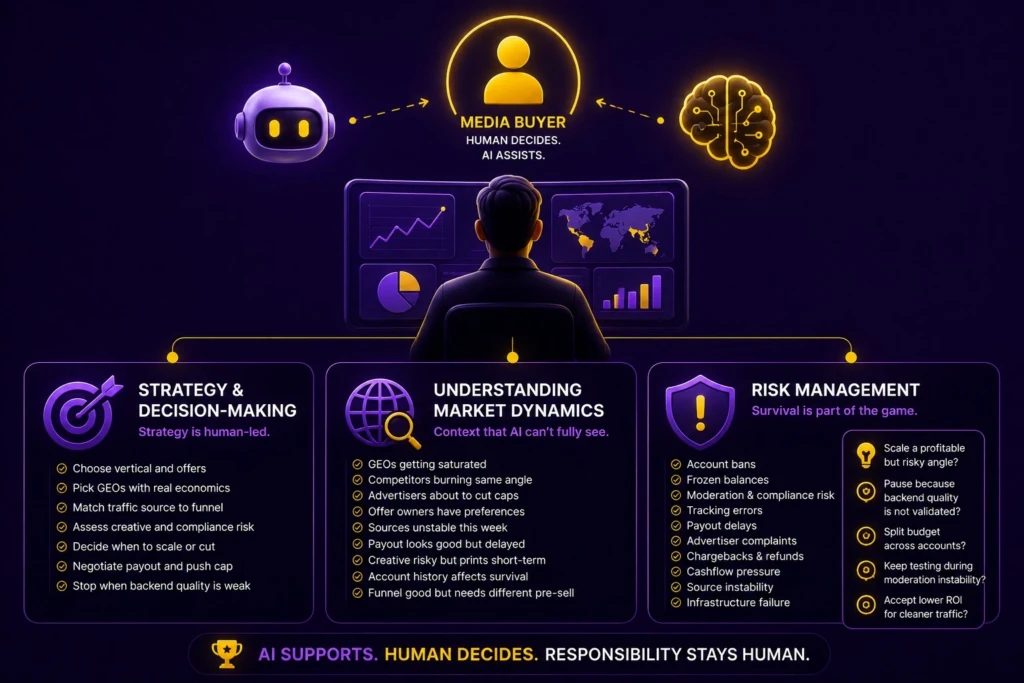
Strategy and decision-making
Strategy is still human-led.
AI can suggest angles, compare data, summarize market signals, and generate options. But the final strategic decision depends on context that AI may not fully understand.
A buyer has to decide:
- which vertical to enter;
- which offer is worth testing;
- which GEO has the right economics;
- which traffic source fits the funnel;
- which creative risk is acceptable;
- when to scale;
- when to cut;
- when to negotiate payout;
- when to push cap;
- when to stop because backend quality is weak.
These decisions involve incomplete data. That is normal in affiliate marketing.
AI is uncomfortable with incomplete, delayed, contradictory data. It may sound confident even when the data is not reliable. A buyer has to know when a number is real, when it is noise, and when it is too early to decide.
Understanding market dynamics
Affiliate marketing is not a clean laboratory.
It is a market full of human behavior, competition, platform moods, network politics, advertiser preferences, moderation patterns, offer fatigue, payment delays, and timing windows.
AI can analyze visible data. But experienced buyers understand invisible context.
For example:
- a GEO is getting saturated;
- a competitor is burning the same angle;
- an advertiser is about to cut caps;
- an offer owner dislikes a certain traffic type;
- a source is unstable this week;
- a payout looks good but approval is delayed;
- a creative is risky but may print for two days;
- an account has enough history to survive a test;
- a funnel is good but needs a different pre-sell.
This is why buyer intuition still matters. Not “magic intuition,” but pattern recognition from real spend.
AI can help organize signals, but human experience connects them.
Risk management
Risk management is one of the biggest reasons buyers still matter.
Affiliate campaigns are not only about ROI. They are also about survival.
A buyer manages:
- account bans;
- frozen balances;
- moderation risk;
- compliance risk;
- tracking errors;
- payout delays;
- advertiser complaints;
- chargebacks;
- refund behavior;
- cashflow;
- source instability;
- infrastructure failure.
AI can flag risks if the system is built well. But risk decisions are business decisions.
Should you scale a profitable but risky angle?
Should you pause because backend quality is not validated?
Should you split budget across accounts?
Should you keep testing during moderation instability?
Should you accept lower ROI for cleaner traffic?
AI can support. The buyer decides.
Tasks that moved from humans to AI
The real labor shift in 2026 is not “AI replaces buyer.” It is “AI replaces parts of the workflow that used to require multiple humans.”
This is where ai replacing jobs affiliate marketing becomes real.
Not because strong buyers disappear, but because many execution-heavy roles become smaller, merged, or AI-assisted.
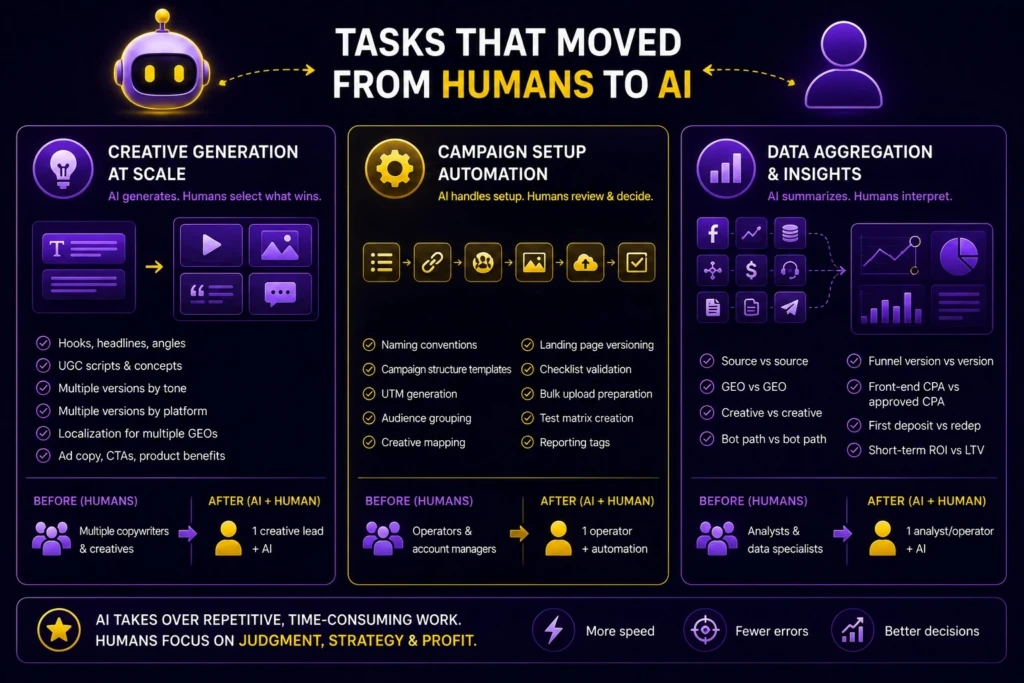
Creative generation at scale
Creative generation is the biggest shift.
Before, a team needed more people to scale creative output. Now AI can generate large batches of hooks, scripts, headlines, and concepts in minutes.
A creative lead can use AI to build:
- 30 hooks for one pain point;
- 20 UGC scripts for one offer;
- 10 angles for one GEO;
- multiple versions by tone;
- multiple versions by platform;
- localized versions for several markets.
This changes team economics.
The person who wins is not the one manually writing every line. The person who wins is the one who understands:
- which hooks are native;
- which claims are risky;
- which angles attract buyers, not clickers;
- which creative fits the platform;
- which scripts can be produced cheaply;
- which variations deserve spend.
AI creates volume. Human filtering creates value.
Campaign setup automation
Campaign setup is also getting more automated.
AI and automation tools can help with:
- naming conventions;
- campaign structure templates;
- UTM generation;
- audience grouping;
- creative mapping;
- landing page versioning;
- checklist validation;
- bulk upload preparation;
- test matrix creation;
- reporting tags.
This does not mean AI runs the campaign alone. But it reduces manual setup time.
For large teams, this matters because small operational mistakes become expensive. Wrong naming, wrong UTM, wrong landing page, wrong creative mapping, wrong postback — all of this creates data mess.
Automation makes execution cleaner if the workflow is designed properly.
Data aggregation and insights
Data aggregation used to require analysts or very disciplined buyers.
Now AI can help turn fragmented data into readable performance summaries.
It can compare:
- source vs source;
- GEO vs GEO;
- creative vs creative;
- bot path vs bot path;
- funnel version vs funnel version;
- front-end CPA vs approved CPA;
- first deposit vs redep;
- short-term ROI vs LTV.
This is valuable because media buyers often drown in data but lack time to process it.
AI does not remove the need for analysis. It compresses the time needed to reach the analysis stage.
How team structure changes in 2026
Affiliate teams are becoming smaller, faster, and more systems-driven.
The old model was often built around more hands: more junior buyers, more copywriters, more assistants, more translators, more reporting people, more operators. The new model is built around fewer people with better tooling.
This does not mean everyone disappears. It means roles change.
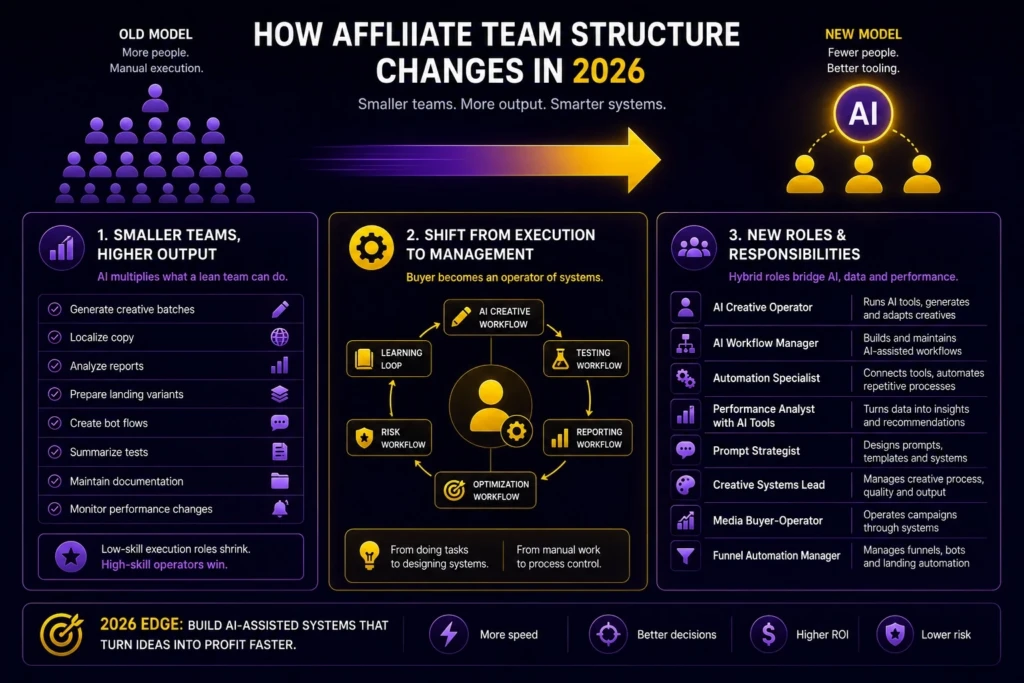
Smaller teams, higher output
AI allows smaller teams to produce more.
A lean team can now do things that previously required a larger setup:
- generate creative batches;
- localize copy;
- analyze reports;
- prepare landing variants;
- create bot flows;
- summarize tests;
- maintain documentation;
- monitor performance changes.
This is good for strong operators and dangerous for low-skill execution roles.
If your value is only manual production, AI is a threat.
If your value is judgment, systems, and performance understanding, AI is leverage.
That is the new division.
Shift from execution to management
The buyer’s role shifts from manual execution to process management.
Instead of doing everything by hand, the buyer manages systems:
- AI creative workflow;
- testing workflow;
- reporting workflow;
- optimization workflow;
- risk workflow;
- learning loop.
The buyer becomes more like an operator of a performance machine.
This requires different thinking. You need to know not only how to launch ads, but how to build a process where ideas, assets, data, and decisions move faster.
Manual work does not disappear completely. But the advantage shifts to people who can design and control workflows.
New roles and responsibilities
New hybrid roles are appearing inside affiliate teams.
Examples:
- AI creative operator;
- AI workflow manager;
- automation specialist;
- performance analyst with AI tools;
- prompt strategist;
- creative systems lead;
- media buyer-operator;
- funnel automation manager.
These roles sit between classic media buying, creative production, analytics, and operations.
They are valuable because AI needs direction. Someone has to feed it the right inputs, control outputs, validate quality, and connect AI workflows to real campaign performance.
In 2026, “knowing how to prompt” is not enough. The useful skill is knowing how to build an AI-assisted system that improves ROI.
Where money is made: human vs AI
Money is made in the combination.
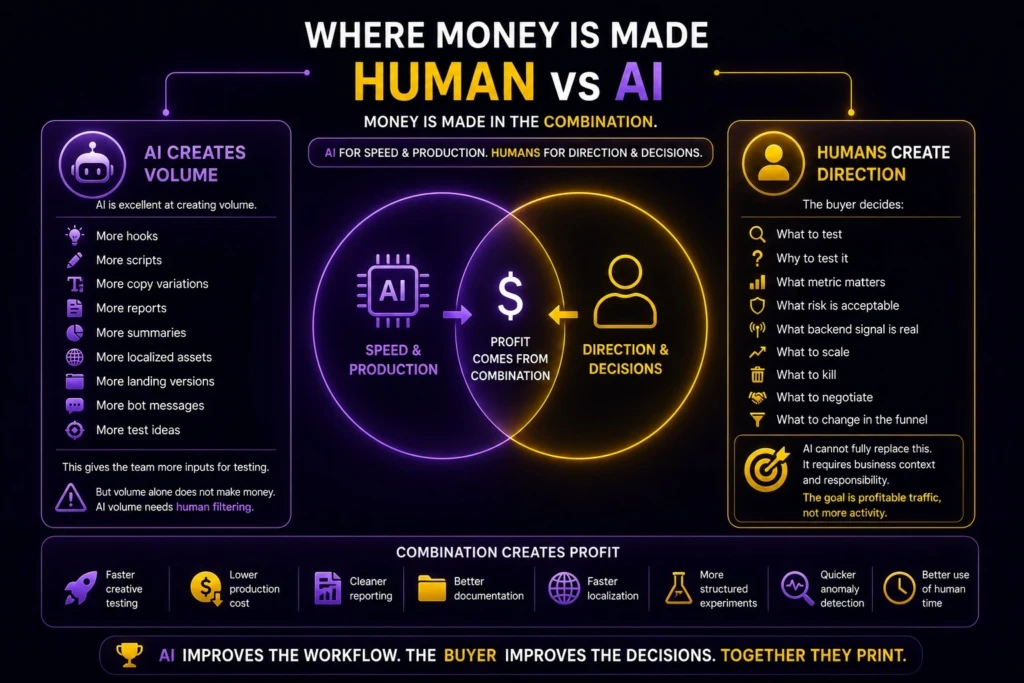
AI without human judgment creates volume and noise. Humans without AI move too slowly. The strongest teams combine both: AI for speed and production, humans for direction and decisions.
AI creates volume
AI is excellent at creating volume.
It can produce:
- more hooks;
- more scripts;
- more copy variations;
- more reports;
- more summaries;
- more localized assets;
- more landing versions;
- more bot messages;
- more test ideas.
This gives the team more inputs for testing.
But volume alone does not make money. A team can generate 500 creatives and still lose if they are generic, non-compliant, low-intent, or mismatched with the offer.
AI volume needs human filtering.
Humans create direction
Humans create direction.
The buyer decides:
- what to test;
- why to test it;
- what metric matters;
- what risk is acceptable;
- what backend signal is real;
- what to scale;
- what to kill;
- what to negotiate;
- what to change in the funnel.
This is the part AI cannot fully replace because it requires business context and responsibility.
A human buyer understands that the goal is not more activity. The goal is profitable traffic.
Combination creates profit
The best setup is not AI vs buyer. It is AI plus buyer.
AI helps the buyer move faster.
The buyer helps AI stay relevant.
Together, they create:
- faster creative testing;
- lower production cost;
- cleaner reporting;
- better documentation;
- faster localization;
- more structured experiments;
- quicker anomaly detection;
- better use of human time.
Profit comes when AI improves the workflow and the buyer improves the decisions.
Common misconceptions about AI
The AI hype creates bad expectations.
Some teams think AI will solve everything. Others think it is useless because it cannot run campaigns alone. Both views are wrong.
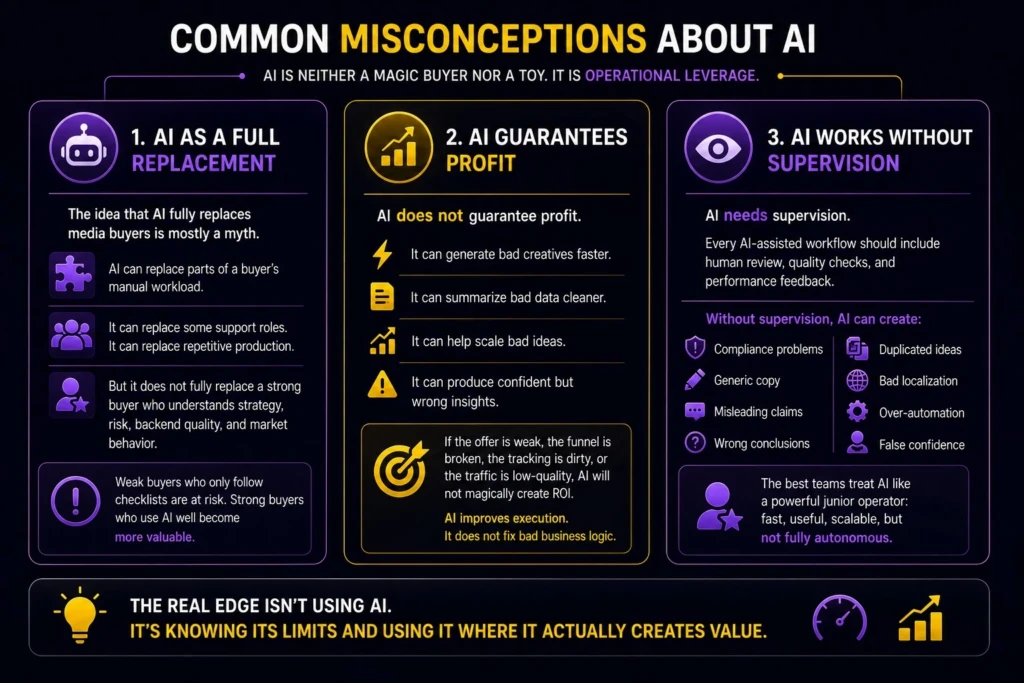
AI is neither a magic buyer nor a toy. It is operational leverage.
AI as a full replacement
The idea that AI fully replaces media buyers is mostly a myth.
AI can replace parts of a buyer’s manual workload. It can replace some support roles. It can replace repetitive production. But it does not fully replace a strong buyer who understands strategy, risk, backend quality, and market behavior.
Weak buyers who only follow checklists are at risk. Strong buyers who use AI well become more valuable.
AI guarantees profit
AI does not guarantee profit.
It can generate bad creatives faster.
It can summarize bad data cleaner.
It can help scale bad ideas.
It can produce confident but wrong insights.
If the offer is weak, the funnel is broken, the tracking is dirty, or the traffic is low-quality, AI will not magically create ROI.
AI improves execution. It does not fix bad business logic.
AI works without supervision
AI needs supervision.
Every AI-assisted workflow should include human review, quality checks, and performance feedback.
Without supervision, AI can create:
- compliance problems;
- generic copy;
- misleading claims;
- wrong conclusions;
- duplicated ideas;
- bad localization;
- over-automation;
- false confidence.
The best teams treat AI like a powerful junior operator: fast, useful, scalable, but not fully autonomous.
How to adapt as a media buyer
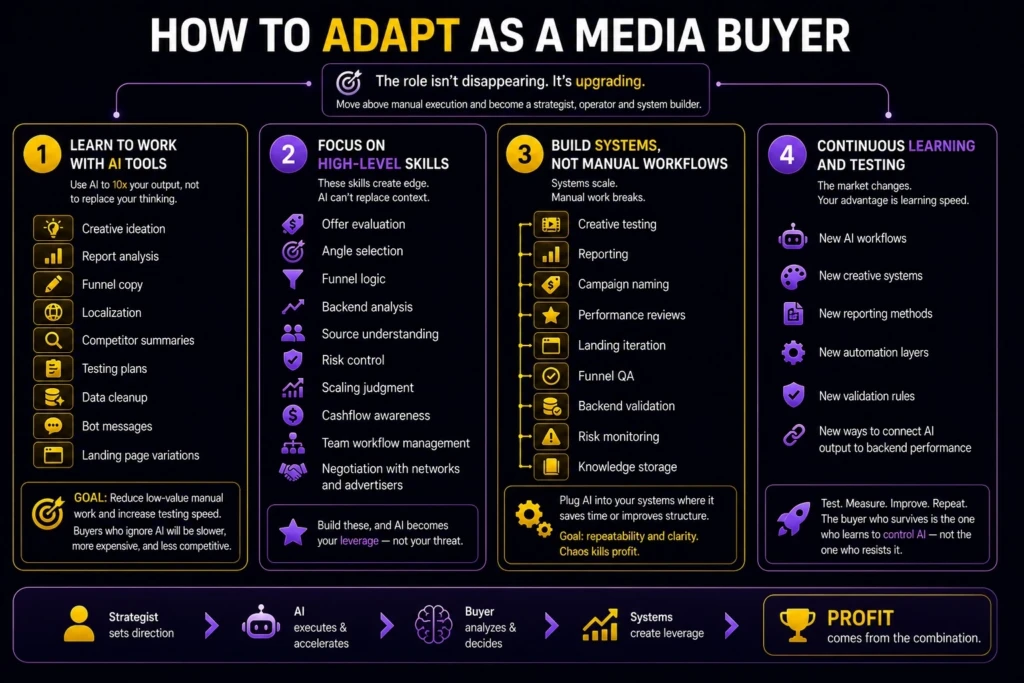
The media buyer role is not disappearing. It is upgrading.
To stay valuable, buyers need to move above manual execution and become better at systems, strategy, analytics, and AI-assisted workflows.
Learn to work with AI tools
Every buyer should understand how to use AI tools for practical work:
- creative ideation;
- report analysis;
- funnel copy;
- localization;
- competitor summaries;
- testing plans;
- data cleanup;
- bot messages;
- landing page variations.
The goal is not to become an “AI guru.” The goal is to reduce low-value manual work and increase testing speed.
A buyer who ignores AI will compete against teams that move faster and cheaper.
Focus on high-level skills
The most valuable buyer skills in 2026 are high-level skills:
- offer evaluation;
- angle selection;
- funnel logic;
- backend analysis;
- source understanding;
- risk control;
- scaling judgment;
- cashflow awareness;
- team workflow management;
- negotiation with networks and advertisers.
These are harder to automate because they require context.
If you build these skills, AI becomes leverage instead of a threat.
Build systems, not manual workflows
Manual workflows do not scale well.
A modern buyer should build systems for:
- creative testing;
- reporting;
- campaign naming;
- performance reviews;
- landing iteration;
- funnel QA;
- backend validation;
- risk monitoring;
- knowledge storage.
AI should be plugged into those systems where it saves time or improves structure.
The goal is repeatability. If every campaign is managed chaotically, AI only adds more chaos.
Continuous learning and testing
The market will keep changing.
AI tools will improve. Traffic sources will change. Platforms will tighten rules. Buyers will automate more. Teams will become leaner.
The only stable advantage is learning speed.
A buyer should constantly test:
- new AI workflows;
- new creative systems;
- new reporting methods;
- new automation layers;
- new validation rules;
- new ways to connect AI output to backend performance.
The media buyer who survives is not the one who resists AI. It is the one who learns to control it.
FAQ
Does AI replace media buyers in affiliate marketing?
AI does not fully replace strong media buyers. It replaces routine tasks, basic production, reporting, and some support roles. Strategic decisions, risk control, offer selection, and backend judgment still need humans.
Why are affiliate teams getting smaller because of AI?
AI reduces the need for large execution teams. One skilled operator can now generate creatives, summarize reports, localize copy, and automate routine work that previously required several people.
What tasks can AI automate in media buying?
AI can automate or speed up creative generation, reporting, data cleanup, localization, campaign documentation, basic analysis, naming templates, test planning, and repetitive operational tasks.
What can AI not replace in affiliate marketing?
AI cannot fully replace strategic judgment, market intuition, risk management, advertiser relationships, cashflow decisions, backend interpretation, and responsibility for scaling decisions.
How should media buyers adapt to AI?
Media buyers should learn AI tools, build AI-assisted workflows, focus on strategy and backend analysis, improve system thinking, and use automation to increase testing speed instead of relying on manual execution.
Will AI replace junior affiliate roles?
AI is already replacing parts of junior roles, especially repetitive writing, reporting, translation, formatting, and basic analysis. Junior specialists need to move toward AI operation, data interpretation, creative strategy, and workflow management.