
Choosing the right traffic source in 2026 is not just a media buying preference. It is one of the biggest profit decisions in affiliate marketing. The same offer, funnel, creative angle, and payout can behave completely differently depending on whether you run it on TikTok or Facebook. One source may give you cheap traffic and fast volume, while the other may deliver stronger intent, better backend quality, and more predictable ROI.
That is why the question is not simply “where are clicks cheaper?” Cheap traffic does not automatically mean profitable traffic. TikTok and Facebook operate on different user behaviors, auction dynamics, creative logic, and scaling patterns. In this tiktok vs facebook ads 2026 breakdown, we will compare traffic quality, cost structure, ROI, scaling potential, backend value, and practical use cases so you can understand which platform is more profitable for affiliate marketing and where to run ads in 2026.
Contents
- Core difference between TikTok and Facebook
- Traffic quality comparison
- Cost structure and scaling dynamics
- Where you actually make money
- When TikTok wins
- When Facebook wins
- How to choose the right platform
- FAQ
Core difference between TikTok and Facebook
The core difference between TikTok and Facebook is user mode.
TikTok is an entertainment-first, discovery-driven, short-attention platform. Users are not usually looking for solutions, products, offers, apps, or financial decisions. They are scrolling for stimulation. The ad has to interrupt that scroll, create interest instantly, and push the user into action before attention disappears.
Facebook is more mature, intent-rich, and behaviorally stable. Users are still scrolling, but the platform has deeper historical data, stronger interest mapping, older audiences in many GEOs, and more developed conversion infrastructure. Facebook is usually less explosive than TikTok, but it can be more stable when the offer, funnel, and pixel signals are clean.
This is the foundation of any serious affiliate marketing platforms comparison. TikTok is not simply “cheaper Facebook.” Facebook is not simply “older TikTok.” They are different traffic ecosystems.
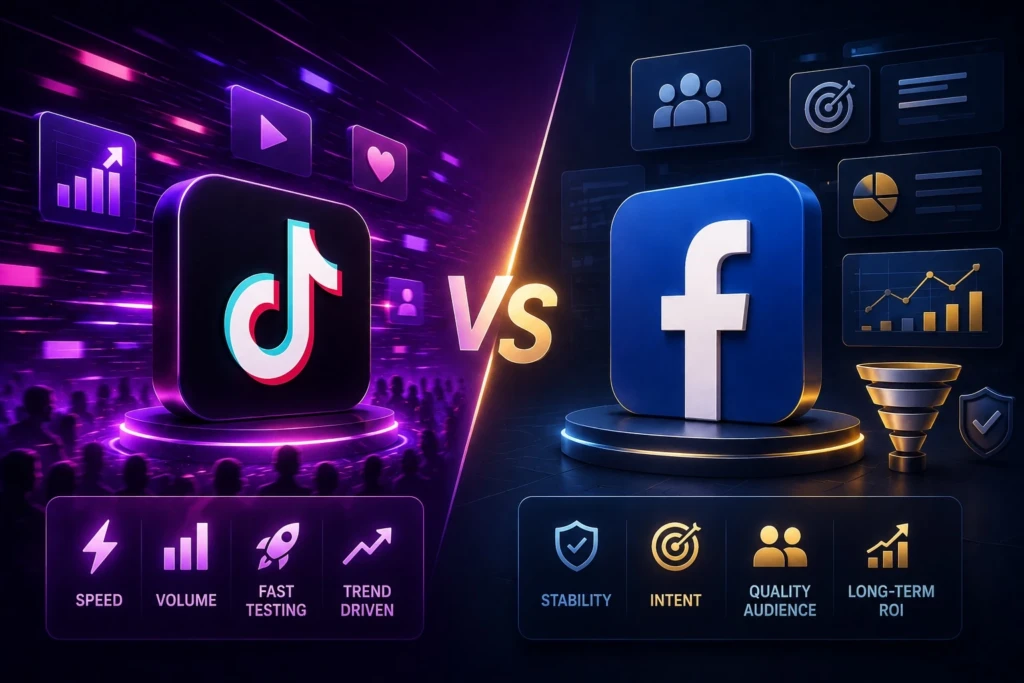
TikTok = volume and speed
TikTok is built for speed.
It can generate fast impressions, fast CTR spikes, fast creative validation, and fast campaign feedback. If the angle hits, TikTok can push volume aggressively, especially in broad consumer verticals, app installs, sweepstakes-style flows, leadgen, nutra, low-friction e-commerce, mobile-first products, and trend-based offers.
The platform is powerful when the campaign needs reach and rapid testing. A fresh creative can catch attention quickly and produce strong early signals. This is why many affiliates use TikTok to discover hooks, test emotional triggers, validate UGC scripts, and find angles before moving budget elsewhere.
But TikTok’s strength is also its weakness. Speed creates volatility. Volume can appear before quality is proven. A campaign can look profitable on day one and collapse on day three. Cheap leads can turn into weak approvals. High CTR can hide low buying intent.
TikTok is a volume machine, but not every volume machine is a profit machine.
Facebook = stability and intent
Facebook is slower but usually more stable.
It has a more developed ad ecosystem, better optimization depth, stronger retargeting logic, and more predictable campaign behavior when the account is healthy. The users are often more deliberate, especially in verticals where trust, money, age, financial capacity, or repeated decision-making matter.
Facebook can be harder to enter. CPMs are often higher. Testing can be more expensive. Account restrictions, policy issues, and creative review problems can hurt performance. But when a campaign works, it often has a longer lifecycle than a typical TikTok creative.
Facebook is not always cheaper on the front end, but it can be more profitable on the backend. That is why serious buyers do not judge facebook vs tiktok ads ROI only by CPC or raw CPA. They look at approved CPA, deposit quality, sale quality, retention, rebill, refunds, and LTV.
Traffic quality comparison
Traffic quality is where the real difference starts.
Many buyers make the mistake of comparing TikTok and Facebook by surface metrics: CPM, CPC, CTR, raw lead cost, registration cost, or install cost. These numbers matter, but they do not tell the full story. In affiliate marketing, traffic quality is decided after the click.
The real question is: what happens after the user enters the funnel?
Do they submit real data?
Do they answer the call?
Do they deposit?
Do they purchase?
Do they pass KYC?
Do they rebill?
Do they refund?
Do they create LTV?
That is where tiktok vs facebook traffic quality becomes more meaningful than basic ad metrics.
TikTok traffic characteristics
TikTok traffic is often impulsive.
Users react to hooks, emotion, curiosity, trend formats, creator energy, social proof, controversy, fear, desire, and entertainment value. This can generate strong click activity, especially when the creative looks native and does not feel like a traditional ad.
The upside is obvious: TikTok can produce cheap attention. If your offer has a simple action, low commitment, mobile-friendly flow, and strong creative match, it can convert fast.
The downside is intent quality. A user may click because the video is funny, shocking, relatable, or visually satisfying, not because they are genuinely ready to buy, deposit, subscribe, or complete a high-value action.
Common TikTok traffic patterns include:
- high engagement but weak backend;
- cheap raw leads but low approval;
- strong CTR but poor funnel continuation;
- fast testing but fast fatigue;
- good top-funnel numbers but unstable ROI;
- strong day-one performance followed by rapid decay.
TikTok traffic can absolutely make money. But it has to be filtered, qualified, and validated aggressively.
Facebook traffic characteristics
Facebook traffic is usually more intentional.
This does not mean every Facebook user is high quality. There is still junk traffic, bad placements, poor clicks, and weak leads. But compared with TikTok, Facebook often gives media buyers more structured user behavior and better conversion consistency, especially when the pixel has enough clean data.
Facebook users may be more likely to read, compare, evaluate, click through longer funnels, submit more accurate information, and complete higher-value actions. This is especially important for affiliate verticals where monetization depends on backend validation.
Facebook often performs better for:
- financial offers;
- insurance;
- solar and home services;
- high-ticket leadgen;
- iGaming with proper compliance and funnel logic;
- e-commerce with proven product-market fit;
- subscriptions;
- education;
- B2C services;
- offers where trust and user quality matter.
The key advantage is not always cheaper acquisition. It is stronger commercial behavior after acquisition.
Conversion behavior differences
TikTok conversions are often more emotional and immediate. Facebook conversions are often more deliberate and stable.
On TikTok, the creative does most of the heavy lifting. The user sees the video, reacts quickly, clicks, and enters the funnel. If the lander does not continue the same emotional momentum, conversion rate drops. If the offer requires too much thinking, TikTok traffic may bounce.
On Facebook, the user journey can tolerate more explanation. Advertorials, quiz funnels, VSLs, comparison pages, long-form presell pages, and retargeting sequences can work better because users are more accustomed to this type of conversion path.
This matters because different offers need different decision speeds.
A simple mobile app, viral gadget, or low-friction lead form may perform well on TikTok. A financial product, insurance funnel, subscription offer, or high-value service may perform better on Facebook because the user needs more trust before converting.
Cost structure and scaling dynamics
Cost is where many buyers get tricked.
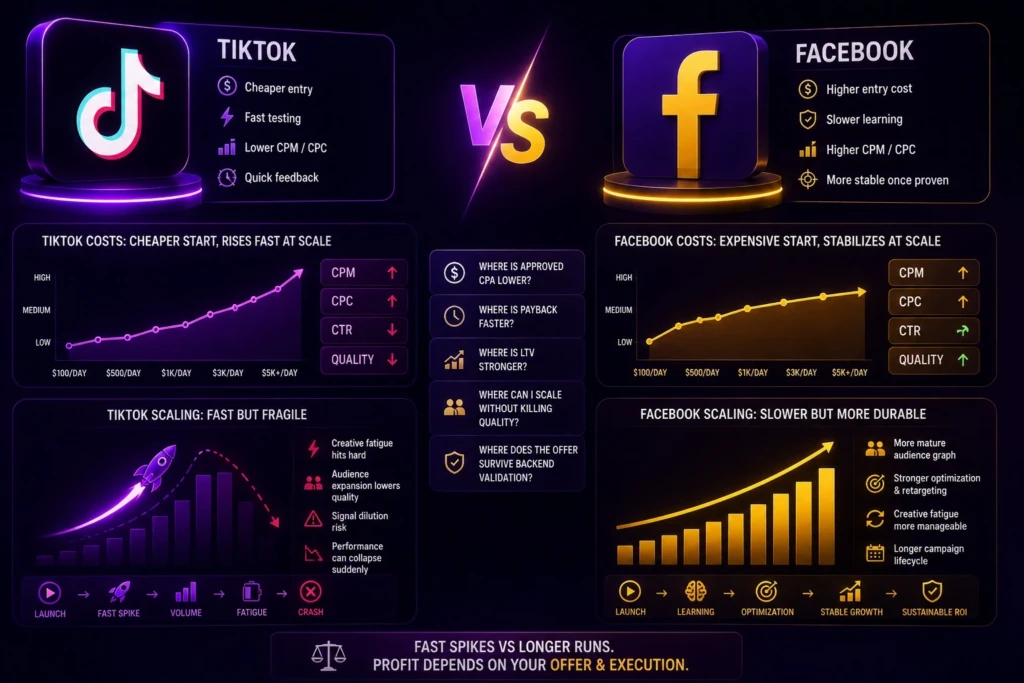
TikTok often looks cheaper at the start. Facebook often looks expensive at the start. But the cheapest traffic source is not always the most profitable traffic source.
A buyer asking where to run ads in 2026 should not only ask:
“Where is the CPC lower?”
The better questions are:
“Where is approved CPA lower?”
“Where is payback faster?”
“Where is LTV stronger?”
“Where can I scale without killing quality?”
“Where does the offer survive backend validation?”
TikTok cost model
TikTok usually has a cheaper entry point.
You can test multiple creatives, angles, hooks, and landing page flows with relatively fast feedback. In many GEOs and verticals, TikTok can still deliver attractive CPMs and CPCs compared with Facebook.
This makes it useful for early-stage testing. If you need to validate whether an angle has attention potential, TikTok can be efficient.
But TikTok costs can rise quickly during scaling. A campaign that works at $100/day may not hold at $1,000/day. CPM can increase, CTR can decline, CPC can inflate, and conversion quality can degrade as the algorithm expands beyond the cleanest audience pocket.
The biggest danger is thinking that TikTok’s low entry cost means low final acquisition cost. It does not. TikTok may give you cheap data, but not always cheap profit.
Facebook cost model
Facebook usually has a more expensive entry point.
Testing can require more budget because CPMs may be higher, learning periods may be longer, and stable optimization often needs more conversion data. The platform can punish weak creatives, bad landing pages, low trust, and poor compliance.
But once Facebook finds a working pocket, performance can become more predictable. Strong campaigns can run longer, retargeting can improve economics, and backend quality may support higher front-end costs.
This is why Facebook can look worse in the tracker on day one but better in the finance report after validation.
For example, TikTok may generate leads at $8 and Facebook at $18. But if TikTok approval is 20% and Facebook approval is 55%, Facebook may actually produce the better approved CPA. If Facebook users deposit more, rebill more, or refund less, the ROI gap becomes even stronger.
Scaling differences
TikTok scaling is faster but more fragile.
The platform can push volume quickly, but creative fatigue hits hard. Winning assets may burn fast. Audience expansion can lower quality. Signal dilution can appear when the system starts optimizing toward shallow or mixed conversion events.
Facebook scaling is usually slower but more durable.
A good Facebook campaign can often survive longer because the audience graph, optimization system, and retargeting layers are more mature. Creative fatigue still exists, but the campaign lifecycle may be longer if the account structure, creative pipeline, and funnel are built properly.
In simple terms:
TikTok can give you fast spikes.
Facebook can give you longer runs.
Neither is automatically better. It depends on your offer economics and operational setup.
Where you actually make money
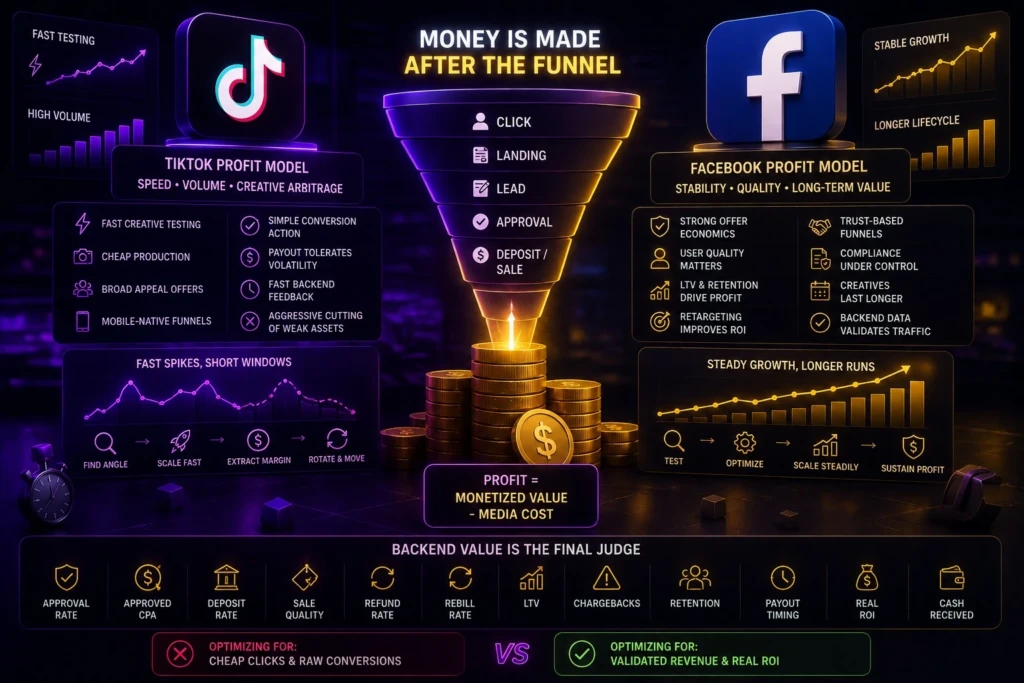
Money is not made in the ad account. Money is made after the user moves through the funnel and creates real value.
This is the main mistake in most facebook vs tiktok ads ROI discussions. Buyers compare ad platform numbers but ignore backend performance. In affiliate marketing, the platform report is only the beginning of the story.
Profit comes from the gap between media cost and monetized user value.
That means the real comparison is not TikTok CPC vs Facebook CPC. It is TikTok backend value vs Facebook backend value after traffic cost, funnel performance, approval, payout, retention, and cashflow.
TikTok profit model
TikTok’s profit model is based on speed, volume, and creative arbitrage.
You make money on TikTok when you can find angles faster than competitors, generate cheap attention, push traffic through a low-friction funnel, and kill weak assets before they burn budget.
TikTok works well when:
- creative testing is fast;
- production is cheap;
- the offer has broad appeal;
- the funnel is mobile-native;
- conversion action is simple;
- payout supports volatility;
- backend feedback comes quickly;
- the buyer cuts aggressively.
TikTok profit often comes in windows. A creative hits, you scale carefully, extract margin, rotate assets, and move before fatigue kills the setup.
This requires a strong creative pipeline. Without constant new hooks, TikTok becomes unstable very quickly.
Facebook profit model
Facebook’s profit model is based on stable optimization, stronger user value, and longer campaign lifecycle.
You make money on Facebook when your funnel converts qualified users, the pixel receives clean events, the account has enough data, and backend value supports higher acquisition costs.
Facebook works well when:
- the offer has strong economics;
- user quality matters;
- LTV is meaningful;
- retargeting improves ROI;
- the funnel requires trust;
- compliance is under control;
- creatives can run longer;
- backend data validates the traffic.
Facebook may not always give the cheapest leads, but it can give better users. In many verticals, better users are where the money is.
Backend value differences
Backend value is the final judge.
TikTok can win on front-end efficiency and lose on backend quality. Facebook can lose on CPC and win on approved CPA, LTV, refund rate, or deposit quality.
Important backend metrics include:
- approval rate;
- approved CPA;
- deposit rate;
- sale quality;
- refund rate;
- rebill rate;
- LTV;
- chargebacks;
- retention;
- payout timing;
- real ROI;
- cash received.
If you optimize only for cheap clicks or raw conversions, TikTok will often look better. If you optimize for validated revenue, Facebook may win more often in high-value verticals.
When TikTok wins
TikTok wins when speed matters more than stability.
It is one of the best platforms for discovering what people react to right now. If you have a strong creative team, fast editing process, enough angles to test, and a funnel that monetizes impulse traffic, TikTok can be extremely powerful.
Fast testing and discovery
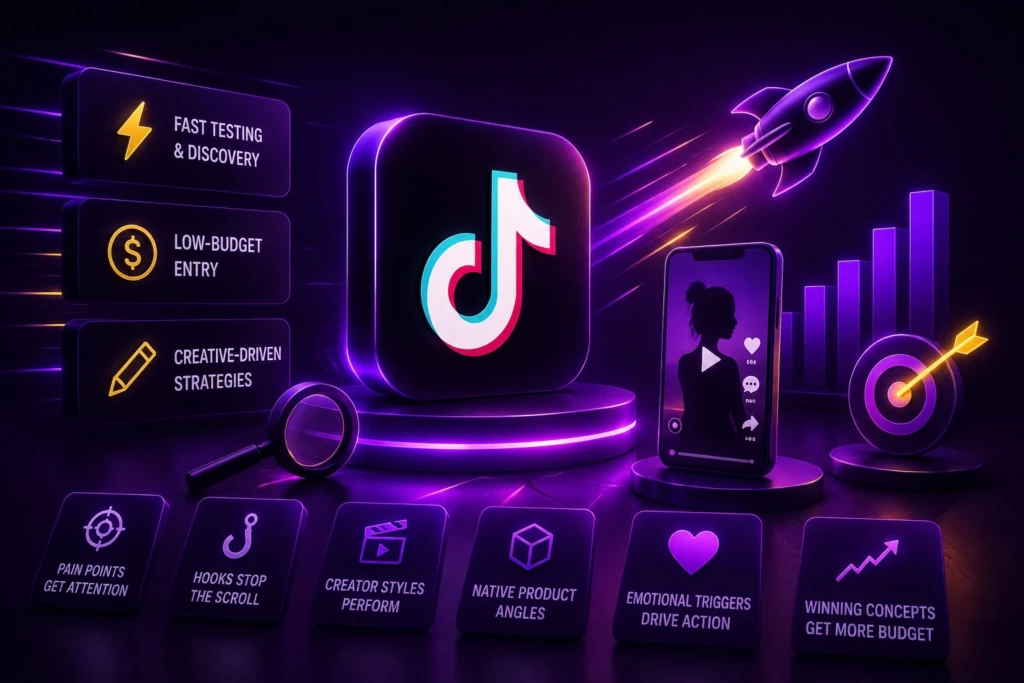
TikTok is excellent for creative discovery.
You can test hooks, formats, claims, emotional triggers, creator types, storylines, and objections quickly. This is valuable even if TikTok is not your final scaling source.
A smart team can use TikTok to learn:
- which pain points get attention;
- which hooks stop the scroll;
- which creator styles perform;
- which product angles feel native;
- which emotional triggers generate action;
- which concepts deserve more budget.
That data can later inform Facebook ads, landing pages, email flows, advertorials, and offer positioning.
Low-budget entry
TikTok is attractive for smaller budgets because the entry cost can be lower.
A beginner or smaller affiliate team may not have enough cash to properly test Facebook in competitive GEOs. TikTok can offer more affordable initial data and faster learning cycles.
This does not mean TikTok is easy. It means the testing barrier may be lower. You still need strong creatives, fast analysis, proper tracking, and backend validation.
For low-budget buyers, TikTok can be a good starting point if they understand that cheap testing is not the same as guaranteed profit.
Creative-driven strategies
TikTok rewards creative strength.
If your team understands native content, UGC, fast hooks, trend adaptation, emotional pacing, and visual storytelling, TikTok can outperform more traditional platforms.
On TikTok, a strong creative can sometimes compensate for limited targeting. The algorithm needs signals, but the creative creates the first signal.
This is why TikTok is dangerous for lazy buyers and powerful for creative operators. If you can produce and iterate fast, you have an edge.
When Facebook wins
Facebook wins when quality, stability, and backend monetization matter more than cheap attention.
For many serious affiliate teams, Facebook remains a stronger profit source for validated scale. It is not always easier. It is not always cheaper. But it can be more commercially reliable.
Long-term scaling
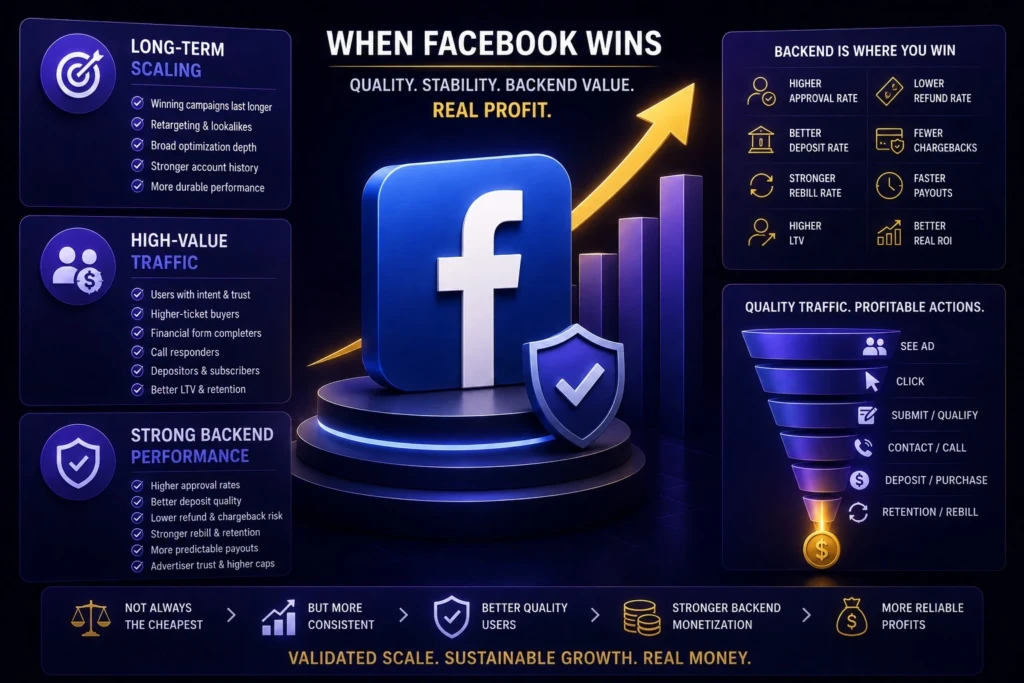
Facebook is usually stronger for long-term scaling.
If you have a proven offer, tested funnel, compliant creative strategy, clean tracking, and enough budget, Facebook can build more durable campaigns than TikTok. Winning campaigns may last longer, and performance can be supported by retargeting, lookalikes, broad optimization, and stronger account history.
This matters for teams that do not want to chase short-lived creative spikes every day.
High-value traffic
Facebook often wins in verticals where users need trust, money, or serious intent.
High-value traffic is not just traffic that clicks. It is traffic that completes profitable actions.
Facebook can be stronger for users who:
- buy higher-ticket products;
- complete financial forms;
- answer sales calls;
- deposit;
- subscribe;
- pass verification;
- retain longer;
- produce stronger LTV.
In this sense, Facebook may be more profitable even when the initial CPA is higher.
Strong backend performance
Facebook’s biggest advantage is often backend performance.
When the funnel is strong, Facebook traffic may deliver better approval, better deposit quality, lower refund risk, stronger rebill, and more predictable advertiser feedback.
This is especially important in affiliate verticals where networks and advertisers judge traffic quality heavily. If your traffic generates bad users, your caps get reduced, payouts get cut, or the offer gets pulled.
Facebook traffic is not automatically clean, but it is often easier to optimize toward backend value when tracking and events are set up properly.
How to choose the right platform
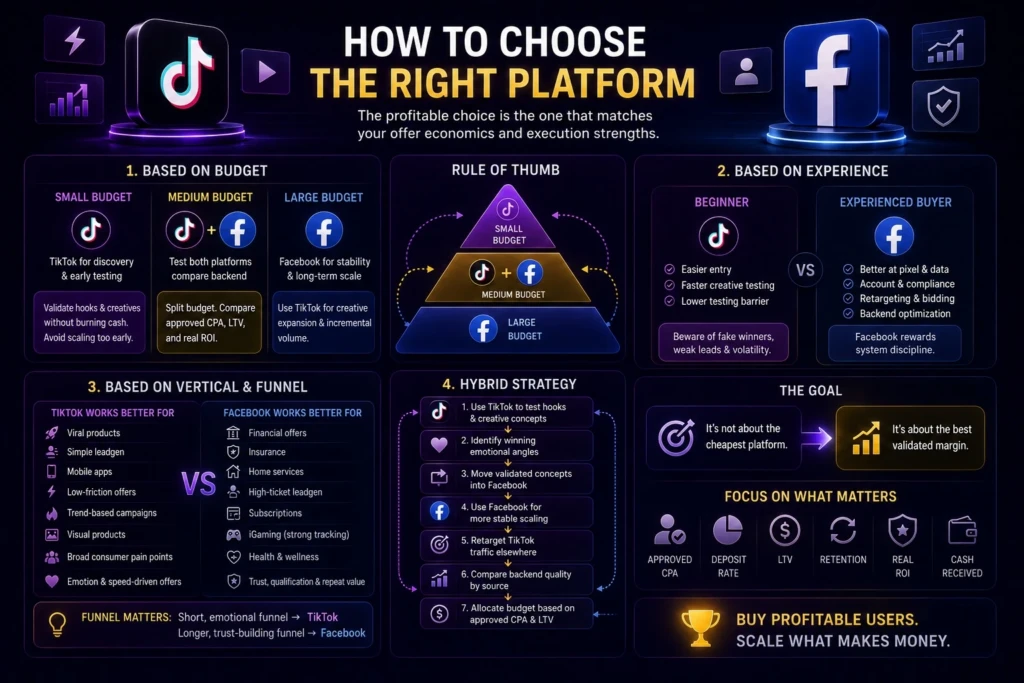
The right platform depends on budget, experience, vertical, funnel, and monetization model.
There is no universal winner in tiktok vs facebook ads 2026. The profitable choice is the one that matches your offer economics and execution strengths.
Based on budget
If your budget is small, TikTok may be easier for early testing. You can validate hooks, creatives, and basic funnel response without burning too much cash upfront.
But small-budget TikTok buyers must avoid scaling too early. A few cheap conversions do not prove the campaign is profitable.
If your budget is larger, Facebook may offer better long-term economics, especially if you can afford proper testing, account infrastructure, creative production, tracking, and optimization.
Rule of thumb:
Small budget: TikTok for discovery.
Medium budget: test both, compare backend.
Large budget: Facebook for stability, TikTok for creative expansion and incremental volume.
Based on experience
Beginners may find TikTok more accessible because the creative logic is easier to test quickly. But TikTok can also punish beginners with fake winners, weak leads, and unstable performance.
Experienced buyers may prefer Facebook because they can manage pixel data, compliance, account structure, bidding logic, retargeting, and backend optimization more effectively.
TikTok rewards creative speed.
Facebook rewards system discipline.
The best platform depends on which skill you actually have.
Based on vertical and funnel
TikTok usually works better for:
- viral products;
- simple leadgen;
- mobile apps;
- low-friction offers;
- trend-based campaigns;
- visual products;
- broad consumer pain points;
- offers that can be sold through emotion and speed.
Facebook usually works better for:
- financial offers;
- insurance;
- home services;
- high-ticket leadgen;
- subscriptions;
- iGaming with strong backend tracking;
- health and wellness funnels;
- offers requiring trust, qualification, or repeat value.
The funnel matters as much as the vertical. A short, emotional funnel may fit TikTok. A longer, trust-building funnel may fit Facebook.
Hybrid strategy
The strongest teams often do not choose only one platform.
They use TikTok and Facebook together.
A hybrid strategy may look like this:
- use TikTok to test hooks and creative concepts;
- identify winning emotional angles;
- move validated concepts into Facebook;
- use Facebook for more stable scaling;
- retarget TikTok traffic elsewhere;
- compare backend quality by source;
- allocate budget based on approved CPA and LTV.
This approach avoids platform religion. The goal is not to prove TikTok or Facebook is better. The goal is to buy profitable users.
In 2026, smart affiliates do not ask, “Which platform is cheaper?” They ask, “Which platform produces the best validated margin for this offer?”
FAQ
Is TikTok or Facebook more profitable for affiliate marketing in 2026?
It depends on the offer and funnel. TikTok can be more profitable for fast testing and creative-driven volume. Facebook is often more profitable for stable scaling, higher-quality users, and stronger backend value.
Which platform has better traffic quality, TikTok or Facebook?
Facebook usually has stronger traffic quality for high-value funnels, but TikTok can work well for impulse-driven offers. The real comparison should be based on approval rate, deposit quality, LTV, refunds, and real ROI.
Is TikTok cheaper than Facebook ads?
TikTok often has a cheaper entry point and faster testing costs. However, cheaper CPM or CPC does not always mean better profit. TikTok traffic can become expensive after backend validation if user quality is weak.
Does Facebook still work for affiliates in 2026?
Yes, Facebook still works when the offer, funnel, tracking, compliance, and creative strategy are strong. It is harder than before, but it remains one of the strongest platforms for validated performance and long-term ROI.
Where should beginners run ads in 2026?
Beginners can start with TikTok for faster creative testing and lower initial costs, but they must track backend quality. Facebook may require more budget and experience, but it can produce more stable results once optimized.
Should I run both TikTok and Facebook?
Yes, if the budget allows it. TikTok can be used for fast hook discovery and volume testing, while Facebook can be used for more stable scaling and higher-value backend performance. The best strategy is to compare real ROI, not platform vanity metrics.