

Telegram has been sold to affiliates as a cheap traffic source for years. Low CPC, fast volume, flexible placements, active communities, simple bot flows, and fewer entry barriers made it look like a perfect playground for media buyers. You could launch fast, test fast, and get users into a funnel without the same level of cost pressure as Meta, Google, or TikTok.
But cheap traffic is not the same as profitable traffic. A click that does not register, deposit, buy, approve, rebill, or retain is not cheap. It is just wasted spend with a nice front-end number. This article breaks down telegram traffic quality, why the telegram ads cheap traffic problem kills ROI, where money leaks after the click, and how affiliates should evaluate Telegram traffic by real value instead of low CPC.
Contents
- What is traffic quality in Telegram
- Why cheap traffic looks attractive
- The problem with low-quality traffic
- How traffic quality affects profit
- Where money is lost
- How to evaluate Telegram traffic
- How to improve traffic quality
- FAQ
What is traffic quality in Telegram
Traffic quality in Telegram is not about how many users click. It is about what kind of users click and what they do after the click.
A Telegram campaign can generate cheap CPC, strong bot starts, decent channel joins, and even good engagement, but still be commercially useless. If users do not move toward monetized actions, the traffic has low quality.
In affiliate marketing, quality means value after validation.
For Telegram, that value usually depends on:
- registration rate;
- lead approval;
- first deposit;
- purchase rate;
- subscription;
- redeposit;
- retention;
- refund rate;
- LTV;
- advertiser feedback;
- real ROI.
A traffic source is not good because it sends volume. It is good because it sends users who monetize.

Intent and user behavior
Intent is the first layer of Telegram traffic quality.
A high-intent user understands the offer, has a real reason to continue, and is more likely to complete the money action. A low-intent user clicks because the message is curious, funny, aggressive, hyped, or emotionally triggering — but has no real desire to pay, register, deposit, or buy.
Telegram traffic often sits somewhere between attention and intent.
Users are active. They click links. They join bots. They react to promos. But that does not automatically mean they are ready to convert.
This is why affiliate marketing Telegram traffic needs proper filtering and pre-sell. The user may be warm to the topic, but still cold to the offer.
A buyer has to understand the difference between:
“I clicked because I am curious”
and
“I clicked because I want this product or action.”
The first type creates activity. The second type creates money.
Engagement vs conversion
Engagement is not conversion.
Telegram can generate a lot of engagement: channel views, clicks, bot starts, reactions, comments, joins, and message interactions. These signals can look good in reports, but they do not prove profitability.
A user can:
- click the link;
- start the bot;
- join the channel;
- read the message;
- tap buttons;
- open the offer;
and still never become valuable.
This is one of the biggest telegram ads ROI issues. Buyers see movement and assume the campaign is working. But if the backend does not confirm value, the traffic is just noisy.
Real conversion quality starts deeper:
- did the user register?
- did the user approve?
- did the user deposit?
- did the user buy?
- did the user stay?
- did the user rebill?
- did the user refund?
- did the advertiser accept the traffic?
Engagement is a signal. Money is the result.
Backend value
Backend value is the final judge of Telegram traffic quality.
A user who clicks cheaply but never pays has no value. A user who costs more but deposits, retains, and redeposits may be much more profitable.
Backend value includes:
- LTV;
- retention;
- repeat deposits;
- rebill;
- upsell;
- refund behavior;
- advertiser quality score;
- chargeback risk;
- payout stability.
For iGaming, backend value may depend on dep, redep, activity, retention, and player quality.
For leadgen, it may depend on approval, call-center contact, sale rate, and advertiser feedback.
For e-commerce, it may depend on purchase quality, refund rate, and repeat orders.
For subscriptions, it may depend on trial-to-paid rate and rebill.
If Telegram traffic brings cheap users with weak backend value, the traffic is not profitable. Even if the front-end looks clean.
Why cheap traffic looks attractive
Cheap traffic is seductive because it lowers emotional pressure.
A buyer sees low CPC and thinks there is room to test. The campaign gets clicks quickly. Bot starts appear. Volume feels easy. The first dashboard looks alive.
That creates a dangerous feeling: “This source works.”
But Telegram’s cheap traffic can hide low intent, weak monetization, bad funnel fit, and poor backend quality.

Low CPC illusion
Low CPC creates the illusion of efficiency.
If one source gives clicks at $0.08 and another gives clicks at $0.60, the cheap one looks better. But CPC is only the price of attention. It does not show whether the user is valuable.
For example:
Source A:
- CPC: $0.08;
- 1,000 clicks: $80;
- registrations: 20;
- deposits: 0.
Source B:
- CPC: $0.60;
- 1,000 clicks: $600;
- registrations: 80;
- deposits: 20.
Source A is cheaper. Source B makes money.
This is the Telegram trap. Low CPC can make bad traffic look attractive because the loss comes later in the funnel.
A cheap click only matters if the click has a path to monetization.
Easy volume scaling
Telegram can make volume feel easy.
A buyer can buy placements, push channel ads, run bot flows, scale across communities, test multiple channels, and generate traffic quickly. That speed is useful, but it can also become a problem.
Easy volume means you can scale losses faster.
If the traffic is low-quality, more volume does not fix the campaign. It only sends more weak users into the same funnel. The buyer sees bigger numbers, but the backend gets worse.
This is especially dangerous when the buyer optimizes for top-funnel metrics:
- cheaper clicks;
- cheaper bot starts;
- cheaper joins;
- cheaper raw leads;
- cheaper registrations.
If those users do not monetize, volume becomes a liability.
Entry-level accessibility
Telegram has a lower barrier to entry than many other sources.
You do not always need complex creative production, advanced account farming, heavy compliance setup, or huge test budgets. That makes Telegram attractive for beginners and small teams.
But accessibility creates competition and low-quality execution.
Many buyers enter Telegram with weak funnels, basic bots, copied copy, poor tracking, and no backend logic. They buy traffic because it looks affordable, then discover that cheap entry does not mean easy profit.
Telegram is easy to test. It is not easy to monetize.
That difference matters.
The problem with low-quality traffic
Low-quality traffic does not always look bad immediately.
It can click. It can engage. It can start bots. It can fill forms. It can even register. But it fails when money or validation is required.
This is why telegram traffic not profitable is such a common problem. The source sends users, but the users do not create enough commercial value.

Low intent users
Low-intent users are the main issue.
They click because of curiosity, entertainment, hype, fake urgency, or broad interest. They are not ready for a paid action.
Low-intent Telegram users often behave like this:
- click fast;
- open the bot;
- tap once;
- ignore the offer;
- register with weak motivation;
- do not deposit;
- do not answer calls;
- do not buy;
- disappear after the first step.
This kind of traffic can destroy metrics deeper in the funnel.
The campaign may show cheap traffic, but approved CPA, deposit CPA, or sale CPA becomes too high.
The buyer thinks the problem is the offer. Sometimes it is. But often the funnel is attracting the wrong type of user.
High drop-off rates
Low-quality traffic creates high drop-off.
Users enter the funnel but leave before the money event. The leak can happen between any steps:
- click to bot start;
- bot start to first action;
- first action to offer click;
- offer click to registration;
- registration to deposit;
- lead to approval;
- trial to paid;
- purchase to retention.
High drop-off means the buyer is paying for traffic that never reaches monetization.
For Telegram, this is often caused by mismatch:
- ad promise does not match bot content;
- bot does not build trust;
- offer is too hard for the audience;
- GEO is wrong;
- payment friction is too high;
- users are not qualified;
- traffic source is too broad;
- creative is too clickbait.
Drop-off is not just a funnel metric. It is a quality signal.
Weak monetization
Weak monetization is when users complete shallow actions but do not create revenue.
This is common in Telegram campaigns.
Examples:
- many bot starts, no deps;
- many channel joins, no sales;
- many registrations, no deposits;
- many leads, low approval;
- many free trials, no rebills;
- many offer clicks, no purchases.
The buyer feels like something is happening, but the campaign does not produce money.
This is where telegram ads conversion quality becomes more important than conversion quantity. A raw conversion is not enough. The user has to be valuable after the conversion.
If raw CPA is low but approved CPA is high, the traffic is weak.
If registrations are cheap but deposits are expensive, the traffic is weak.
If sales happen but refunds are high, the traffic is weak.
If trials convert but do not rebill, the traffic is weak.
How traffic quality affects profit
Profit is not only about traffic cost. It is about the relationship between cost and user value.
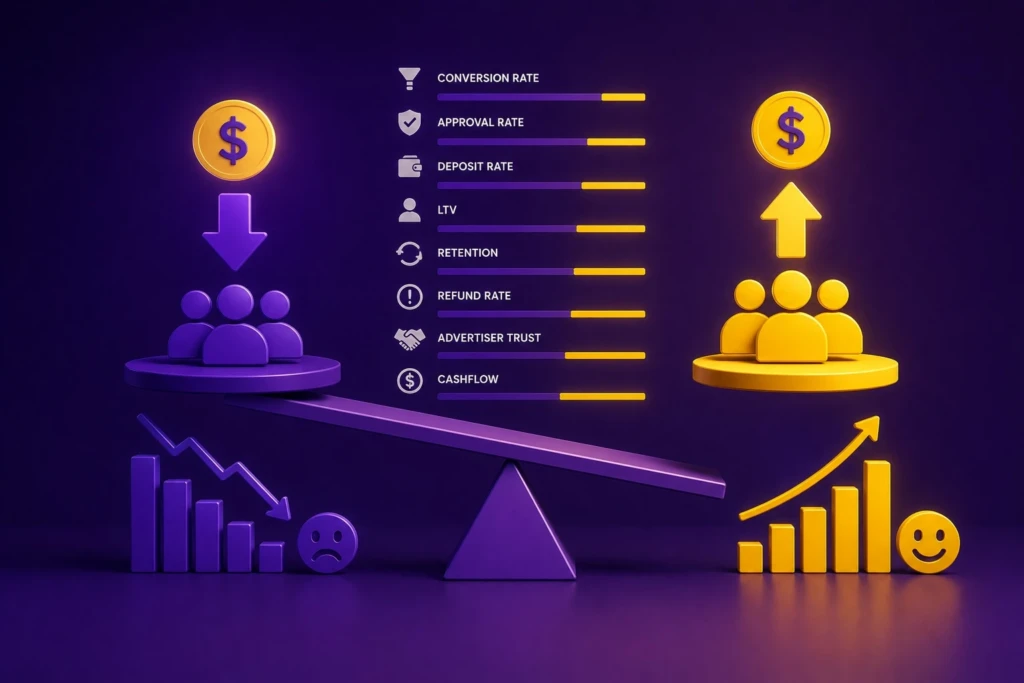
Telegram traffic quality affects every part of the profit equation: conversion rate, approval rate, deposit rate, LTV, retention, refund rate, advertiser trust, and cashflow.
Conversion rate impact
Low-quality traffic lowers conversion rate.
Even if CPC is cheap, poor CR can make the campaign expensive.
Example:
Campaign A:
- CPC: $0.10;
- click-to-dep conversion: 0.1%;
- cost per dep: $100.
Campaign B:
- CPC: $0.50;
- click-to-dep conversion: 1%;
- cost per dep: $50.
Campaign B has higher CPC but better economics.
This is why Telegram buyers should not obsess over front-end cost. The real question is how many paid users come from the traffic.
A cheap user who does not convert is expensive.
An expensive user who converts well can be profitable.
LTV differences
Traffic quality also affects LTV.
Two users may both deposit once, but their long-term value can be completely different. One deposits once and disappears. Another returns, redeposits, plays longer, buys again, or stays subscribed.
That difference changes the entire campaign.
High-quality Telegram traffic may bring fewer users but stronger LTV. Low-quality traffic may bring more users but weak retention.
For affiliates, this is critical because some offers pay based on first action, while advertisers evaluate traffic over time. If your users have poor LTV, the advertiser may reduce caps, cut payout, delay payments, or block the source.
Strong traffic quality protects relationships and long-term buying capacity.
Feedback signals
Low-quality traffic sends bad feedback signals.
Depending on the platform, funnel, or advertiser, weak users can create negative downstream signals:
- no deposits;
- fake leads;
- low contact rate;
- refund requests;
- chargebacks;
- poor retention;
- spam complaints;
- advertiser rejection;
- payment failures;
- blocked accounts.
These signals can damage optimization and business relationships.
If the advertiser sees bad quality, your traffic may get capped. If the source sees bad user behavior, delivery may become worse. If the funnel receives low-intent users, optimization events become polluted.
Bad traffic does not only lose money today. It can damage the campaign’s future performance.
Where money is lost
Money is lost when buyers pay for volume that does not turn into value.
Telegram makes this especially easy because the source can produce cheap activity. But activity without monetization is a trap.
Paying for useless clicks
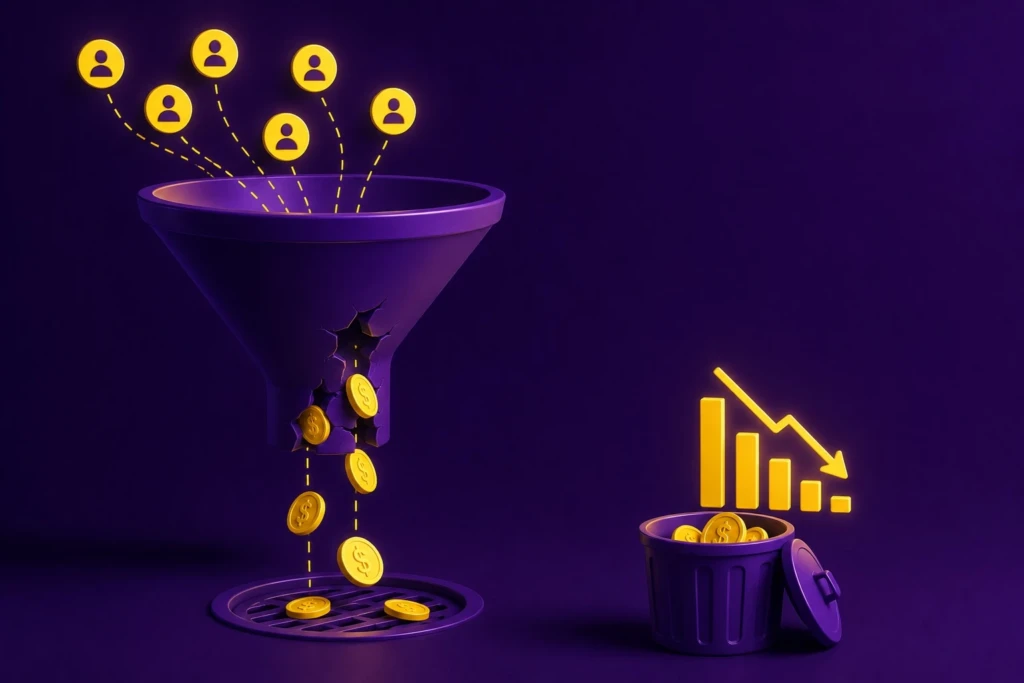
The first leak is useless clicks.
A useless click is not always bot traffic or fake traffic. It can be a real human user with no commercial value.
They clicked, but they were never going to buy.
They opened the bot, but they had no intent.
They registered, but they had no payment ability.
They joined the channel, but they were not qualified.
The buyer still pays.
This is why the cheapest traffic can become the most expensive traffic. You pay less per click, but you need too many clicks to get one valuable user.
Useless clicks usually come from:
- broad placements;
- clickbait copy;
- weak targeting;
- wrong channel selection;
- bad GEO fit;
- low-trust audience;
- irrelevant communities;
- poor pre-sell.
Cutting useless clicks is one of the fastest ways to improve Telegram ROI.
Scaling low-quality traffic
Scaling low-quality traffic is budget destruction.
At small spend, weak traffic may look manageable. Losses are limited. Data is noisy. The buyer hopes the funnel will improve with volume.
But when volume increases, the truth becomes clear.
More low-intent users.
More weak leads.
More no-dep registrations.
More refunds.
More advertiser complaints.
More negative ROI.
Scaling does not improve traffic quality. It amplifies the existing quality.
If the source segment is weak at $100, it will usually be worse at $1,000 unless something changes in targeting, funnel, pre-sell, offer match, or optimization.
Misreading metrics
Many Telegram buyers lose money because they read the wrong metrics.
They optimize for:
- CPC;
- CPM;
- bot starts;
- joins;
- raw leads;
- registrations;
- clicks to offer.
But they should optimize for:
- approved CPA;
- deposit CPA;
- sale quality;
- refund rate;
- retention;
- redep;
- LTV;
- real ROI;
- cash received.
Front-end metrics are useful for diagnostics, not final decisions.
A campaign with high CTR and low CPC can still be trash. A campaign with more expensive clicks can still be profitable if users monetize better.
The buyer has to separate activity metrics from business metrics.
How to evaluate Telegram traffic
Evaluating Telegram traffic means looking beyond the first click.
You need to understand which traffic segments produce value, which ones only create noise, and which ones hurt backend quality.
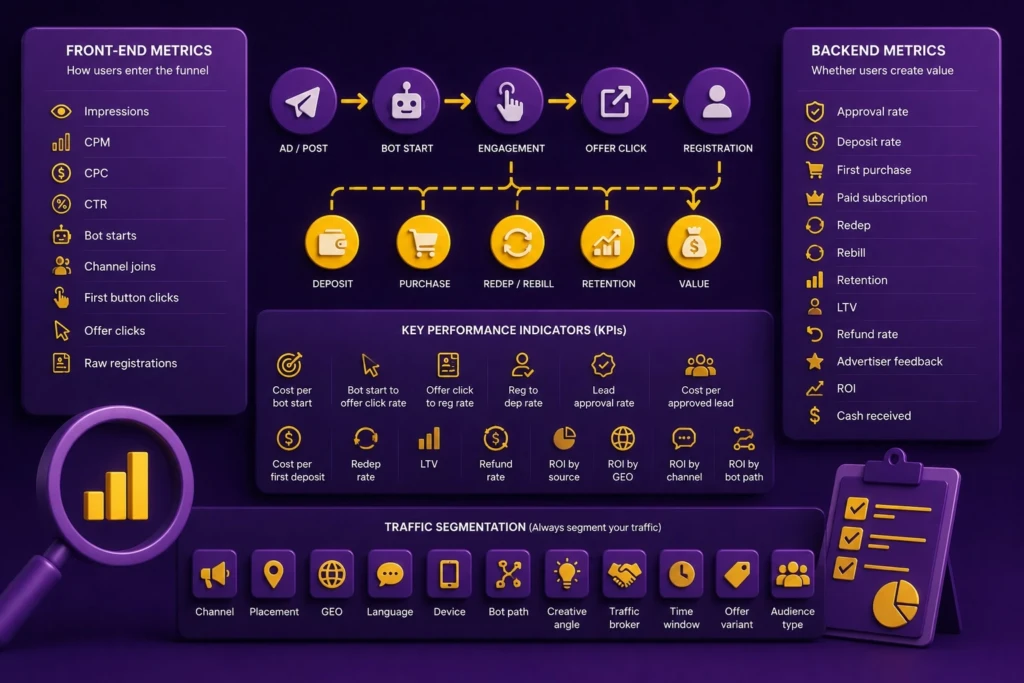
Front-end vs backend metrics
Front-end metrics show how users enter the funnel.
They include:
- impressions;
- CPM;
- CPC;
- CTR;
- bot starts;
- channel joins;
- first button clicks;
- offer clicks;
- raw registrations.
Backend metrics show whether users create value.
They include:
- approval rate;
- deposit rate;
- first purchase;
- paid subscription;
- redep;
- rebill;
- retention;
- LTV;
- refund rate;
- advertiser feedback;
- ROI;
- cash received.
Front-end metrics help you understand attention. Backend metrics tell you if the traffic is profitable.
A Telegram campaign should not be scaled until backend confirms quality.
Key performance indicators
For serious Telegram buying, key KPIs should be tied to money.
Important KPIs:
- cost per bot start;
- bot start to offer click rate;
- offer click to reg rate;
- reg to dep rate;
- lead approval rate;
- cost per approved lead;
- cost per first deposit;
- redep rate;
- LTV;
- refund rate;
- ROI by source;
- ROI by GEO;
- ROI by channel;
- ROI by bot path.
The exact KPI depends on the vertical.
For iGaming, deposit and redep matter.
For leadgen, approval and sale quality matter.
For e-commerce, purchase and refund rate matter.
For subscriptions, rebill and retention matter.
The key is to optimize by the metric that actually pays.
Traffic segmentation
Segmenting Telegram traffic is mandatory.
Blended numbers hide problems. One channel may send strong users. Another may send junk. One GEO may produce deposits. Another may only click. One bot path may create better LTV. Another may create cheap but weak registrations.
Segment by:
- channel;
- placement;
- GEO;
- language;
- device;
- bot path;
- creative angle;
- traffic broker;
- time window;
- offer variant;
- audience type.
Segmentation helps buyers avoid killing good traffic because of bad averages, or scaling bad traffic because it hides inside a profitable blend.
If you cannot segment Telegram traffic, you cannot really optimize it.
How to improve traffic quality
Improving Telegram traffic quality does not always mean paying more. It means buying and filtering smarter.
The goal is to attract users who match the offer, warm them properly, and cut sources that do not create backend value.
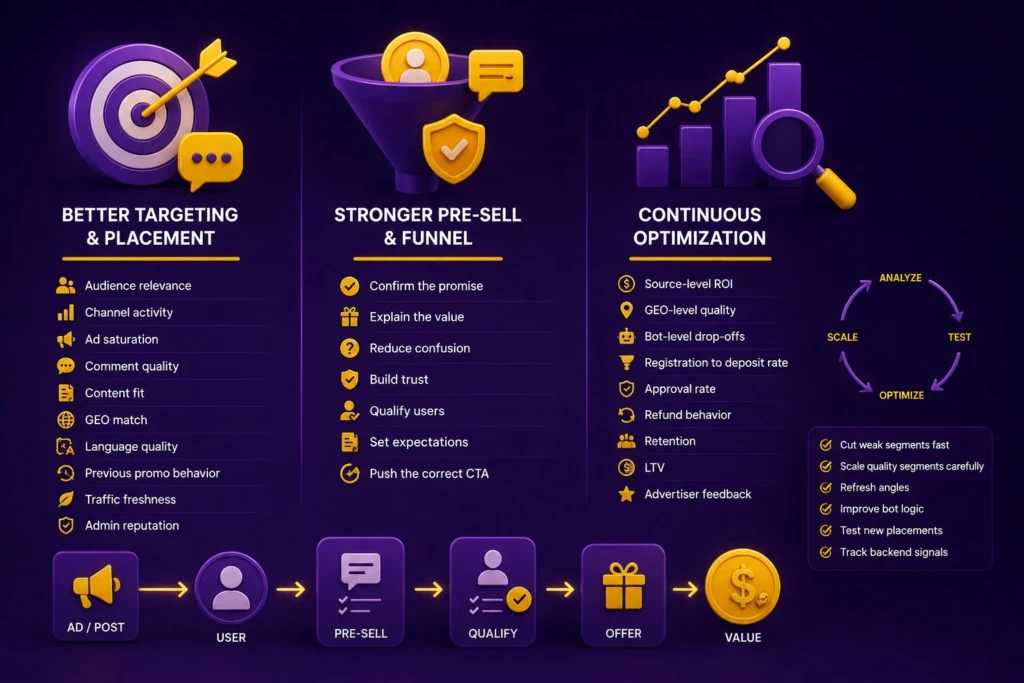
Better targeting and placement
Placement quality matters.
Not all Telegram channels are equal. Some have real communities. Some have dead audiences. Some are full of incentive traffic. Some are overloaded with ads. Some attract low-income users. Some have strong niche intent.
Before buying, evaluate:
- audience relevance;
- channel activity;
- ad saturation;
- comment quality;
- content fit;
- GEO match;
- language quality;
- previous promo behavior;
- traffic freshness;
- admin reputation.
Cheap placements often look attractive, but if the audience does not match the offer, they will burn spend.
A more expensive but relevant placement can outperform cheap broad traffic.
Stronger pre-sell and funnel
Traffic quality is not only created before the click. It is also shaped after the click.
A strong pre-sell can improve quality by filtering and warming users before the offer.
Good pre-sell should:
- confirm the promise;
- explain the value;
- reduce confusion;
- build trust;
- qualify users;
- set expectations;
- push the correct CTA.
A weak funnel sends every user to the offer too early. A strong funnel turns curiosity into intent and cuts users who are unlikely to monetize.
This improves conversion quality and backend value.
Continuous optimization
Telegram traffic quality changes over time.
A channel that worked last month may be exhausted today. A GEO may become saturated. A bot path may start attracting weak users. A creative may pull more curiosity than intent. A placement may degrade after too many promos.
That is why buyers need continuous optimization.
Review:
- source-level ROI;
- GEO-level quality;
- bot-level drop-offs;
- registration to deposit rate;
- approval rate;
- refund behavior;
- retention;
- LTV;
- advertiser feedback.
Cut weak segments fast.
Scale quality segments carefully.
Refresh angles.
Improve bot logic.
Test new placements.
Track backend signals.
Telegram is not a “set and forget” source. It needs active quality control.
FAQ
What is Telegram traffic quality?
Telegram traffic quality means how valuable users are after the click. It is measured by registrations, approvals, deposits, purchases, redeposits, retention, LTV, refunds, advertiser feedback, and real ROI.
Why is cheap Telegram traffic often not profitable?
Cheap Telegram traffic is often low-intent. Users may click, start bots, or join channels, but fail to register, deposit, buy, approve, or retain. Low CPC does not matter if backend value is weak.
How do I know if Telegram traffic is low quality?
Look at backend metrics. If you have cheap clicks but low approval, weak deposit rate, poor retention, high refunds, low LTV, or bad advertiser feedback, the traffic quality is poor.
What metrics should I track for Telegram ads ROI?
Track both front-end and backend metrics: CPC, bot starts, offer clicks, registration rate, approval rate, deposit rate, redep, refund rate, retention, LTV, and real ROI by source, GEO, channel, and bot path.
Can Telegram traffic still work for affiliate marketing?
Yes. Telegram can still work well, but only when traffic is matched with the right offer, GEO, placement, funnel, and pre-sell. Profit comes from quality users, not just cheap volume.
How can I improve Telegram traffic quality?
Use better placements, avoid clickbait, segment traffic, strengthen pre-sell, improve bot flow, track backend events, cut weak channels, and optimize by approved CPA, deposit quality, LTV, and real ROI.