

For years, Telegram was treated by affiliates as a shortcut source: cheaper than Meta, less crowded than TikTok, easier to launch than Google, and flexible enough for aggressive funnels. Buyers used it for fast tests, direct-response flows, crypto, finance, gambling, nutra, info products, channels, bots, private communities, and all kinds of semi-warm traffic plays. The pitch was simple: low cost, low friction, fast volume.
But in 2026, that old Telegram logic is breaking. Competition is heavier, moderation is stricter, funnel checks are deeper, trust matters more, and the real telegram ads 2026 cost is no longer just CPM or CPC. The idea that Telegram is still a cheap traffic source is becoming an expensive illusion. This article breaks down why telegram ads are not cheap anymore, where the money actually disappears, and how affiliates should approach Telegram traffic now if they still want real ROI.
Contents
- Why Telegram used to be cheap
- What changed in 2026
- The real cost of Telegram traffic
- Moderation and risk factors
- Where money is actually lost
- Why cheap traffic doesn’t mean profit
- How to work with Telegram now
- FAQ
Why Telegram used to be cheap
Telegram became attractive because it filled a gap between classic paid social and messier direct traffic sources. It had strong attention, niche communities, channel-based distribution, and users who were already used to clicking links, joining groups, reading short promo posts, and moving into bots or private funnels.
For affiliates, that was gold. You did not need the same level of polished creative production as TikTok. You did not need the same account farming and policy gymnastics as Facebook. You did not need search intent like Google. You could run lean, move fast, and test offers with relatively simple setups.
In the early Telegram traffic era, the source worked because the market was inefficient. Fewer buyers understood it, fewer advertisers were competing, moderation was easier to navigate, and users were not yet oversaturated with low-effort affiliate promos.

Low competition
Low competition was the first major advantage.
Telegram had huge user attention but fewer professional performance teams fighting for the same inventory. Many media buyers were still focused on Facebook, TikTok, native, push, pop, or search. Telegram looked niche, technical, and less obvious.
That created cheap pockets.
Affiliates could find channels, placements, and audience clusters where costs were low and response was strong. Even average creatives could work because users were less ad-blind. Many funnels could survive with basic copy, a simple bridge page, a bot, or a direct channel join flow.
When competition is low, mistakes are cheaper. Bad copy, weak segmentation, and rough funnels can still produce acceptable numbers because the traffic price gives you room to breathe.
That room is much smaller now.
Weak moderation
Weak moderation made Telegram attractive for aggressive verticals.
It was not that Telegram had no rules. But compared with Meta or Google, the practical launch process often felt easier. Buyers could test offers, angles, claims, bots, and redirect paths with less immediate friction.
For grey verticals, this mattered. Some teams used Telegram as a traffic layer where they could push stronger angles, more direct promises, and rougher funnels than they could on heavily moderated platforms.
This made the source especially popular for affiliates working with crypto, betting, casino, trading, adult-adjacent communities, finance, make-money angles, private channels, and high-pressure direct-response flows.
The weaker the moderation, the easier the launch. The easier the launch, the cheaper the test.
That equation changed.
Simple funnels
Telegram also worked because funnels were simple.
A user saw an ad, clicked, joined a channel, opened a bot, read a short pitch, or moved to a landing page. In many cases, the whole flow was built around speed and low friction.
The buyer did not need a complex ecosystem. A working setup could be:
- ad placement;
- Telegram channel;
- bot sequence;
- short bridge;
- offer link;
- postback tracking.
Simple funnels made Telegram feel cheap because infrastructure was light. You could launch quickly without huge dev resources, massive creative teams, or expensive pre-sell architecture.
But simple funnels only work when users still trust the path and platforms do not inspect it too deeply. Once moderation, competition, and user skepticism increase, the old simple funnel starts leaking money.
What changed in 2026
Telegram in 2026 is not the same playground.
The market matured. More affiliates entered. More brands started paying attention. More arbitrage teams built Telegram-specific infrastructure. More aggressive verticals pushed the limits. More users saw repetitive promo mechanics. More compliance pressure appeared.
As a result, telegram traffic cost increase is not just about higher CPM. It is about the entire ecosystem becoming more expensive to operate.
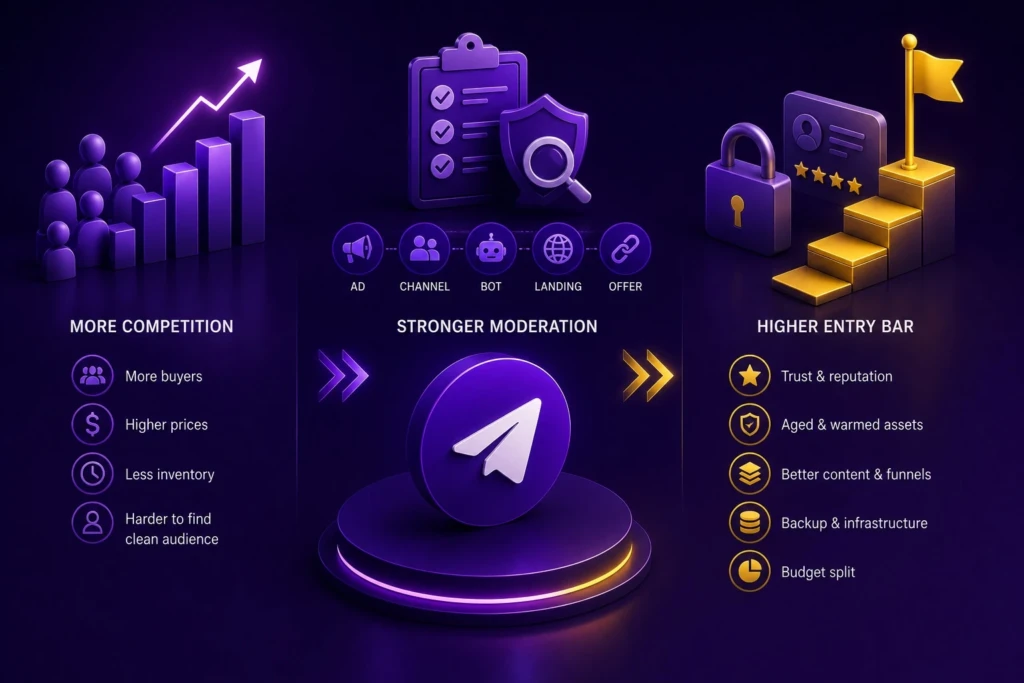
Increased competition
Competition is the obvious change.
Telegram is no longer a hidden source. Affiliate teams know it. Networks know it. Advertisers know it. Sellers, channel owners, bot builders, and traffic brokers know it. Everyone understands that Telegram can monetize attention.
That means more buyers chasing the same users.
When more buyers enter the auction or placement market, costs rise. Clean channels become more expensive. Quality placements get booked faster. Cheap audience pockets disappear. Channel admins understand their inventory value better. Users get exposed to more ads, more offers, more hype, and more recycled angles.
The result is simple: the easy arbitrage gap is smaller.
Before, you could win because you found underpriced attention. Now you need better execution. The market no longer pays beginners for just showing up.
Stronger moderation
Moderation is the second major shift.
Telegram Ads and related traffic flows are under more pressure to control what is being promoted, how users are being moved, and what happens after the click. Manual reviews, funnel inspections, landing checks, channel checks, bot checks, and suspicious redirect monitoring are becoming more important.
This is one of the biggest telegram ads problems 2026: it is no longer enough to make the ad itself look clean. The whole chain matters.
If your ad is clean but the channel is aggressive, you have a problem.
If your channel is clean but the bot pushes banned claims, you have a problem.
If your bot is clean but the final offer is risky, you have a problem.
If your bridge hides the real vertical, you have a problem.
The platform does not only look at the first visible step anymore. It can care about the full user path.
That changes everything for affiliates who built their Telegram strategy around loose funnel control.
Higher entry requirements
Telegram now requires more trust.
Fresh, empty, suspicious, or low-quality assets are riskier. Warmed channels matter more. Account reputation matters more. Clean naming, history, content quality, audience structure, and funnel consistency all matter more.
In practice, this means higher entry requirements.
You may need:
- warmed Telegram channels;
- aged accounts;
- cleaner content environments;
- better landing pages;
- stable bots;
- less aggressive claims;
- separate assets by vertical;
- stronger compliance review;
- backup infrastructure;
- budget split across multiple entities.
All of that costs money before you even buy traffic.
This is why the old idea of Telegram as a “cheap entry” source is misleading. The visible ad cost may still look manageable, but the operational cost is higher.
The real cost of Telegram traffic
The real cost of Telegram traffic is not only CPM, CPC, or cost per subscriber.
In 2026, Telegram cost includes media cost, infrastructure cost, moderation risk, asset loss, account freezes, creative testing, funnel rebuilding, compliance adaptation, and wasted spend from dead or low-quality traffic.
That is the full telegram ads ROI affiliate equation.
If you only calculate the traffic bill, your numbers are fake.
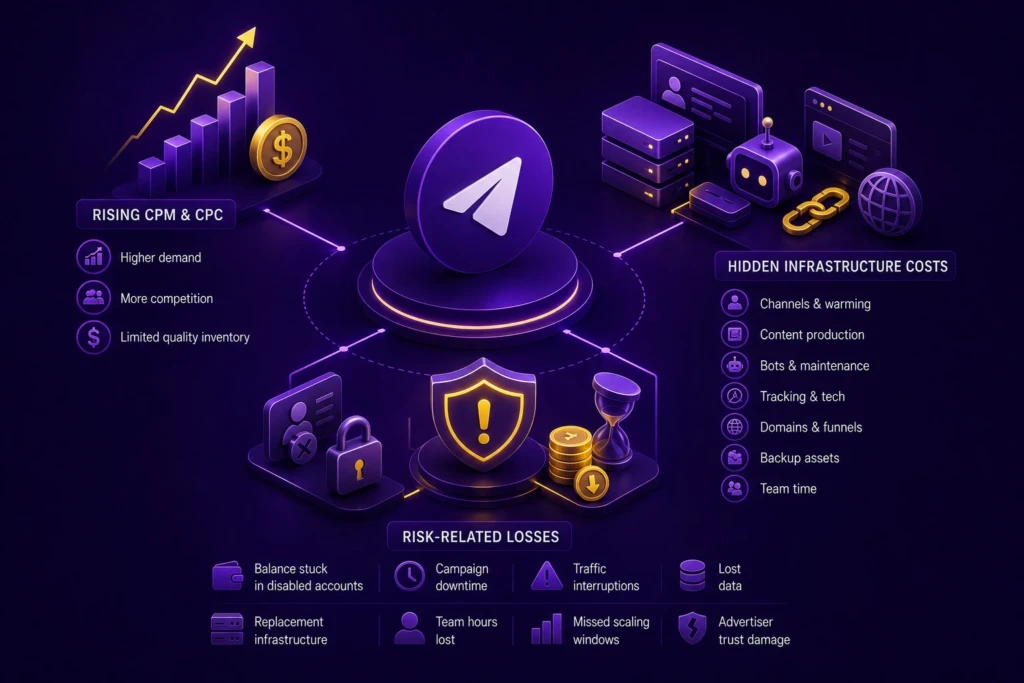
Rising CPM and CPC
CPM and CPC are rising because demand is higher and quality inventory is more limited.
Telegram audiences are not infinite. Strong placements, relevant channels, and high-response segments get crowded quickly. When multiple advertisers compete for the same attention, prices go up.
This creates a painful shift for affiliates who built their model on cheap clicks.
A funnel that worked at low CPM may die when CPM increases by 40–80%. A bot flow that looked profitable with cheap subscribers may become weak when cost per join rises. A casino or finance funnel that needs enough backend value may no longer survive if the cost of qualified traffic increases faster than approval or deposit quality.
This is where buyers start saying “Telegram became expensive.” But the deeper issue is that the source became less forgiving.
Hidden infrastructure costs
Infrastructure is one of the most underestimated costs in affiliate marketing Telegram ads.
Telegram campaigns often require more than an ad account. Depending on the setup, you may need channels, bots, content, warmed assets, tracking, bridge pages, redirects, moderation-safe pages, backup domains, account management, and operational support.
That means you pay for:
- channel creation and warming;
- content production;
- bot setup and maintenance;
- technical tracking;
- cloaking or routing logic, where allowed and compliant;
- domain infrastructure;
- moderation-safe funnel versions;
- backup assets;
- team time.
Even if your CPM looks cheap, your real cost per validated user can become high once you include infrastructure.
A buyer who ignores these costs may think the campaign is profitable while the business is actually bleeding through setup, replacement, and maintenance work.
Risk-related losses
Risk-related losses are where Telegram can get ugly.
Bans, freezes, rejected campaigns, lost balances, disabled assets, broken channels, dead bots, and interrupted funnels can destroy ROI. The media buyer may calculate traffic cost, but the finance team sees something else: lost working capital.
Risk cost includes:
- balance stuck in disabled accounts;
- campaign downtime;
- traffic interruptions;
- lost data;
- replacement infrastructure;
- team hours spent recovering assets;
- missed scaling windows;
- advertiser trust damage.
When risk is high, the real cost of traffic is always higher than the visible bid.
This is one reason telegram ads not cheap anymore is not just a complaint about CPM. It is a statement about operating economics.
Moderation and risk factors
Moderation changes the source from a simple traffic buy into a risk-managed media operation.
Affiliates who treat Telegram like a low-control dump source usually get punished. The platform expects cleaner assets, more consistent funnels, and fewer abusive patterns.
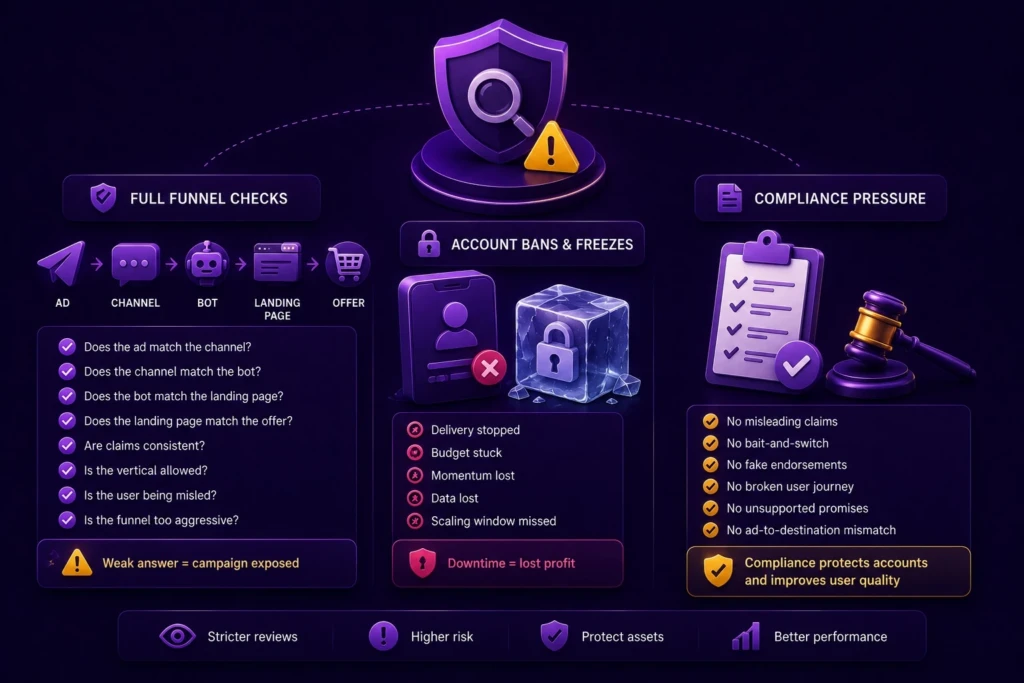
Full funnel checks
Full funnel checks are a major issue.
A campaign can fail not because the ad text is bad, but because the downstream path looks risky. The review may consider the channel, bot, landing page, redirects, offer page, and overall user experience.
This creates problems for classic affiliate flows where the first page is clean but the final offer is aggressive.
In 2026, buyers need to think like this:
- Does the ad match the channel?
- Does the channel match the bot?
- Does the bot match the landing page?
- Does the landing page match the offer?
- Are claims consistent?
- Is the vertical allowed?
- Is the user being misled?
- Is the funnel too aggressive?
If the answer is weak, the campaign is exposed.
Account bans and freezes
Account bans and freezes are not just technical issues. They are financial events.
A blocked account can stop delivery, trap budget, kill momentum, and force the team to rebuild. If the campaign was entering a profitable window, the loss is bigger than the frozen balance. You also lose time, data, and scaling continuity.
For affiliates working with fast-moving offers, downtime kills margin.
A campaign can be profitable for three days, then lose the window because the account gets frozen or the funnel gets flagged. By the time assets are replaced, the offer cap is gone, the creative is tired, or competitors copied the angle.
That is why Telegram requires risk planning before scale, not after the first ban.
Compliance pressure
Compliance pressure is becoming more serious.
This does not mean Telegram has become Facebook. It means the source is no longer a free-for-all. Risky claims, misleading funnels, fake urgency, prohibited verticals, aggressive finance promises, gambling claims, health claims, and deceptive flows can create problems.
Buyers need to clean up the basics:
- no obvious misleading claims;
- no bait-and-switch funnel logic;
- no fake endorsement;
- no broken user journey;
- no aggressive promise that the final offer cannot support;
- no mismatch between ad and destination.
Compliance is not just about avoiding bans. It also improves user quality. Cleaner funnels often pre-qualify users better, which can help backend performance.
Where money is actually lost
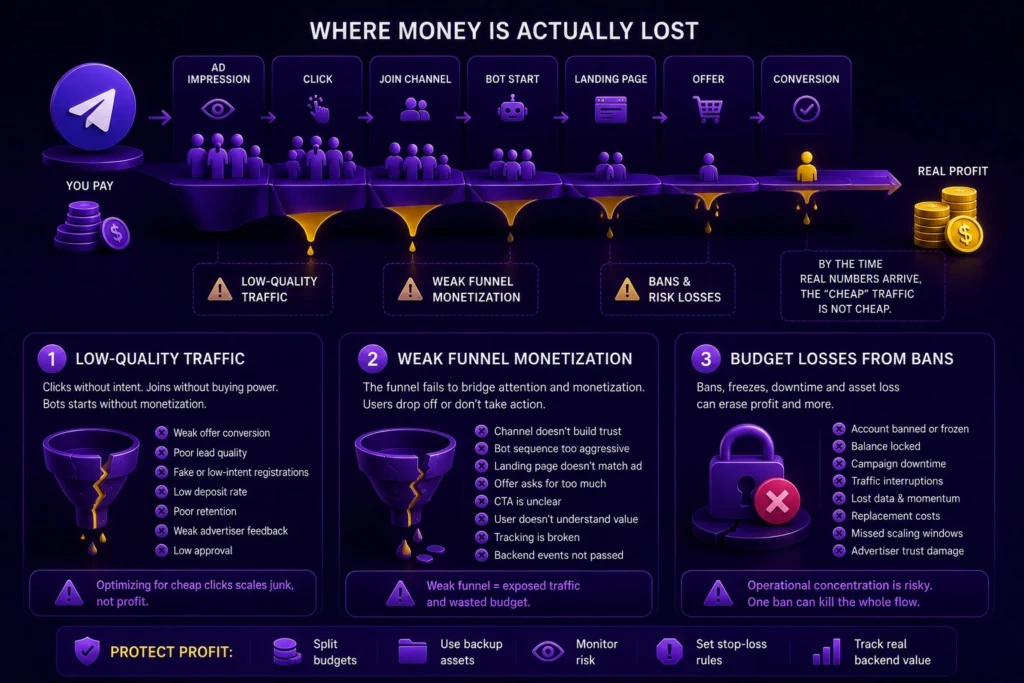
Most Telegram losses do not happen in one dramatic moment. They happen through leakage.
The buyer pays for traffic. Some users click. Some join. Some move through the bot. Some reach the offer. A smaller group converts. An even smaller group becomes valuable. Then moderation, bans, and backend quality cut more margin.
By the time the real numbers arrive, the “cheap” traffic is not cheap.
Low-quality traffic
Low-quality traffic is the first leak.
Telegram users may click out of curiosity, channel habit, or promo fatigue. A click does not mean intent. A channel join does not mean buying power. A bot start does not mean monetization.
Low-quality traffic creates:
- weak offer conversion;
- poor lead quality;
- fake or low-intent registrations;
- low deposit rate;
- poor retention;
- weak advertiser feedback;
- low approval.
If you optimize only for cheap clicks or cheap subscribers, you can scale junk very efficiently.
That is not growth. That is controlled budget destruction.
Weak funnel monetization
Telegram traffic needs a funnel that understands the source.
You cannot always send users directly to a hard offer and expect strong ROI. Telegram users often need context, trust, and warm-up. The funnel must bridge the gap between attention and monetization.
Weak funnel monetization happens when:
- the channel does not build trust;
- the bot sequence is too aggressive;
- the landing page does not match the ad;
- the offer asks for too much too soon;
- the CTA is unclear;
- the user does not understand the value;
- tracking is broken;
- backend events are not passed correctly.
Telegram is not magic traffic. If the funnel is weak, the source will expose it.
Budget losses from bans
Budget losses from bans are one of the most painful Telegram costs.
A campaign can be slightly profitable in performance terms but negative after account loss and downtime. This is especially true when balances are large, budgets are not split, or the whole setup depends on one account, one channel, one bot, or one domain.
Operational concentration is dangerous.
If one ban kills the whole flow, the setup is not scalable. It is fragile.
Professional teams protect themselves with budget splitting, backup assets, monitoring, and clear stop-loss rules. Beginners often push everything into one setup because it looks easier. Then one freeze wipes out the week.
Why cheap traffic doesn’t mean profit
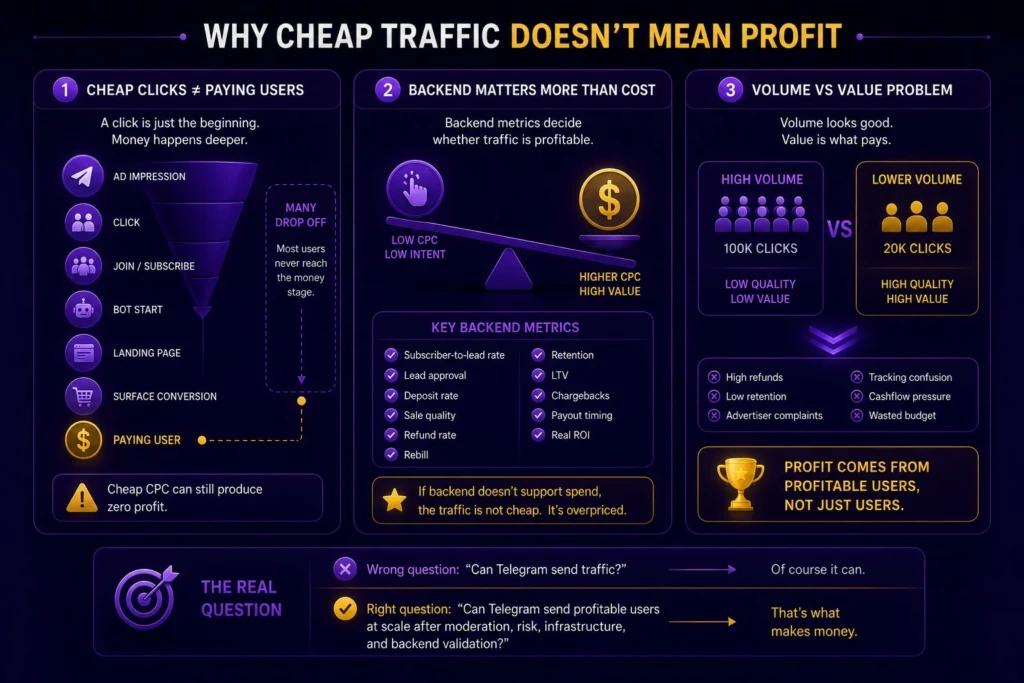
The biggest Telegram mistake is confusing cheap traffic with profitable traffic.
Cheap traffic is only useful if it creates monetized users. If the backend does not hold, cheap clicks are just cheap noise.
Cheap clicks ≠ paying users
A paying user is not the same as a clicker.
Telegram can generate clicks, joins, bot starts, and surface conversions. But the money is deeper in the funnel.
In affiliate marketing, the real value may depend on:
- approved leads;
- first deposits;
- qualified sales;
- paid subscriptions;
- repeat purchases;
- retention;
- advertiser quality score;
- LTV.
If Telegram sends users who click but do not pay, the campaign is not profitable. It is just active.
This is where many affiliates get trapped. They see cheap CPC and assume they found a source. Then the backend report shows no money.
Backend matters more than cost
Backend decides everything.
A source with higher CPC can outperform Telegram if the users approve better, deposit more, rebill longer, or refund less. A source with lower CPC can still be terrible if users are low intent.
For Telegram, backend metrics should include:
- subscriber-to-lead rate;
- lead approval;
- deposit rate;
- sale quality;
- refund rate;
- rebill;
- retention;
- LTV;
- chargebacks;
- payout timing;
- real ROI.
If these metrics do not support spend, the traffic is not cheap. It is overpriced.
Volume vs value problem
Telegram can still produce volume. The question is whether that volume has value.
A campaign can generate thousands of users and still fail because the traffic is too weak. Volume without quality creates operational noise, advertiser complaints, tracking confusion, and cashflow pressure.
The best buyers do not ask, “Can Telegram send traffic?”
Of course it can.
They ask, “Can Telegram send profitable users at scale after moderation, risk, infrastructure, and backend validation?”
That is the real question in 2026.
How to work with Telegram now
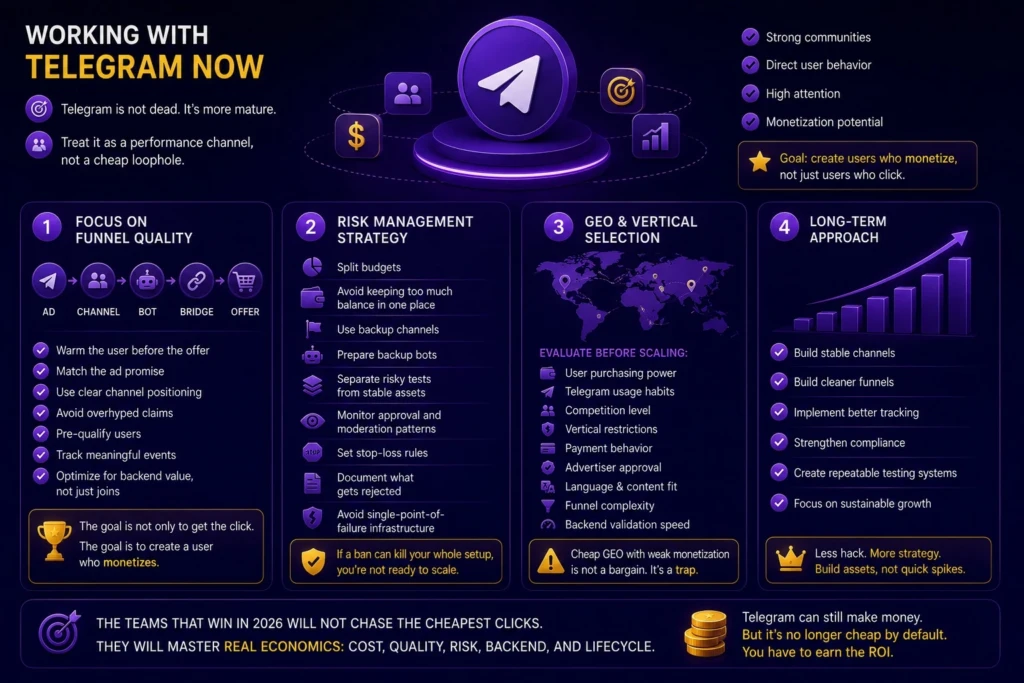
Telegram is not dead. It is just more mature.
The source still has attention, strong communities, direct user behavior, and monetization potential. But affiliates need to stop treating it as a cheap loophole and start treating it as a real performance channel.
Focus on funnel quality
Funnel quality is now mandatory.
Telegram users need a clean path from ad to value. The channel, bot, bridge, and offer must feel connected. If the user journey is broken, aggressive, or confusing, traffic quality drops and moderation risk increases.
A better Telegram funnel should:
- warm the user before the offer;
- match the ad promise;
- use clear channel positioning;
- avoid overhyped claims;
- pre-qualify users;
- track meaningful events;
- optimize for backend value, not just joins.
The goal is not only to get the click. The goal is to create a user who monetizes.
Risk management strategy
Risk management has to be built into the campaign.
This means:
- split budgets;
- avoid keeping too much balance in one place;
- use backup channels;
- prepare backup bots;
- separate risky tests from stable assets;
- monitor approval and moderation patterns;
- set stop-loss rules;
- document what gets rejected;
- avoid single-point-of-failure infrastructure.
If a ban can kill your whole operation, the setup is not ready for scale.
Telegram media buying in 2026 is partly about ROI and partly about survival.
GEO and vertical selection
Not every GEO or vertical works the same on Telegram.
Some markets are oversaturated. Some users are promo-blind. Some verticals face stronger moderation. Some offers require more trust than Telegram can deliver cold. Some GEOs have cheap clicks but poor payment behavior.
Before scaling, buyers should evaluate:
- user purchasing power;
- Telegram usage habits;
- competition level;
- vertical restrictions;
- payment behavior;
- advertiser approval;
- language and content fit;
- funnel complexity;
- backend validation speed.
A cheap GEO with weak monetization is not a bargain. It is a trap.
Long-term approach
The long-term Telegram approach is different from the old churn-and-burn model.
Instead of burning assets for short spikes, serious teams build stable channels, cleaner funnels, better tracking, stronger compliance, and repeatable testing systems.
That means Telegram becomes less of a hack and more of a channel strategy.
The teams that win in 2026 will not be the ones chasing the cheapest clicks. They will be the ones who understand Telegram’s real economics: cost, quality, risk, backend, and lifecycle.
Telegram can still make money. But it is no longer cheap by default. You have to earn the ROI.
FAQ
Are Telegram Ads still cheap in 2026?
Not in the old sense. Entry costs, CPMs, infrastructure, moderation risk, and asset replacement costs have increased. Telegram can still be efficient, but it is no longer a simple cheap traffic source.
Why are Telegram traffic costs increasing?
Costs are rising because more affiliates and advertisers are competing for the same inventory. Quality placements are more expensive, users are more saturated, and moderation makes operations more complex.
Can affiliates still make money with Telegram Ads?
Yes, but only with strong funnel control, clean tracking, risk management, and backend-focused optimization. Cheap clicks alone are not enough to produce real ROI.
What are the biggest Telegram Ads problems in 2026?
The biggest problems are higher CPM/CPC, stronger moderation, full funnel checks, account bans, frozen balances, low-quality traffic, and weak backend monetization.
Which verticals work best with Telegram traffic?
Telegram can work for community-driven, mobile-first, finance, crypto, iGaming, info, app, and subscription-style funnels, but vertical success depends heavily on GEO, compliance, offer quality, and funnel structure.
How should buyers optimize Telegram Ads now?
Buyers should optimize for backend value: approved CPA, deposits, sales quality, retention, LTV, refunds, and real ROI. They also need budget splitting, backup assets, warmed channels, and stronger funnel pre-qualification.