


Scaling TikTok ads looks simple from the outside: if a campaign works at $100/day, push it to $500, then $1,000, then $3,000. In reality, this is where many TikTok setups collapse. The campaign that looked clean on a small budget starts bleeding as soon as volume increases: CPM rises, CPC gets worse, CTR softens, conversion rate drops, lead quality gets weaker, and backend value stops supporting the spend.
The reason is simple: volume changes the system. You are not buying the same users at a higher quantity. You are entering different auction conditions, broader audience pockets, faster creative fatigue, weaker intent, and more volatile algorithmic behavior. This article breaks down why scaling kills profit on TikTok, what changes when spend grows, where money disappears, and how to build a safer TikTok scaling strategy in 2026.
Contents
- Why scaling changes everything
- What breaks when you increase spend
- Traffic quality degradation at scale
- How algorithm reacts to higher budgets
- Hidden losses during scaling
- Common scaling mistakes
- How to scale without killing profit
- FAQ
Why scaling changes everything
The biggest TikTok scaling mistake is assuming that scale is just “more of the same.” It is not. Scale changes the environment. A campaign that works on low spend may be operating inside a small, clean, responsive audience pocket. Once budget increases, TikTok has to find more impressions, more users, and more conversion opportunities. That usually means the system expands beyond the best pocket.
At $100/day, your campaign may reach users who respond quickly, click with intent, and convert at acceptable quality. At $1,000/day, the same creative may need to reach colder users, broader segments, less responsive placements, and more competitive inventory. The campaign is technically the same, but the traffic mix is different.
This is why tiktok ads scaling problems often appear after a campaign already looked validated. The buyer thinks the setup “died.” In reality, the original setup was never proven under scale pressure.

Different auction conditions
When you increase spend, you compete differently. TikTok needs to spend more budget inside the auction, and that can push your campaign into more expensive or less efficient inventory.
At low spend, the algorithm may find cheap pockets with good engagement. At higher spend, those pockets are not enough. The campaign starts touching broader auctions, competing against more advertisers, and paying more for reach.
This usually creates:
- higher CPM;
- higher CPC;
- less stable delivery;
- weaker CTR;
- more expensive testing;
- faster creative exhaustion.
A campaign with an $8 CPM at launch may move toward $12, $15, or higher during scale. If your margin is thin, that change alone can destroy profitability.
This is the first reason why scaling kills profit TikTok buyers expected to keep: the auction does not owe you the same cost at higher volume.
Different audience segments
The second shift is audience composition. More budget means the algorithm needs more people. That often means moving beyond the “clean” users who reacted first.
The first audience pocket may include people who are unusually responsive to the hook, offer, or category. They click fast. They convert fast. They make the campaign look strong. But that first pocket is not infinite.
At scale, the campaign starts reaching:
- colder users;
- less qualified users;
- lower-intent users;
- users who have seen similar angles;
- users who click but do not continue;
- users who submit weak leads;
- users who do not deposit, buy, or approve.
This is where tiktok ads volume vs profit becomes obvious. More users do not automatically mean more money. Sometimes more users simply means more weak traffic.
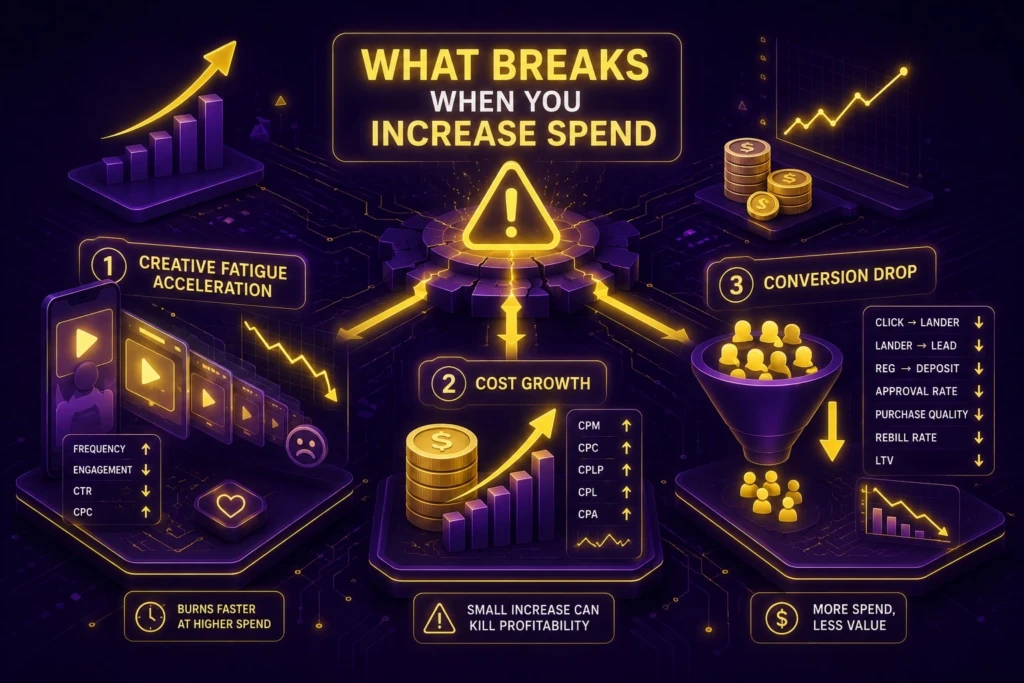
What breaks when you increase spend
Scaling exposes weaknesses that low spend can hide. A campaign can survive small volume with a mediocre creative, average funnel, or unstable offer economics. But once spend increases, every weakness gets amplified.
Creative fatigue acceleration
Creative fatigue is one of the first things to break during scale. TikTok is already a fast-fatigue platform. Higher spend makes that worse.
When the campaign spends more, the same creative gets more impressions faster. Frequency rises. Users recognize the pattern. Engagement drops. CTR softens. CPC rises. The campaign loses its edge.
This can happen even if the creative is still “new” in your account. If the structure is familiar, if competitors run similar hooks, or if you duplicated the same asset across accounts, the market may already be tired.
Scale accelerates fatigue because it compresses exposure.
A creative that could survive four days at $200/day may burn in one day at $1,500/day. That is why TikTok scaling strategy 2026 needs creative rotation built in before the scale move, not after CPA explodes.
Cost growth
The second break is cost growth. Buyers often calculate scale using old costs:
“If CPA is $20 at $100/day, maybe we can spend $1,000/day and keep the same CPA.”
That assumption is dangerous.
As budget increases, the campaign may see:
- CPM growth;
- CPC growth;
- higher cost per landing page view;
- higher cost per lead;
- higher approved CPA;
- less predictable cost by hour or day.
Even a small cost increase can kill the campaign if the payout is fixed. If your offer pays $45 and the campaign works only below $30 approved CPA, then a move from $24 to $36 approved CPA changes the setup from profitable to weak.
The problem is not only higher media cost. It is higher cost combined with weaker quality.
Conversion drop
The third break is conversion rate. Scale can reduce CR because the campaign starts reaching broader, less motivated users.
At low spend, users may click with clear interest. At high spend, more users click casually. That creates lower funnel continuation.
You may see:
- lower click-to-lander rate;
- lower lander-to-lead rate;
- lower registration-to-deposit rate;
- lower approval rate;
- weaker purchase quality;
- lower rebill rate;
- worse LTV.
This is why tiktok ads high spend low ROI is so common. The buyer sees spend growing, but the money events do not grow proportionally. The campaign scales volume faster than value.
Traffic quality degradation at scale
Traffic degradation is the silent killer of TikTok scale. The ad account may still show impressions, clicks, and conversions. But the commercial quality of those actions gets weaker.

Expansion into lower-quality traffic
TikTok’s system has to spend the budget you give it. If the highest-quality audience pocket cannot absorb the budget, delivery expands.
That expansion is not always bad. Sometimes it helps the campaign find new pockets. But in many affiliate setups, expansion reduces average user quality.
At scale, the campaign may start buying users who:
- click because the ad is entertaining;
- do not understand the offer;
- are not financially qualified;
- cannot complete payment;
- are outside the best intent segment;
- submit low-quality leads;
- fail advertiser validation.
This is the part many buyers miss. The campaign did not only become more expensive. It became less qualified.
Loss of intent
Intent is fragile on TikTok. The platform is entertainment-first, so the creative has to create and preserve intent quickly. At scale, that becomes harder because the audience gets broader.
A tight audience pocket may respond to the offer logic. A broader audience may respond only to the hook.
That distinction matters.
The buyer may still get:
- clicks;
- comments;
- raw leads;
- low CPC;
- decent engagement.
But the deeper funnel may show:
- fewer deposits;
- weaker approvals;
- poor call-center contact;
- low purchase quality;
- refunds;
- weak backend value.
This is one of the most painful affiliate marketing scaling mistakes: scaling attention instead of intent.
More noise, less value
Volume creates noise. More clicks, more leads, more data, more spend, more variation. That can make the campaign look alive while real profit gets worse.
Noise appears when:
- low-intent users enter the funnel;
- shallow conversions increase;
- backend value drops;
- buyers optimize based on blended numbers;
- weak segments hide inside average performance;
- the algorithm gets mixed signals.
A campaign can generate more total conversions and still become worse economically. That is because not all conversions have the same value.
If high spend produces more low-quality users, the dashboard may look bigger while profit gets smaller.
How algorithm reacts to higher budgets
The TikTok algorithm does not behave in a perfectly linear way when budgets change. A budget increase can affect delivery, learning, signal quality, and optimization direction.

Learning phase reset or shift
When you increase budget aggressively, the campaign may shift behavior. It may re-enter exploration, broaden delivery, or start testing new audience pockets. That does not always look like a formal “reset,” but performance can change quickly.
The buyer sees:
- unstable CPA;
- spend spikes;
- sudden CTR changes;
- weaker conversion quality;
- inconsistent hourly performance;
- different audience behavior.
This is why hard budget jumps are risky. A campaign that was stable at $200/day may become unstable at $800/day because the algorithm is forced to search outside the original efficiency zone.
Gradual increases are not magic, but they reduce shock. They give the system time to adjust without destroying the data too quickly.
Signal dilution
Signal dilution happens when strong conversion patterns get mixed with weak traffic.
At low spend, the algorithm may receive relatively clean signals: this type of user watches, clicks, lands, converts, approves, and creates value. At higher spend, broader users enter. Some click but do not convert. Some convert but do not approve. Some engage but bounce.
Now the signal gets muddy.
The campaign may optimize toward a blended pattern that no longer represents your best users. That is especially dangerous when the optimization event is shallow, such as clicks, raw leads, registrations, or low-quality conversions.
The deeper the business model, the more dangerous signal dilution becomes.
Misoptimization risk
Misoptimization happens when TikTok optimizes toward the wrong thing at scale.
If the campaign optimizes for clicks, it may find more clickers.
If it optimizes for raw leads, it may find more form-fillers.
If it optimizes for cheap registrations, it may find users who register but never deposit.
If poor-quality events are passed back as successful conversions, the system may scale poor-quality users.
At small spend, this may not look fatal. At high spend, it becomes expensive fast.
A TikTok campaign should not be scaled only because the platform event looks good. It should be scaled because the event has proven downstream value.
Hidden losses during scaling
Scaling losses are not always visible in TikTok Ads Manager. Many of them show up later in network reports, finance, advertiser feedback, refunds, approval data, or LTV.
Backend value drop
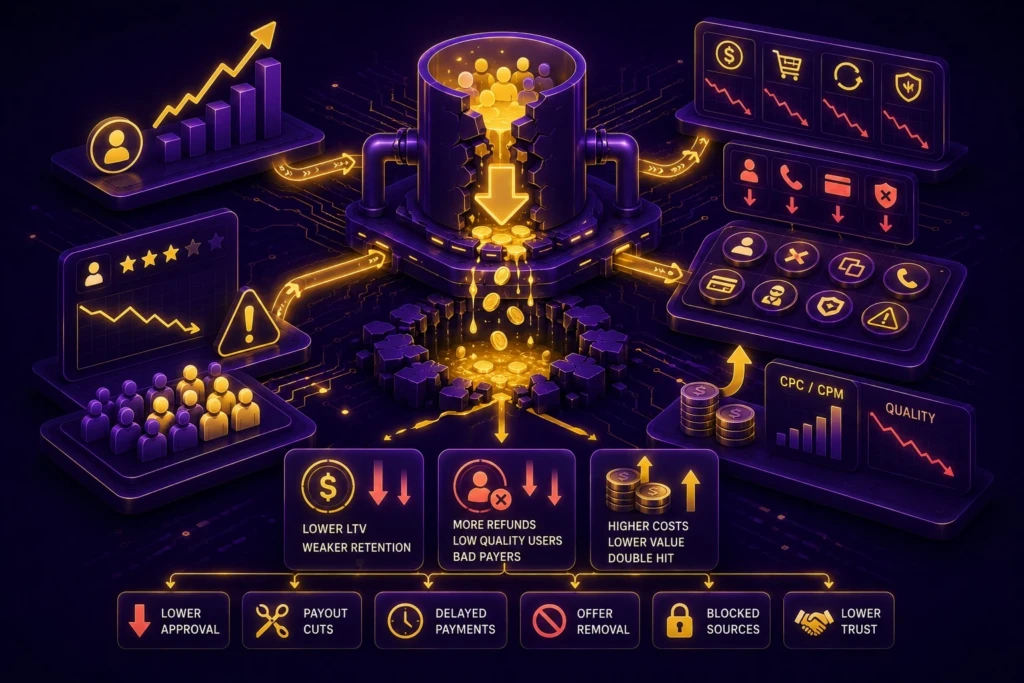
Backend value can drop as volume increases. This is one of the most important reasons why volume kills profit.
At low spend, users may approve, deposit, buy, or retain at acceptable levels. At high spend, lower-quality users enter, and backend metrics soften.
You may see:
- lower LTV;
- lower deposit quality;
- weaker purchase quality;
- fewer repeat actions;
- lower rebill;
- reduced advertiser value;
- worse retention.
The campaign may still produce front-end conversions, but those conversions are worth less.
For affiliates, this is dangerous because payout and approval changes can lag. The buyer may scale today and only discover next week that backend quality was poor.
Increased refunds / low-quality users
Higher volume often brings more weak users. Weak users create commercial problems:
- refund risk;
- chargebacks;
- fake leads;
- duplicate registrations;
- low call-center contact rate;
- bad payment behavior;
- weak KYC completion;
- poor advertiser quality score.
These issues may not show immediately in the ad account. The campaign may look like it is scaling, but the advertiser sees junk.
Sooner or later, that comes back through:
- lower approval;
- payout cuts;
- stricter caps;
- delayed payments;
- offer removal;
- blocked traffic sources;
- lower advertiser trust.
That is how high spend becomes low ROI even when front-end numbers looked acceptable.
Overpaying for weak traffic
The worst scaling loss is paying premium prices for weak users.
This happens when CPM and CPC rise at the same time user quality drops. You are not just buying worse traffic. You are paying more for it.
That creates a double hit:
- media cost increases;
- conversion value decreases.
Example:
At low spend:
- CPC: $0.35;
- lead CPA: $12;
- approval: 55%;
- approved CPA: $21.80.
At scale:
- CPC: $0.62;
- lead CPA: $20;
- approval: 35%;
- approved CPA: $57.10.
The campaign did not “scale.” It moved into a different economic reality.
Common scaling mistakes
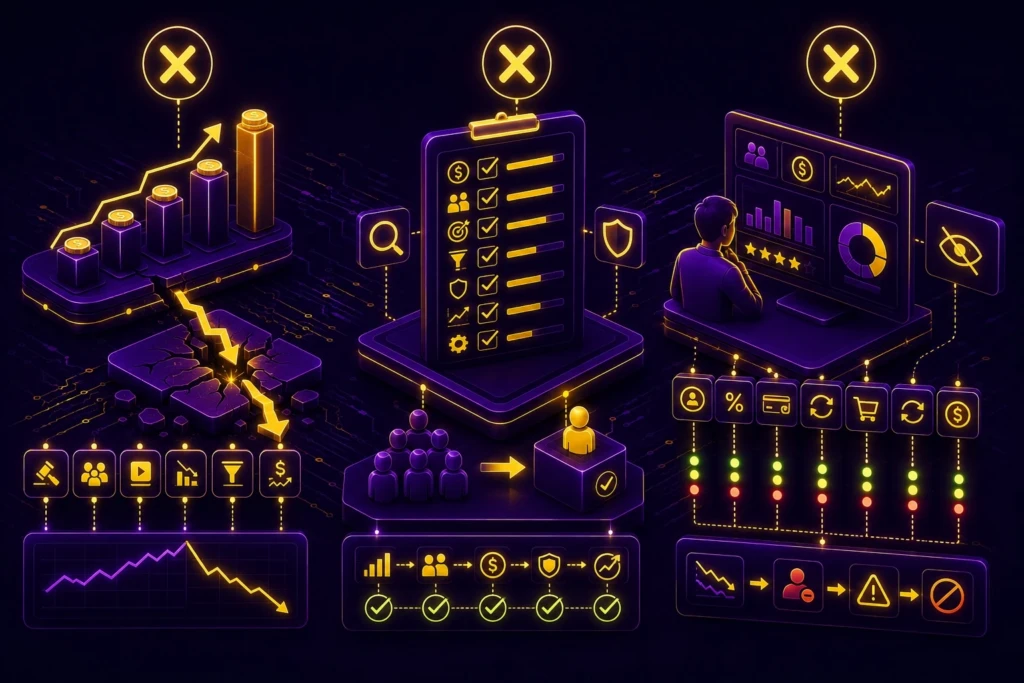
Most scaling failures come from the same behavior patterns: scaling too fast, scaling without proof, and ignoring backend data.
Scaling too fast
The classic mistake is aggressive budget jumps.
The campaign works at $150/day. The buyer pushes it to $500/day. Then $1,000/day. The next day performance collapses.
Fast scaling causes:
- auction shock;
- broader audience expansion;
- creative fatigue;
- unstable delivery;
- signal dilution;
- higher CPA;
- weaker approval.
Sometimes fast scaling works for short windows. But it is not a reliable strategy unless the campaign has deep proof, strong creative pipeline, and backend tolerance.
Most buyers scale fast because they are afraid the window will close. Ironically, aggressive scaling often closes the window faster.
Scaling unproven campaigns
A campaign is not proven because it had one good day. It is not proven because CTR is high. It is not proven because raw CPA looks decent. It is not proven because the tracker shows early green.
Before scaling, the campaign needs validation:
- enough spend depth;
- enough conversion volume;
- stable CPA;
- clean tracking;
- acceptable approval;
- deposit or sale quality;
- payout confidence;
- early fatigue check;
- funnel continuation;
- backend signal.
Without this, the buyer is scaling hope.
This is one of the most common affiliate marketing scaling mistakes: treating early signal as validation.
Ignoring backend metrics
Backend blindness kills scale. The buyer watches TikTok Ads Manager and maybe the tracker, but ignores the metrics that decide whether the campaign is actually profitable.
Critical backend metrics include:
- approval rate;
- approved CPA;
- deposit rate;
- sale quality;
- refund rate;
- rebill rate;
- LTV;
- payout timing;
- advertiser feedback;
- real ROI;
- cash received.
If backend quality drops during scale, the campaign is not healthy. It does not matter if TikTok still shows conversions.
A scaled campaign must make money after validation, not just before it.
How to scale without killing profit
Scaling TikTok ads safely does not mean being scared to spend. It means making spend earn the next level.

Gradual budget increase
Gradual scaling gives the campaign more room to adjust.
Instead of jumping from $200/day to $1,000/day, test controlled increases:
- 20–30% budget increases;
- separate scale campaigns;
- duplicated winners with clear limits;
- budget caps by performance threshold;
- review windows after each change.
The point is not to move slowly forever. The point is to avoid shocking the system before you understand how the campaign behaves under pressure.
Each spend increase should answer a question: can this setup hold quality at the next level?
Segment-based scaling
Do not scale everything blended. Segment the campaign so you can see what is actually working.
Possible segmentation:
- by creative family;
- by angle;
- by GEO;
- by audience pocket;
- by placement;
- by device;
- by funnel version;
- by offer variant;
- by account cluster.
Segment-based scaling prevents weak traffic from hiding inside averages. It helps the buyer identify which part deserves more budget and which part should be cut.
Blended scale is easy. Controlled scale is profitable.
Creative rotation strategy
TikTok scale requires a creative pipeline. Without it, spend kills the creative.
A strong rotation strategy includes:
- fresh hooks;
- different opening structures;
- multiple UGC scripts;
- different creator types;
- new proof formats;
- angle variations;
- fatigue replacements;
- backup assets ready before scale;
- separate creative testing and scale logic.
Do not wait until CTR collapses to produce new creatives. By then, the campaign is already paying for fatigue.
For every winning creative, prepare the next generation before increasing volume.
Backend-focused optimization
The final rule: scale toward money, not platform activity.
Watch:
- approved CPA;
- approval rate;
- deposit quality;
- sales quality;
- refund rate;
- rebill;
- LTV;
- payout timing;
- real ROI;
- cash received;
- backend value.
If TikTok metrics improve but backend drops, do not scale. If CTR is lower but approval is stronger, that creative may be better. If raw CPA is cheap but deposit quality is weak, the setup is not ready.
Backend-focused scaling protects the campaign from fake growth.
FAQ
Why does scaling TikTok ads kill profit?
Scaling changes auction conditions, audience quality, creative fatigue speed, and algorithm behavior. A campaign that works at low spend may start reaching weaker users at higher volume, causing CPA to rise and backend value to drop.
Why do TikTok ads perform well at $100/day but fail at $1,000/day?
At low spend, TikTok may find a clean responsive audience pocket. At higher spend, the campaign expands into broader and lower-intent traffic, which can reduce CTR, conversion rate, approval, deposits, and ROI.
What are the biggest TikTok ads scaling problems?
The biggest problems are creative fatigue, rising CPM and CPC, weaker audience quality, conversion rate drop, signal dilution, backend value decline, and scaling before the campaign is properly validated.
How fast should I scale TikTok ads?
Scale gradually. Many teams use controlled 20–30% increases, separate scale campaigns, or segmented duplication. The exact speed depends on spend depth, CPA stability, approval quality, and creative fatigue.
Should I scale based on CTR and CPC?
No. CTR and CPC are useful front-end signals, but they do not prove profit. Scale based on approved CPA, conversion quality, deposit or sale value, backend metrics, and real ROI.
How can I scale TikTok ads without losing money?
Use gradual budget increases, segment-based scaling, constant creative rotation, clean tracking, and backend-focused optimization. Do not scale campaigns that only look good on shallow front-end metrics.