

A lot of campaigns look solid at $300 a day. The creative still feels fresh, the audience pocket is clean enough, the funnel doesn’t get stress-tested too hard, and the account can carry the load without throwing weird signals. Then the buyer tries to scale, and the whole thing starts cracking. CPM goes up. CTR softens. CPA drifts. Conversion rate slips. The account gets touchier. What looked like a strong setup suddenly feels fragile.
That’s the part many buyers still misread. They think scaling campaigns in Facebook Ads is just about buying more of what already worked. It isn’t. Scale changes the environment. It changes the auction, the audience, the delivery pattern, the account stress level, and the way weak spots in the funnel show up. Read this to the end and you’ll get the real map: what actually changes when you push budget up, what usually breaks first, how to separate normal softening from real failure, and how to scale ad spend without turning a profitable setup into an expensive mess.
Contents
- What changes when you scale budget
- What breaks first when scaling
- How traffic and auction dynamics shift
- Where profit starts leaking
- How to scale without losing control
- FAQ
What changes when you scale budget
The first thing to understand is simple: scale is not just more traffic. It is a different operating mode.
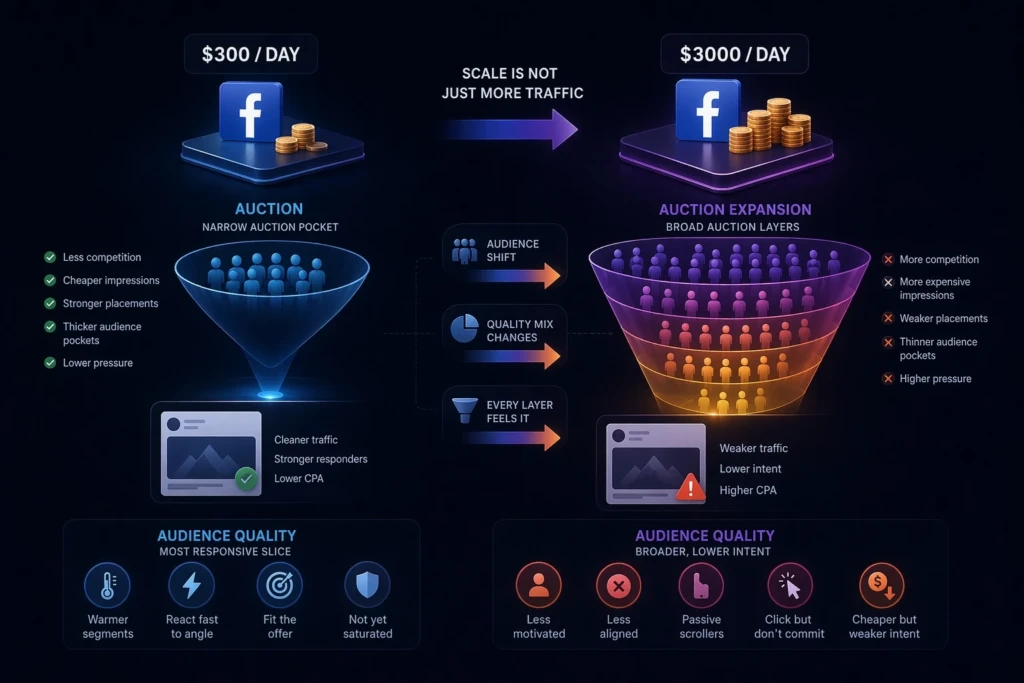
At $300 a day, Facebook can often keep you inside a relatively comfortable delivery pocket. The system has enough room to find reactive users, decent placements, and a manageable spend pace. Once you push toward $3000 a day, that comfortable pocket is not enough anymore. The platform has to widen. And widening is where the trouble starts.
Auction expansion
When you raise budget hard, you do not just buy more of the same inventory. You push into broader auction layers. That means:
- more competition
- more expensive impressions
- weaker placements
- thinner audience pockets
- higher pressure on the campaign to keep spending
This is why so many affiliate marketing scaling attempts fail. Buyers think the winning setup has “room.” What it often had was a profitable niche. That’s not the same thing.
At smaller spend, the auction can flatter you. It feeds you cleaner traffic, stronger early responders, and enough quality to keep your CPA healthy. At higher spend, the campaign has to touch users that weren’t in the first clean layer. That is where performance starts to normalize — and normalize usually means worse.
A lot of people call that “Facebook got bad.” Usually it didn’t. You just ran out of cheap, good inventory.
Audience shift
The second thing that changes is the audience itself.
At $300/day, you may still be feeding on the most responsive slice:
- warmer segments inside broad
- users who react fast to the angle
- people who fit the offer naturally
- people not yet saturated by the same hook
At $3000/day, the audience broadens whether you want it to or not. The system starts pulling in:
- less motivated users
- less aligned users
- more passive scrollers
- people who click but don’t commit
- cheaper but weaker intent segments
That’s the hidden part of how to scale ads budget: you are not only increasing spend. You are changing the quality mix of the traffic.
And once quality mix changes, every layer below it feels it.
What breaks first when scaling
This is where most buyers ask the wrong question. They ask, “Why did the campaign die?” The better question is, “Which layer failed first?”
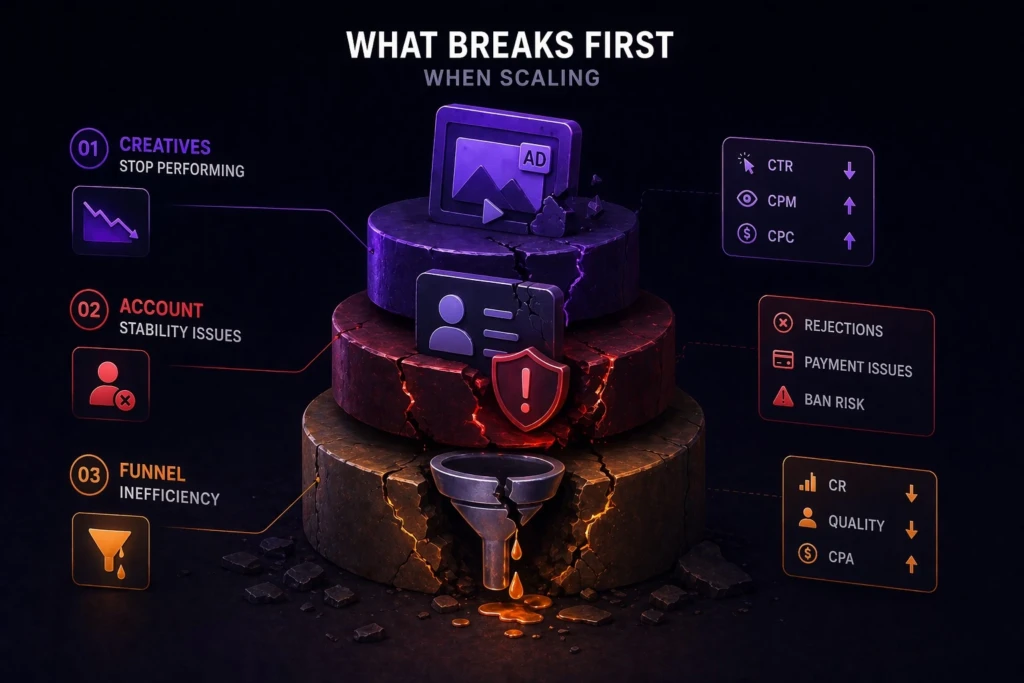
Because scale doesn’t usually destroy everything at once. It stresses the stack, and the weakest layer cracks first.
Creatives stop performing
Most of the time, creatives are the first obvious casualty.
At low spend, one strong ad can carry a setup. At higher spend, that same ad gets burned through much faster. More impressions mean:
- frequency climbs faster
- the visual loses freshness
- the hook gets over-seen
- the audience gets numb
- CTR starts slipping
This is one of the first visible signals in scaling campaigns Facebook Ads buyers miss. They think the ad is still “good enough” because it worked yesterday. But at scale, “good enough” dies fast. What held at $300/day often cannot carry ten times the pressure.
The ad doesn’t have to become bad. It only has to become less sharp. And when you’re scaling hard, even a small drop in CTR can start a chain reaction:
- CPM rises
- CPC rises
- traffic quality softens
- CPA starts drifting
That’s why creative rotation is not optional at scale. If you try to stretch one winner too far, it will punish you.
Account stability issues
The second thing that often breaks is account stability.
More spend means more scrutiny. More delivery volume, more edits, more billing load, more aggressive behavior patterns — all of that puts pressure on the business manager and account stack. What felt stable at lower spend can start acting fragile once volume rises.
Typical scaling stress points:
- accounts becoming more sensitive to edits
- learning resetting too often
- payment friction
- review delays
- ad rejections
- business manager instability
- higher ban probability
This is where a lot of people get hit during affiliate marketing scaling. They focus on the campaign and ignore the infrastructure. But scale is not only a campaign problem. It is an operational problem too.
A setup that barely holds at low volume often breaks once you ask it to behave like a real buying machine.
Funnel inefficiency
Then the funnel starts leaking harder.
At lower spend, weak funnel parts can hide. Maybe the landing page is only okay. Maybe the prelander does enough. Maybe the registration step is clunky but not fatal. At small budget, those flaws don’t always look dramatic.
At scale, they get exposed immediately.
Why? Because weaker traffic hits the funnel first. And weak traffic is much less forgiving. A funnel that converts high-intent users decently may collapse when fed broader, softer traffic.
This is where buyers misdiagnose scaling all the time. They blame Facebook when the real issue is that the funnel only worked on good traffic and had no tolerance for weaker users.
Scale doesn’t create funnel weakness. It reveals it.
How traffic and auction dynamics shift
If you want a real facebook ads scaling strategy, you need to understand the shift beneath the dashboard numbers.

Higher CPM and competition
One of the most obvious things that happens during scale is CPM growth. That should not surprise anyone. More spend means you are asking Facebook to find more impressions in a competitive market. Those extra impressions are rarely as cheap or as valuable as the first batch.
Higher spend usually means:
- broader auction exposure
- more overlap with competitive buyers
- more premium placements getting bid up
- less room for easy wins
The mistake is assuming higher CPM automatically means the campaign is failing. Not always. Sometimes higher CPM is just the cost of reaching better or broader inventory. The real issue is whether the economics still hold.
But in a lot of failed scale attempts, CPM rises while everything else softens:
- CTR down
- CR down
- CPA up
- margin gone
That is not normal scale pressure anymore. That is the setup losing control.
Lower intent audience
This is the silent killer. Once Facebook exhausts the easiest pockets, it starts feeding you users with lower intent.
Lower intent audiences tend to:
- engage more shallowly
- take longer to convert
- click out of curiosity
- bounce faster
- fail deeper in the funnel
That is why scaling often produces a weird feeling in the dashboard. Traffic volume looks fine. Click flow is alive. The campaign appears active. But money stops landing the same way.
The setup is still moving. It’s just moving weaker people through it.
This is one of the biggest reasons why scaling campaigns fail. The buyer thinks they are increasing the amount of good traffic. In reality, they are diluting the traffic mix.
Algorithm behavior change
The platform itself also changes behavior as spend rises.
At lower budgets, the optimization logic can stay relatively narrow and patient. At higher budgets, Facebook becomes more aggressive about finding room to spend. That usually means:
- broader testing
- faster expansion
- more spend allocation into adjacent pockets
- less flattering delivery behavior
This is where people start saying the algo “changed.” In a sense, it did — but not because Facebook suddenly decided to attack you. It changed because the campaign’s requirements changed.
You asked the system for more scale. It answered by widening the search radius.
That answer is exactly where the trouble lives.
Where profit starts leaking
Most bad scale attempts don’t die from one dramatic mistake. Profit leaks slowly first, then falls apart.

CPA increase
The first clean signal is usually CPA drift.
This is not always panic-worthy. Some CPA growth during scaling is normal. You are asking the campaign to move beyond its best pocket, so some softening is expected.
But there is a difference between healthy drift and bad drift.
Healthy drift:
- CPA increases modestly
- spend grows
- volume grows
- margin still works
Bad drift:
- CPA rises sharply
- volume quality gets worse
- payout efficiency drops
- margin disappears
- the campaign keeps spending anyway
This is the key reason scaling increase ad spend strategy needs guardrails. If you don’t know what CPA range is acceptable before you scale, you will always react too late.
Conversion rate drop
CR drop is where real damage gets clearer.
At scale, CR often falls because:
- lower intent users enter
- the funnel gets tested harder
- landing pages lose relevance
- the hook stops matching the traffic quality
A small CR drop can destroy economics faster than many buyers expect. Because once spend is big enough, tiny inefficiencies become very expensive.
This is the ugly math of scale:
- 10% more spend pressure
- 10% worse traffic
- 10% weaker CR
- suddenly the whole margin is gone
That is why experienced buyers obsess over funnel quality before scaling. They know a weak page is survivable at low spend and deadly at high spend.
Over-scaling mistakes
And then there’s the classic self-inflicted wound: scaling too fast.
This is where the buyer kills the campaign before the market had a chance to judge it fairly.
Common over-scaling mistakes:
- jumping budget too aggressively
- making too many edits at once
- scaling while creative is already tired
- scaling before the funnel is really stable
- scaling on shallow proof
- forcing spend into a setup with weak infrastructure
This is one of the biggest reasons why scaling campaigns fail. It’s not that the campaign had no scale. It’s that the buyer tried to pull too much too fast and snapped the whole thing.
How to scale without losing control
You cannot scale without pressure. But you can scale without losing your mind.
Gradual scaling approach
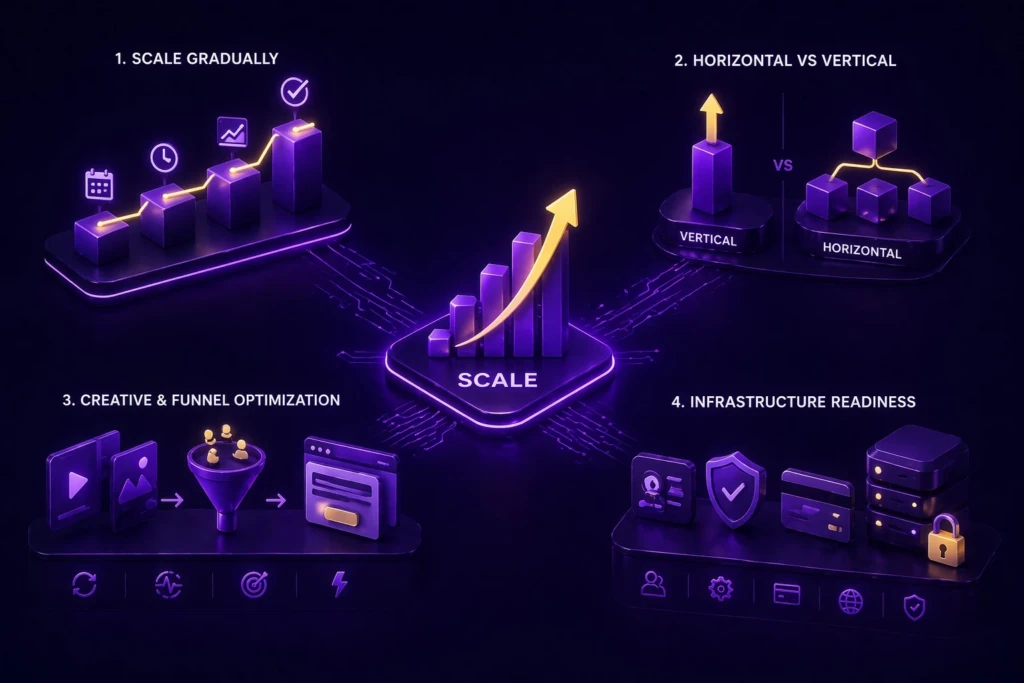
The boring approach is still the most reliable: scale gradually.
That means:
- increase spend in steps
- let the campaign settle
- watch the key metrics after each move
- know what normal softening looks like
- do not stack multiple aggressive changes together
This is not sexy advice, but it’s how serious buyers protect ROI. You don’t need dramatic jumps to scale. You need controlled pressure.
A good increase ad spend strategy is not about proving confidence. It is about protecting signal quality while the setup expands.
Horizontal vs vertical scaling
This is the classic question: duplicate or raise budget?
Vertical scaling means increasing budget on the same campaign.
Horizontal scaling means duplicating or expanding across multiple campaign structures.
Both work. Both fail when used badly.
Vertical scaling is cleaner when:
- the campaign is stable
- the creative still has room
- the funnel is strong
- the account can carry more pressure
Horizontal scaling is useful when:
- you want to reduce dependency on one asset
- you need multiple entry points into the auction
- you want to test adjacent audiences or angles
- the current campaign becomes fragile under direct pressure
A lot of good facebook ads scaling strategy comes down to mixing both. One stable campaign is not a real scale plan. It is a single point of failure.
Creative and funnel optimization
Before scaling, strengthen the machine.
That means:
- refresh creatives before they obviously die
- build variants, not one “hero” ad
- tighten the landing page
- remove friction from the next step
- improve continuation rates
- make sure the hook still lands on broader users
A setup with weak creative and average funnel quality is not ready for serious scale, no matter how pretty the small-budget numbers look.
Scale rewards strong mechanics. It punishes setups that only looked good because they were underfed.
Infrastructure readiness
This is the part a lot of buyers pretend doesn’t matter until it blows up.
If you want real affiliate marketing scaling, the infrastructure needs to be ready:
- enough account depth
- stable business manager behavior
- payment reliability
- proxy consistency
- anti-detect logic that doesn’t create extra noise
- operational discipline
You do not need a “fancy” setup. You need a stable one.
Because scale hits everything:
- the campaign
- the account
- the review system
- the billing stack
- the operator
If your infrastructure is shaky, budget growth just reveals it faster.
FAQ
What’s the first step to scaling up content production?
The first step is auditing your current workflow to identify bottlenecks and document repeatable processes. Transitioning from manual tasks to standardized templates and style guides allows for consistent quality as the team grows. Once the foundation is set, you can integrate automation tools and outsource specific production stages effectively.
Should I do a campaign budget or an ad set budget?
Choose Campaign Budget (CBO) to let algorithms automatically distribute funds to the best-performing sets, which is ideal for scaling and saving time. Select Ad Set Budget (ABO) if you need manual control to test specific audiences or ensure equal spending across different segments. CBO is generally better for overall efficiency, while ABO is superior for initial testing and research.
How fast should I scale ad spend?
Fast enough to grow, slow enough to keep signal quality intact. If the campaign starts changing shape too quickly, you are moving too hard.
What breaks first when scaling campaigns?
Usually creatives, then traffic quality, then the funnel economics. Account stability often becomes a problem too once spend pressure rises.
How can you scale your advertising without losing quality?
To scale without losing quality, increase budgets incrementally by 10-20% every 48 hours to avoid resetting the learning phase. Broaden your audience targeting through Lookalike audiences and interest expansion to prevent creative fatigue. Continuously refresh ad creatives and monitor Key Performance Indicators (KPIs) to ensure the Return on Ad Spend (ROAS) remains stable during the expansion.
How do you scale without losing ROI?
Scale gradually, watch CPA and CR closely, rotate creatives early, strengthen the funnel, and make sure the infrastructure can actually handle higher pressure.