


Some affiliate teams get stable results not because they have magic creatives or secret offers, but because their campaign structure does not fight against them. They know what each campaign is supposed to prove, how much budget it can burn, which audience it is testing, which creatives belong inside it, and when the setup should be killed, duplicated, or scaled. The structure gives the buyer control before the data gets noisy.
Most buyers do the opposite. They launch too many things into one messy account, mix tests with scaling campaigns, judge creatives across dirty audiences, and then wonder why performance becomes impossible to read. That is not “Facebook being random.” That is a bad operating system. This article breaks down how top teams structure campaigns, why the setup matters as much as the angle, and how to build a cleaner affiliate marketing campaign setup that improves testing, scaling, and decision quality.
Contents
- Why campaign structure matters
- Core elements of a strong campaign setup
- How top teams organize testing
- Scaling structure and budget control
- Where most setups fail
- How to build a proper campaign structure
- FAQ
Why campaign structure matters
Campaign structure is not just account hygiene. It is how a media buying team controls risk, isolates signal, and decides what deserves more money. A clean structure helps you understand what worked and why. A messy structure makes everything look like a mystery.
A lot of buyers treat campaign setup as a technical step before the “real” work starts. Top teams treat it as part of the strategy. They understand that the way campaigns are arranged affects learning, budget flow, creative fatigue, audience overlap, CPA drift, and the speed of decision-making.
Chaos vs system
A chaotic setup usually looks active from the outside. There are many campaigns, many ad sets, many creatives, constant edits, and endless tests. The buyer feels busy. The dashboard moves. The team has things to discuss every day.
But activity is not structure.
Chaos usually means:
- tests and scaling campaigns are mixed together
- one campaign is trying to answer five questions
- naming is inconsistent
- budgets are changed emotionally
- old creatives keep running because nobody owns cleanup
- audience segments overlap without intention
- bad tests stay alive because nobody defined kill rules
- campaign history is impossible to read two weeks later
That kind of setup can still produce lucky wins. But it cannot produce repeatable learning. Every result becomes hard to interpret because too many variables are moving at once.
A structured setup is different. Each campaign has a clear job. One campaign tests a new angle. Another validates an audience. Another scales a proven combination. Another protects a stable winner. That separation is what makes data readable.
Impact on performance and scaling
Structure directly affects ROI because it affects how fast a team can cut waste and protect winners. If you cannot tell whether CPA rose because of creative fatigue, weak audience quality, budget pressure, or offer approval issues, you will fix the wrong thing. And fixing the wrong thing is expensive.
At small budgets, messy structure is annoying. At scale, it becomes dangerous. A setup spending $200/day can survive some confusion. A setup spending $3,000/day cannot. At higher spend, every wrong decision gets multiplied. A creative that should have been killed yesterday burns more. An ad set that should have been separated pollutes the campaign. A scale campaign that should have stayed stable gets edited too often and loses signal.
That is why facebook ads campaign structure matters so much for affiliate teams. The structure does not guarantee profit, but it gives the team a cleaner way to protect signal and control downside.
Core elements of a strong campaign setup
A strong campaign setup is built around separation. Top teams separate objectives, audiences, creatives, budgets, and decision rules. They do not let one messy campaign carry the whole test logic.

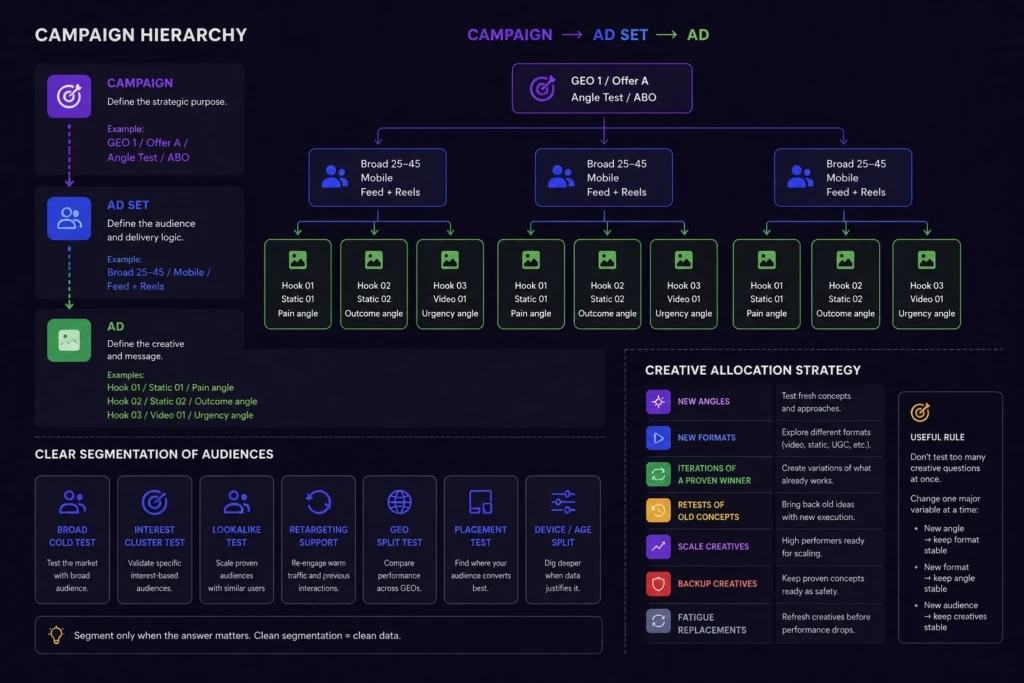
Campaign hierarchy: campaign → ad set → ad
The basic hierarchy is simple, but most teams still misuse it.
At campaign level, you define the strategic purpose. Is this a test? A validation campaign? A scale campaign? A retest? A backup version? A new GEO launch?
At ad set level, you define the audience and delivery logic. This is where segmentation should stay clean. If an ad set contains too many audience assumptions, the result becomes harder to read.
At ad level, you define the creative and message. This is where the team tests hooks, formats, visuals, openings, proof elements, and emotional angles.
A clean hierarchy might look like this:
- Campaign: GEO 1 / Offer A / Angle Test / ABO
- Ad set: Broad 25–45 / Mobile / Feed + Reels
- Ad: Hook 01 / Static 01 / Pain angle
- Ad: Hook 02 / Static 02 / Outcome angle
- Ad: Hook 03 / Video 01 / Urgency angle
This sounds basic, but it changes everything. If the campaign has a clear role, the ad set has a clear audience, and the ad has a clear creative variable, the buyer can actually understand the result.
Clear segmentation of audiences
Audience segmentation is where many buyers create fake data. They mix broad, interest, lookalike, retargeting, and GEO variants inside unclear structures. Then they compare performance as if the setup were clean.
Top teams separate audience logic intentionally.
For example:
- broad cold test
- interest cluster test
- lookalike test
- retargeting support
- GEO split test
- placement test
- device or age split, if needed
They do not over-segment for no reason. They segment only when the answer matters. If broad works best, they keep broad clean. If an interest cluster needs validation, they isolate it. If a GEO behaves differently, they separate it before it distorts the average.
The point is not to create 50 ad sets. The point is to know what each segment is proving.
Creative allocation strategy
Creative allocation is one of the biggest differences between amateur setups and professional media buying structure.
Bad teams throw creatives into campaigns randomly. They mix five angles, three formats, and recycled assets into one ad set, then decide “the offer is bad” after two days.
Top teams allocate creatives by testing logic.
They usually separate:
- new angles
- new formats
- iterations of a proven winner
- retests of old concepts
- scale creatives
- backup creatives
- fatigue replacements
A useful rule: do not test too many creative questions at once. If you are testing a new angle, keep the format stable. If you are testing format, keep the angle stable. If you are testing audience, do not change all creatives at the same time.
The goal is not perfect science. This is affiliate, not a lab. But you still need enough control to avoid lying to yourself.
How top teams organize testing
Testing is where top teams make their money before the winner appears. Not because every test works, but because every test teaches something clean.

Controlled testing environments
A controlled testing environment does not mean slow. It means the buyer knows what is being tested, what budget is allowed, and what result is needed.
A good test campaign usually has:
- one main offer
- one GEO or clearly separated GEOs
- one traffic source
- limited audience variables
- clear creative batches
- fixed starting budget
- defined kill rules
- clean naming
- daily review logic
This protects the team from the most common test mistake: changing too much too quickly. If you launch a new offer, new GEO, new lander, new creative style, new audience, and new account structure all at once, you are not testing. You are gambling with a dashboard.
Top teams isolate enough variables to understand the signal. They may move fast, but they do not move blind.
Budget allocation for tests
Test budgets need discipline. Too little budget gives fake negatives. Too much budget burns money before the setup deserves it.
A practical test framework might look like this:
- Micro test: $50–$150 to check if the angle has any pulse
- Validation test: $300–$700 to check CPA, CTR, CVR, and early lead quality
- Pre-scale test: $1,000–$2,000 to check stability, approval, and fatigue speed
The exact numbers depend on GEO, payout, CPM, and funnel depth. But the logic is always the same: each budget stage must answer a specific question.
Bad teams spend randomly. They give $800 to weak tests because the buyer “feels something,” then underfund a promising campaign because yesterday’s cashflow was tight. Top teams define budget buckets before emotion gets involved.
Fast iteration cycles
Speed matters, but only if the team iterates from clean data. Fast chaos is not an advantage.
Top teams move quickly in cycles:
- Launch controlled test.
- Read early signal.
- Kill obvious losers.
- Identify the strongest variable.
- Produce variations.
- Retest.
- Move stable winners into validation or scale.
The key is that creative, buying, and analytics move together. If the buyer sees a strong hook but the designer gets feedback three days later, the team loses the edge. If the analyst sees approval dropping but the buyer keeps scaling, the team burns money. If the owner changes budget without waiting for the test cycle, the data gets polluted.
A real affiliate marketing workflow is not just launching ads. It is a feedback loop.
Scaling structure and budget control
Scaling is where structure gets tested. A bad setup can look fine during testing and fall apart the moment spend increases.
Horizontal vs vertical scaling
Top teams usually use both horizontal and vertical scaling, but they do not use them randomly.
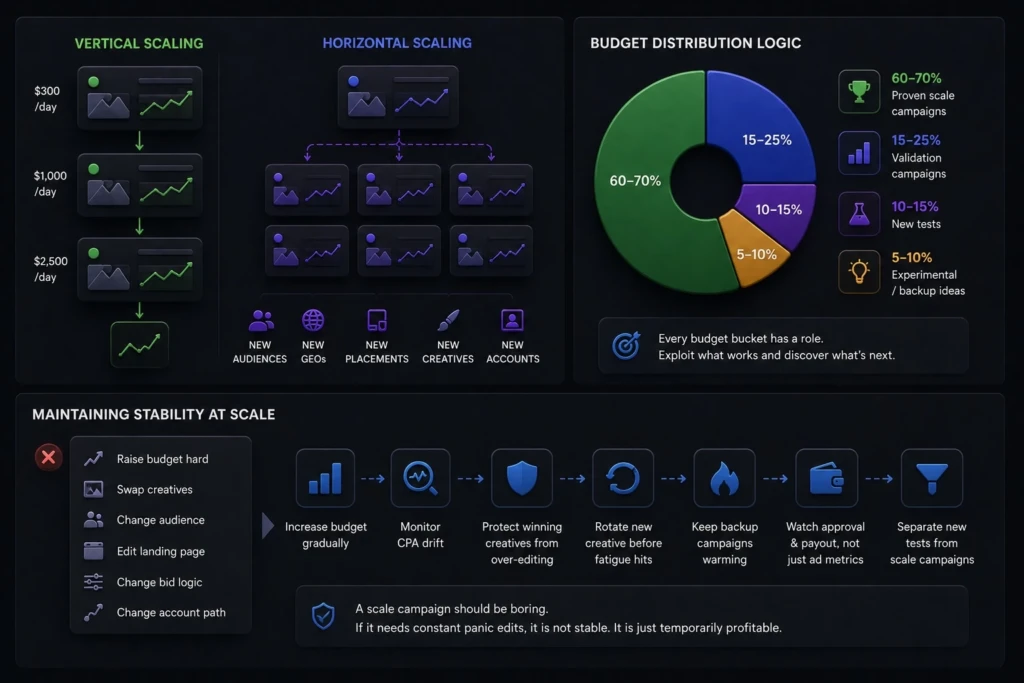
Vertical scaling means increasing budget on a working campaign. It is cleaner when the campaign is stable, the creative still has room, and the account can handle more pressure.
Horizontal scaling means duplicating or expanding the setup across new campaigns, audiences, accounts, GEOs, placements, or creative variants. It is useful when direct budget increases create instability or when the team wants multiple entry points into the auction.
A common mistake is pushing vertical scaling too hard because it feels simple. A campaign runs at $300/day, then gets pushed to $1,000/day, then $2,500/day, and suddenly CPA explodes. The buyer says “the campaign died.” In reality, the structure was never built to absorb that pressure.
A better approach is controlled layering: increase some budget vertically, duplicate some winners horizontally, and keep new tests separate from scale assets.
Budget distribution logic
Budget distribution should follow campaign purpose.
A simple structure could be:
- 60–70% to proven scale campaigns
- 15–25% to validation campaigns
- 10–15% to new tests
- 5–10% to experimental sources or backup ideas
The exact split changes by team maturity. A younger team may need more test budget. A mature team with strong winners may put more into scale. But the important part is that every budget bucket has a role.
Bad teams let weak tests consume scale money. Or they overprotect old winners and starve new testing. Both mistakes create fragility.
Top teams understand that scale requires cash allocation discipline. You need enough money to exploit what works and enough money to discover what works next.
Maintaining stability at scale
Stability at scale comes from not touching everything at once. If a campaign is working, top teams avoid stacking aggressive changes.
They do not:
- raise budget hard
- swap creatives
- change audience
- edit landing page
- change bid logic
- change account path
…all at the same time.
Because if performance drops, nobody knows what caused it.
A stable scale process looks more like this:
- increase budget gradually
- monitor CPA drift
- protect winning creatives from over-editing
- rotate new creative before fatigue is obvious
- keep backup campaigns warming
- watch approval and payout, not just ad metrics
- separate new tests from scale campaigns
A scale campaign should be boring. If it needs constant panic edits, it is not stable. It is just temporarily profitable.
Where most setups fail
Most campaign structures do not fail because the buyer is stupid. They fail because the setup creates bad information.
Overcomplicated structures
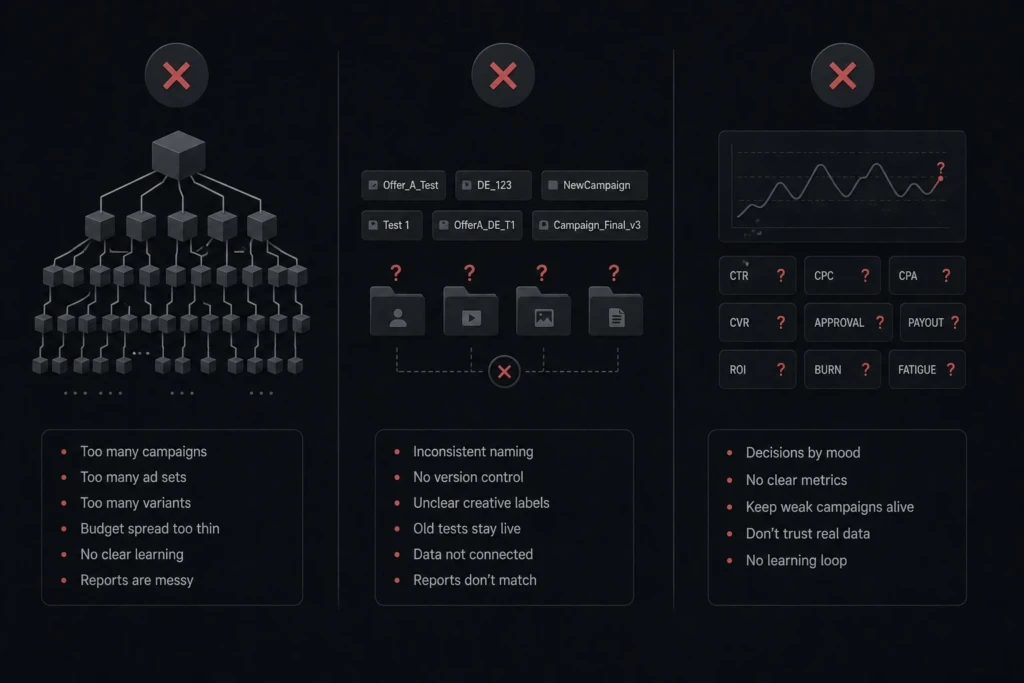
Overcomplication is a common fake-professional mistake. The account has too many campaigns, too many ad sets, too many duplicated variants, too many naming systems, and too many half-dead tests.
The buyer thinks complexity means control. It usually means noise.
Overcomplicated structures create problems:
- budget gets spread too thin
- learning never stabilizes
- weak assets survive unnoticed
- reporting becomes slow
- creative comparison gets messy
- buyers optimize tiny samples
- account history becomes unreadable
A clean setup is not always simple, but it is understandable. If no one can explain why each campaign exists, the structure is already too bloated.
Lack of consistency
Consistency is boring, which is why many buyers ignore it. But it is essential.
Without consistent naming, test rules, budgets, creative labels, audience logic, and reporting, the team loses internal memory. Every review becomes slower. Every mistake becomes easier to repeat.
Examples of inconsistency:
- one buyer names campaigns by offer
- another names them by GEO
- creatives have no hook labels
- landers are not versioned
- old tests are not archived
- approval data is not connected back to campaign names
- reports do not match ad account structure
This is how teams forget what they already learned. They keep moving, but the knowledge does not compound.
No data-driven decisions
The final failure point is decision-making by mood. A buyer likes a creative. The owner likes an offer. The AM says the vertical is hot. The team keeps a campaign alive because it “almost worked.” None of that is enough.
Top teams still use intuition, but they make final calls from numbers:
- CTR
- CPC
- CPA
- CVR
- approval rate
- payout speed
- real ROI
- account burn
- creative fatigue
- test-to-winner ratio
If the team has data but does not use it to make decisions, the data is decoration.
How to build a proper campaign structure
A proper structure does not need to be complicated. It needs to be repeatable.

Standardizing campaign setup
Start with templates. Not because templates are exciting, but because they remove avoidable chaos.
Standardize:
- naming format
- campaign purpose labels
- test budget levels
- ad set audience logic
- creative labels
- lander version names
- kill rules
- scale rules
- reporting fields
For example:
GEO_Offer_Source_Objective_Stage_Date
is already more useful than:
new test 3 final copy good
Good naming is not cosmetic. It is operational memory.
Defining roles and responsibilities
Campaign structure is not only inside the ad account. It is also inside the team.
Clear ownership should exist for:
- launch setup
- creative upload
- naming quality
- tracking QA
- budget approval
- daily review
- approval reconciliation
- scale decision
- archive cleanup
If everyone can edit everything and nobody owns final quality, the setup will decay. Top teams make it clear who can launch, who can scale, who can kill, and who audits the result.
Tracking and analytics integration
A campaign structure is only useful if analytics can read it. That means the tracker, ad account, network, and internal sheet should speak the same language.
At minimum, connect:
- campaign name
- ad set name
- creative ID
- lander ID
- offer ID
- GEO
- source
- spend
- conversions
- approval
- payout
- real ROI
If approvals are not connected back to campaign and creative level, the team is flying half-blind. A creative that produces cheap leads but bad approval is not a winner. A campaign with good CPA but delayed payout may not be as strong as the dashboard says.
Continuous optimization process
Finally, structure needs maintenance. Campaign organization is not a one-time setup. It is a living process.
Top teams review:
- what to kill
- what to scale
- what to duplicate
- what to retest
- what to archive
- what to turn into a template
- what to stop repeating
This is how the workflow improves over time. Every campaign should either make money or produce reusable learning. If it does neither, it is waste.
FAQ
What is the best affiliate campaign structure?
The best affiliate campaign structure separates testing, validation, and scaling campaigns. It keeps audiences, creatives, and budgets clean enough to understand what is working and why.
How should I structure Facebook Ads campaigns for affiliate marketing?
Start with clear campaign purpose, clean audience segmentation at ad set level, and controlled creative batches at ad level. Do not mix too many variables in one campaign if you want readable data.
Why do affiliate campaigns become unstable when scaling?
They usually become unstable because budget increases push the campaign into broader audiences, faster creative fatigue, higher CPMs, and more delivery pressure. Bad structure makes that instability harder to control.
Should I use horizontal or vertical scaling?
Use both, but for different reasons. Vertical scaling works when a campaign is stable and can absorb more budget. Horizontal scaling helps spread risk across duplicates, audiences, accounts, GEOs, or creative variants.
How much budget should go to testing?
It depends on the team, but many setups work better when test budget is separated from scale budget. A common split is 10–15% for new tests, 15–25% for validation, and most of the rest for proven campaigns.
What is the biggest campaign setup mistake?
The biggest mistake is mixing too many variables and then trusting the result. If you change offer, GEO, creative, audience, lander, and budget at the same time, you cannot know what actually caused performance to move.