

Affiliate marketing looks simple from the outside. Buy traffic, push it into an offer, get paid, scale what works. That’s the fantasy version. In real media buying, the money does not just go into traffic and come back as payout. It leaks into testing, infra, accounts, tools, failed launches, approval drag, hold periods, team mistakes, and all the boring operational stuff nobody wants to count when they’re staring at a green tracker.
That is exactly why so many “profitable” setups still end up red by the end of the month. On paper, the buyer sees spend and revenue. In reality, the business is carrying a much heavier cost stack: anti-detect, proxies, trackers, spy tools, account supply, design work, QA, staff time, reload losses, payment friction, and test burn that never made it into the final dashboard screenshot. This article breaks that down properly. By the end, you’ll see where affiliate marketing hidden costs actually sit, why affiliate marketing is expensive even when the campaign looks alive, and how to calculate real economics instead of dashboard cosplay.
Contents
- Why affiliate marketing costs are underestimated
- Traffic-related hidden costs
- Infrastructure and tool expenses
- Team and operational costs
- Where profit disappears unnoticed
- How to track and control costs
- FAQ
Why affiliate marketing costs are underestimated
The main reason people misread affiliate economics is simple: they count the visible numbers and ignore the rest. They see ad spend leave the account and they see revenue show up in the tracker or network. Everything in between gets mentally compressed into “just operations.” That shortcut kills margin.

Simplified profit perception
A lot of buyers still think in this format:
Spent $2,000 → made $2,800 → profit = $800
That’s not profit. That’s a draft. Maybe a bad one.
Because the real question is not just what you spent on media and what the network says you generated. The real question is what it took to generate that result, how much of that revenue survives approval, how long it sits in hold, and what extra costs were necessary to keep the machine alive.
Let’s say a campaign shows:
- ad spend: $2,000
- tracker revenue: $2,800
- visible ROI: 40%
Looks decent. But now add:
- tracker + spy tools: $120
- proxies + anti-detect share: $95
- accounts burned during testing: $180
- creative production allocation: $140
- payment friction / top-up fees: $60
Now your real cost is $2,595, not $2,000. That means your real profit is not $800. It’s $205. Same campaign. Very different business.
That is the core reason affiliate marketing expenses get underestimated: the visible P&L is cleaner than the actual one.
Ignoring non-obvious expenses
The second issue is that a lot of costs feel too small to matter individually, so teams ignore them. That is a mistake. In affiliate, death by a thousand cuts is a very real thing.
Examples of “small” costs that quietly wreck margin:
- extra domains
- cloaker fees
- server renewals
- failed card top-ups
- banned accounts
- account warm-up inventory
- test creatives that never scale
- designer revisions
- QA time
- delayed reloads
- communication overhead with AMs and teams
None of those items looks dramatic alone. But together, they can easily eat 10–25% of what looked like clean campaign profit. That is why costs in affiliate marketing need to be counted at business level, not just ad account level.
Traffic-related hidden costs
Traffic is still the biggest line item, but even inside traffic, the cost is usually much higher than people admit.
Testing budgets
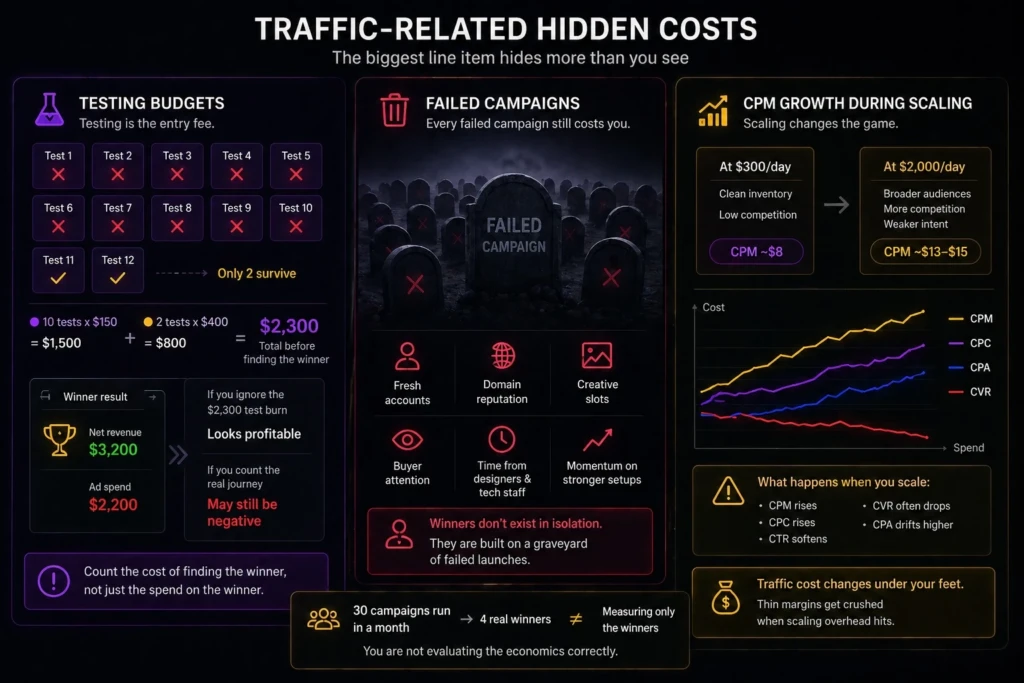
Testing is not optional. It is the entry fee. And a lot of buyers still treat test budgets like they are somehow separate from “real” campaign cost. They are not. Test money is real money.
If you launch 12 angles and only 2 survive, the other 10 did not disappear from the P&L just because they were “tests.” They are part of the acquisition cost of finding a winner.
Example:
- 10 tests at $150 each = $1,500
- 2 promising tests scaled further at $400 each = $800
- total before finding the “winner” = $2,300
Now imagine the “winner” later makes $3,200 in net revenue on $2,200 ad spend. If you ignore the prior $2,300 burn, the setup looks profitable. If you count the real journey, it may still be negative overall.
That is why affiliate marketing profit calculation has to include the cost of discovering the winner, not just the spend on the winner itself.
Failed campaigns
Failed campaigns are not just unlucky outcomes. They are recurring business expenses. If you are actively buying traffic, you are actively paying for setups that won’t hold.
And the cost is not limited to ad spend. A failed campaign can also burn:
- fresh accounts
- domain reputation
- creative slots
- buyer attention
- time from designers and tech staff
- momentum on stronger setups you didn’t prioritize
This is where the fantasy version of affiliate breaks apart. People talk about winning campaigns as if they exist in isolation. They don’t. They exist inside a graveyard of failed launches that financed the learning process.
A team that runs 30 campaigns in a month and gets 4 real winners is not evaluating the economics correctly if it only measures those 4 winners.
CPM growth during scaling
The next hidden cost comes after things start working. Scaling changes traffic economics fast. CPMs rarely stay flat when spend grows. Cheap launch conditions often disappear the moment the campaign tries to become a real business.
At $300/day, a setup may sit in a clean pocket of inventory. At $2,000/day, it’s touching broader audience bands, more competitive placements, and weaker intent users. That means:
- CPM rises
- CPC rises
- CTR softens
- CVR often drops
- CPA drifts higher
So even when the campaign “works,” the traffic cost is changing under your feet. A setup with $8 CPM at launch may be running at $13–$15 CPM after scale. If your margin was thin to begin with, scaling overhead inside media cost alone can flatten the whole thing.
That is one of the main reasons why affiliate marketing losses often appear after the setup looked validated.
Infrastructure and tool expenses
This is the part many beginners massively underestimate. They think infra is a side note. It isn’t. In some verticals, infra can be the difference between a strong month and a fake one.

Anti-detect and proxies
Anti-detect and proxies are not one-time purchases. They are recurring operating costs. If you run multi-account setups, geo-specific environments, or higher-risk verticals, this category becomes a permanent tax on the business.
A realistic monthly stack can include:
- anti-detect browser: $50–$200
- proxy spend: $100–$500+
- extra residential or mobile routing for special setups
- replacement costs when environments burn
- config time and management overhead
Individually these may feel manageable. But if a team is running several buyers and several environments, this can become a four-figure monthly cost surprisingly fast.
Trackers and spy tools
People love talking about the tracker as if it is just a nice-to-have dashboard. It isn’t. It is infrastructure. Same with spy tools, landing-page tools, automation stacks, and analytics helpers.
A typical monthly tool burden might include:
- tracker subscription
- spy platform
- hosting / CDN
- landing page builder or custom deploy tooling
- link management or redirect tools
- funnel analytics
- workspace subscriptions
This can easily land in the $300–$1,000+ range depending on how serious the operation is. And the important part is this: these tools do not stop billing just because your campaigns had a bad week.
Accounts and consumables
Accounts are one of the most painful hidden line items in paid traffic affiliate. People know they cost money, but they rarely count the full burn rate honestly.
Real account-related costs include:
- purchasing or renting accounts
- warming them up
- failed accounts before launch
- spend limits slowing deployment
- BM instability
- bans during tests
- backup account inventory
- replacement cycles
Say you spend $40–$80 average cost per usable account path, and you burn through 15–20 in a month across tests, rejects, and scaling pressure. That alone can add $600–$1,600 of cost that never shows up in the media dashboard.
That is why affiliate marketing hidden costs are so deadly: they live outside the place most buyers stare at.
Team and operational costs
Once a team grows beyond solo buying, cost structure gets more complicated very fast.
Media buyers and staff costs
Salary is not just salary. It’s salary plus errors plus coordination plus process drag.
A real affiliate operation may carry:
- media buyers
- designers
- developers / tech support
- farmer / account support
- data / ops staff
- team lead or owner review time
Even if you’re lean, payroll is still part of campaign economics. If a buyer spends half the week pushing weak setups, those salaries are indirectly subsidizing loss.
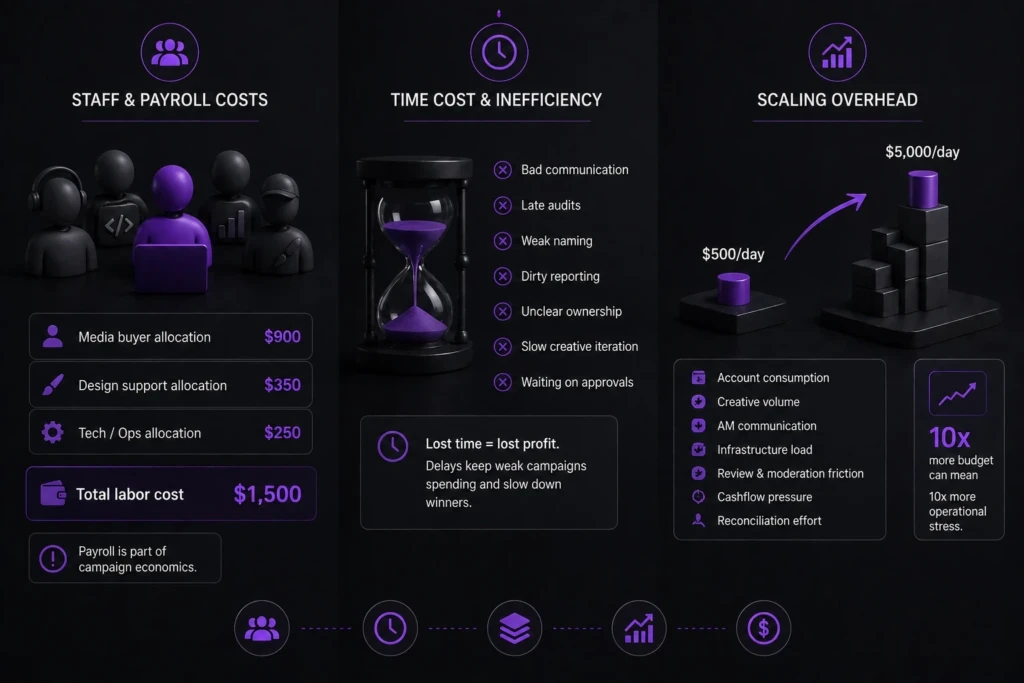
Example:
- buyer cost allocation to campaign cluster: $900
- design support allocation: $350
- tech / ops allocation: $250
That is $1,500 of labor cost before you even discuss whether the campaigns actually held.
Time cost and inefficiency
Time is not an abstract cost in affiliate. It is a margin cost. Slow reaction kills money.
Every day lost to:
- bad communication
- late audits
- weak naming structure
- dirty reporting
- unclear ownership
- slow creative iteration
- waiting on approvals internally
…is a day where weaker campaigns keep spending and stronger campaigns scale slower than they should.
A team can absolutely be “good at traffic” and still be mediocre at operations. When that happens, money disappears through delay, not through obvious mistakes.
Scaling overhead
Scale always introduces overhead. More budget means more complexity, more assets, more monitoring, more replacement work, more QA, more volatility.
Things that get more expensive when you scale:
- account consumption
- creative volume
- customer support / AM communication
- infrastructure load
- review and moderation friction
- cashflow pressure
- reconciliation effort
That means the jump from $500/day to $5,000/day is not just 10x more media. It is often 10x more management stressand a noticeably higher operational cost stack.
Where profit disappears unnoticed
This is the dangerous section, because this is where campaigns keep looking “fine” while the margin is already rotting underneath.
Small losses across funnel
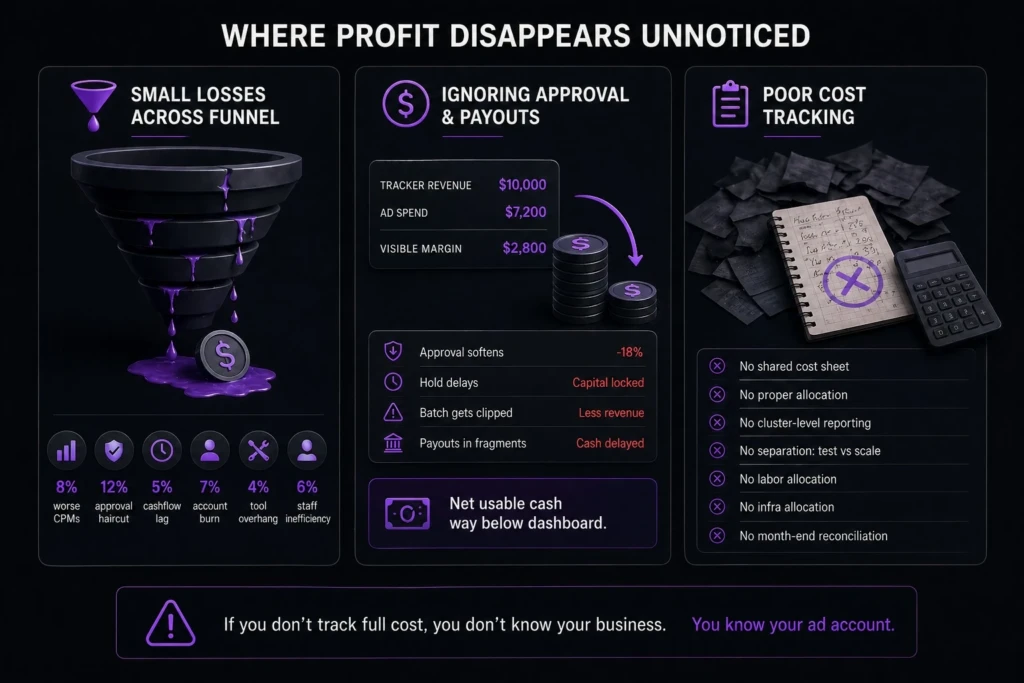
A lot of affiliate losses are cumulative. Not one big blow-up. Just constant small leaks:
- 8% extra media cost from worse CPMs
- 12% approval haircut
- 5% payout lag impact on cashflow
- 7% extra account burn
- 4% tool overhang
- 6% staff inefficiency
Each one feels survivable. Together they can erase the whole month.
That is why so many buyers say things like, “The campaign looked okay, but somehow the month wasn’t strong.” The somehow is usually stacked leakage.
Ignoring approval and payouts
This is still one of the biggest affiliate marketing losses no one wants to fully respect. Revenue in the tracker is not cash. Approval rate matters. Hold matters. Payout timing matters.
A campaign can show:
- tracker revenue: $10,000
- ad spend: $7,200
- visible margin: $2,800
Then reality hits:
- approval softens by 18%
- hold delays capital recycling
- one batch gets clipped
- payout arrives in fragments
- net usable cash is way below what the dashboard implied
Now the setup that looked comfortably profitable is barely carrying itself.
Poor cost tracking
And then there is the simplest leak of all: bad bookkeeping. No shared cost sheet. No proper allocation. No cluster-level reporting. No separation between test burn and scale burn. No labor allocation. No infra allocation. No honest month-end reconciliation.
If you do not track full cost, you do not know your business. You know your ad account.
That is not enough.
How to track and control costs
The fix is not sexy. It is operational discipline.

Full cost accounting
Start by counting everything, not just ad spend.
Your cost model should include:
- media spend
- testing burn
- accounts
- proxies
- anti-detect
- tracker
- spy tools
- hosting / domains
- creative production
- salaries / team allocation
- payment friction
- failed setup waste
If a campaign only looks good when half the cost stack is hidden, it is not a good campaign.
Tracking real profit
Stop asking whether ROI is green and start asking whether money is real.
A better approach is:
Real Profit = Approved or Collectible Revenue – Full Cost
Not:
- raw tracker revenue
- same-day optimism
- “it should approve later”
- “this tool cost doesn’t matter”
A campaign deserves respect only when it survives full cost accounting.
Budget allocation strategy
Control starts with allocation. Do not let weak tests consume the same oxygen as promising setups. Split budgets clearly:
- exploration budget
- validation budget
- scale budget
- reserve / recovery budget
That way, when a test cluster burns $1,200, it doesn’t quietly corrupt the economics of a scale cluster that was actually working.
Optimization and cost reduction
Cost control is not just about cutting things. It is about cutting the right things.
Real improvements usually come from:
- faster kill decisions on weak tests
- cleaner naming and reporting
- fewer useless tool subscriptions
- better creative hit rate
- better account hygiene
- tighter communication between buyer, design, and ops
- reducing infra waste
- scaling only after cleaner proof
The goal is not to become cheap. The goal is to become economically honest.
FAQ
What are hidden costs in affiliate marketing?
Hidden costs are all the expenses that go beyond ad spend. They include testing budgets, paid tools, anti‑detect and proxies, account purchases, design work, hosting, domain fees, payout friction and team labour—all of which quietly impact your affiliate marketing expenses.
Why does affiliate marketing feel expensive even when ROI looks good?
Because ROI on a tracker ignores many real costs. A campaign can show 30 % ROI but still lose money once you factor in approval drops, holds, infra spend, staff time, account churn and the costs of testing failed angles. That’s why affiliate marketing is expensive despite decent-looking dashboards.
How much should I budget for testing in affiliate marketing?
Testing is a core expense in affiliate marketing. Set aside funds for multiple losing campaigns before you find a winner. The amount depends on your geo and traffic source, but budgeting several hundred dollars per test sequence is normal if you want reliable profit calculations.
Which tools and infrastructure do I need, and how much do they cost?
You need a paid tracker, reliable hosting/landing page infrastructure, proxies, anti‑detect solutions, and often spy tools. These subscriptions can add a few hundred dollars per month to your affiliate marketing budget. Without them, you risk losing money from poor tracking, slow landing pages and banned accounts.
How do I calculate real costs and profit in affiliate marketing?
To calculate real affiliate marketing costs, add up ad spend plus testing losses, tool subscriptions, anti‑detect and proxy fees, account costs, creative production, team salaries and payment fees. Then subtract that total from approved or collectible revenue—not just what your tracker shows—to get an accurate affiliate marketing profit calculation.
Can you be profitable if your payout is low but your hidden costs are controlled?
Yes. Low-payout offers can be more profitable if approval is higher and expenses are tightly managed. Profit depends on net revenue after approval, minus all hidden costs. By controlling infrastructure spending and maintaining a strong approval rate, low payout offers can outperform high-payout ones.