

In 2026, Facebook ad account bans feel harsher for one reason: Meta is not looking at one mistake anymore. It is evaluating a system of signals. Payment instability, unusual account behavior, repeated edits, aggressive delivery patterns, policy-sensitive creatives, and attempts to push through enforcement all stack together. Meta’s own help materials explicitly point to unusual payment or account activity, failed or disputed payments, high-risk payment activity, policy violations, and ad review re-checks after launch as real restriction triggers.
That is why even old, previously stable accounts are no longer “safe.” Aged assets still get restricted when the surrounding setup becomes noisy, inconsistent, or too aggressive. If you read this to the end, you will get four practical things: a clearer view of what signals actually lead to bans, the difference between visible causes and real underlying causes, a framework for spotting weak points in your setup before Meta does, and a more realistic way to reduce ban risk without pretending any one trick can make you invisible. Meta’s own support flow for restricted accounts and review requests makes clear that enforcement is ongoing, automated, and reversible only in some cases after review.
Contents
- How Facebook detects risky accounts in 2026
- Behavioral triggers that lead to bans
- Technical signals behind account suspensions
- Creative and content-related risks
- Where most accounts fail without noticing
- How to reduce ban risk in practice
- FAQ
How Facebook detects risky accounts in 2026
Meta’s anti-fraud logic works like a scoring system, not like a single trapdoor. That is the first thing most buyers still misunderstand. The platform does not need one dramatic violation to restrict an account. It can combine signals from payment activity, account behavior, delivery patterns, review history, and policy exposure. Meta’s published support and restriction pages repeatedly refer to unusual account activity, unusual payment activity, failed or disputed payments, and repeated review-related enforcement as restriction factors.

Multi-layer risk evaluation
In practice, the risk model is multi-layered. There is the behavior layer: how the account acts, how fast it changes, how aggressively it scales, how often it edits. There is the technical layer: whether the operating environment looks coherent over time. And there is the billing layer: whether payment behavior looks normal, stable, and believable. Meta does not publish a full scoring matrix, but its own help content is clear enough to support this conclusion: accounts get restricted when several signals begin to look abnormal together.
This is why many bans feel “unfair” from the buyer’s side. The buyer sees one live campaign and one recent creative change. Meta sees a broader pattern: changed billing behavior, a fresh round of significant edits, a jump in spend, and a higher-risk review profile. That gap between what the buyer notices and what the system scores is where most confusion starts.
AI-driven moderation systems
Meta’s ad review is heavily automated. The company explicitly says its ad review system checks ads for violations of its Advertising Standards, and also says an ad may not be reviewed against all policies before it starts delivering impressions. That matters because it means approval is not the final verdict. Ads can go live, spend, and then get re-reviewed later if additional signals accumulate.
This is one of the biggest ban mistakes in 2026: assuming approval equals safety. It does not. Approval only means the ad passed the review stage it saw at that moment. If delivery behavior, user feedback, account signals, or policy interpretation change later, the asset can still be restricted. That is why the current environment feels stricter. The system is not only evaluating ads before launch. It is evaluating patterns after launch too.
Behavioral triggers that lead to bans
Most account bans are not caused by one bold move. They are caused by a sequence of actions that starts looking less and less natural.

Abnormal activity patterns
Meta’s help center language around unusual account activity is deliberately broad, but broad is enough here. When the platform says unusual account or payment activity can trigger restrictions, that includes behavior spikes that do not match the account’s prior history. Sudden changes in spend, bursts of asset creation, strange login patterns, or a sharp shift in account rhythm all fit that logic.
This is where a lot of buyers get caught. They think only policy-sensitive verticals get flagged. In reality, normal offers can still get restricted if the account behaves like a compromised or unstable asset. In 2026, behavior alone can be enough to move an account from “trusted” to “needs scrutiny.”
Rapid changes in campaign settings
Frequent edits are one of the clearest overlooked triggers. Meta states that significant edits can restart the learning phase, affect delivery, and cause the ad set to re-enter learning. It also says editing certain details can trigger re-review. That means aggressive optimization is not neutral. The more often you touch the campaign, the more instability you inject into both delivery and review exposure.
This is a major ban pattern in practice. Buyers panic, edit too much, and create the exact account profile they should be avoiding: unstable, reactive, inconsistent, always in motion. In many 2026 restriction cases, the ban does not start with the creative. It starts with the buyer behaving like the setup is on fire.
Account usage inconsistency
The platform also cares about scenario consistency. If the same account behaves one way for weeks and then suddenly starts acting like a different operator took over, risk rises. Meta’s support materials on unrecognized activity and compromised business portfolios make this point indirectly: suspicious activity that does not align with typical account behavior should be treated as serious.
That means stable patterns matter. A setup that logs in differently, edits differently, spends differently, and pays differently all at once is much easier to flag than a setup that changes one thing at a time.
Technical signals behind account suspensions
Technical conflict is where many buyers still hide behind the phrase “the algorithm banned me.” In reality, a lot of bans are infrastructure bans.

Fingerprint mismatches
Meta does not publish a public fingerprint checklist, so no one credible should pretend they know its internal device model in detail. But you do not need the exact checklist to understand the risk. If an account’s identity signals become unstable across sessions, environments, or usage patterns, the account becomes harder to trust. That is fully consistent with Meta’s published language around unusual activity and restricted account troubleshooting.
This is why anti-detect is not a safety guarantee. If the rest of the environment is incoherent, anti-detect does not solve the trust problem. It can even deepen it by making the setup look engineered rather than normal.
Proxy and GEO inconsistencies
Proxy conflict is not “bad” because proxies are inherently forbidden. It is bad because inconsistency is risky. If login geography, payment geography, operational behavior, and account history do not line up in a believable way, the setup creates friction. Meta’s help text does not publish a proxy blacklist, but its repeated references to unusual account activity and suspicious behavior make the logic clear.
This is one of the main technical ban triggers in 2026: IP behavior that does not match the rest of the account story. Not every mismatch gets you banned instantly. But enough mismatch, combined with other noise, absolutely raises the probability.
Device and environment conflicts
Device-level conflicts work the same way. If the account is being used across inconsistent hardware scenarios, unstable environments, or conflicting operational patterns, that becomes part of the trust picture. Again, Meta does not publish a buyer-facing device risk sheet. But its support framework on restricted assets and suspicious activity is enough to support the practical conclusion: environment coherence matters.
The professional takeaway is simple: a clean setup does not mean “fancy.” It means believable, stable, and low-conflict.
Creative and content-related risks
This is the block many buyers still underestimate because it looks softer than payments or device issues. It is not softer.

Reused creatives and patterns
Meta explicitly lists evading enforcement as a policy violation and says attempts to recreate disapproved or restricted advertising through new assets are not allowed. That matters because repeated creatives are rarely risky in isolation; they become risky when they start looking like a pattern used to brute-force around review outcomes.
This is one of the main 2026 ban reasons. Not “the same creative exists twice,” but “the setup is repeating patterns across accounts, pages, or entities in a way that looks engineered.” If you mass-clone what worked yesterday, you are often not scaling. You are creating a pattern Meta can score more easily.
Policy-sensitive elements
Meta’s review system is especially sensitive when creatives sit close to policy boundaries. Its ad review system exists specifically to check compliance with Advertising Standards, and it states clearly that an ad can be reviewed again after launch. That makes policy-sensitive themes more dangerous than they used to be, because getting through initial review no longer means much on its own.
This includes obvious high-risk areas, but it also includes softer cases where the ad tone, promise structure, or visual framing pushes too close to restricted territory. The visible trigger may look like “account disabled.” The real trigger is usually that the creative was already living too close to the edge.
Aggressive messaging and promises
The more manipulative the message, the more dangerous the setup. Overpromising, hard pressure, disguised compliance workarounds, and heavy-handed selling language all raise the probability of review friction. Meta’s policy violation examples do not always call this out in one simple phrase, but the enforcement logic is consistent: misleading or evasive patterns are not tolerated, and review can happen again after delivery starts.
In practical terms, many 2026 bans start with a message that tried to be too clever. The buyer thinks the trick is subtle. The system thinks the pattern is familiar.
Where most accounts fail without noticing
This is the most important block in the article because it is where buyers usually lose the account before they realize the account is in danger.

Invisible technical errors
A large share of bans are preceded by technical instability that does not look dramatic at first: environment mismatch, billing inconsistency, repeated edits, or suspicious activity that seems minor in isolation. These errors are dangerous precisely because they do not feel like “ban reasons” to the operator. They feel like ordinary workflow. Meta’s own support ecosystem treats them seriously.
Overconfidence in “trusted” accounts
One of the biggest mistakes in 2026 is still blind faith in aged accounts. Old accounts can absolutely still get banned. In fact, overconfidence is one of the most expensive triggers because it makes buyers sloppier. They start assuming history will protect them from current noise. It will not. Meta’s restriction and review systems do not exempt an account just because it used to be stable.
The professional rule is this: trust is conditional, not permanent. The account is only as safe as the current setup around it.
Ignoring system signals
Most bans do not arrive out of nowhere. There are usually small signs first: review friction, repeated learning resets, delivery inconsistency, payment issues, or support prompts around unusual activity. Meta’s own documentation on learning phase resets, ad review, payment restrictions, and restricted accounts shows that the system gives clues before it shuts the door.
This is where operators fail quietly. They treat warnings as operational noise. Then the account gets disabled and they act surprised.
How to reduce ban risk in practice
You cannot eliminate ban risk. But you can stop feeding it.
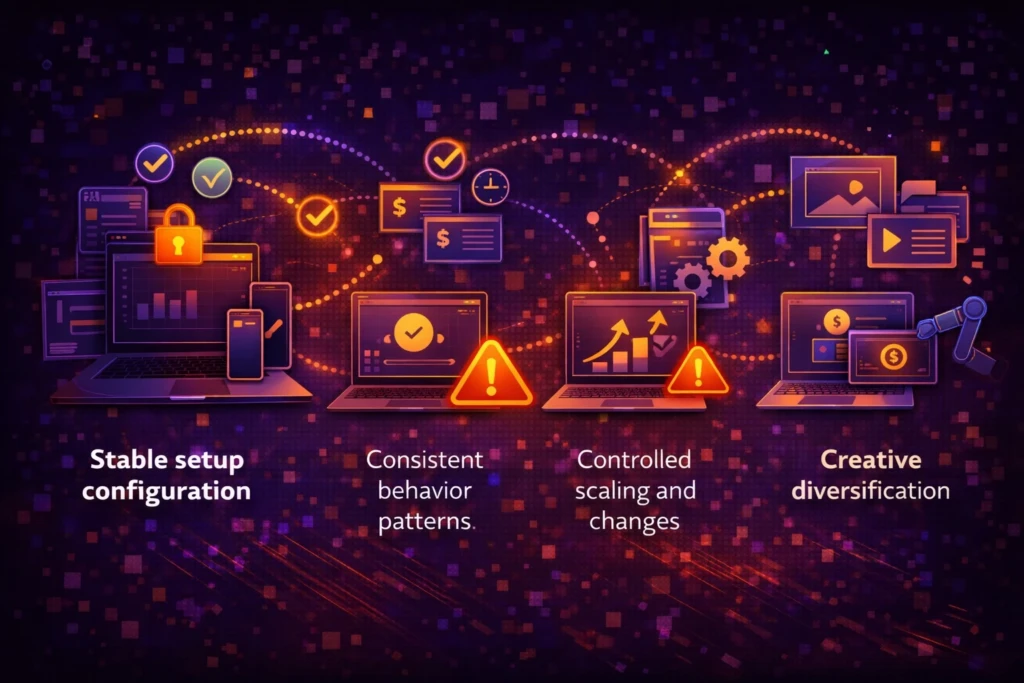
Stable setup configuration
Start with the obvious: reduce conflict. Keep the environment coherent, keep the billing profile stable, and do not create unnecessary mismatch between login behavior, operating environment, and account history. Meta’s own support and suspicious-activity materials strongly support this approach.
A clean setup is not magic. It is just lower noise.
Consistent behavior patterns
Accounts get safer when the operator acts like a normal operator. Stable edits, stable rhythm, stable usage, stable payments. If the account constantly shifts shape, risk rises. Meta’s learning phase and significant-edit guidance already show that frequent edits and repeated restarts create instability in delivery. In practice, they also create instability in trust.
Controlled scaling and changes
Most accounts are not killed by scaling itself. They are killed by reckless scaling. Sudden spend jumps, too many concurrent edits, or rapid campaign changes create exactly the kind of pattern that looks risky in 2026. If you need to scale, do it gradually and keep the rest of the setup quiet.
Creative diversification
Creative diversification is no longer only a performance tactic. It is a compliance and pattern-risk tactic too. Build creative families, not clone farms. Variation lowers the chance that the system reads your asset structure as repetitive or evasive. Meta’s policy examples around evading enforcement make this point very clearly.
FAQ
Why do Facebook ad accounts get banned instantly in 2026?
Instant bans usually happen when several risk signals appear at once: unusual account activity, suspicious payment behavior, policy-sensitive creatives, or patterns that look like enforcement evasion. Meta explicitly says unusual payment or account activity can trigger advertising restrictions.
Can old Facebook ad accounts still get banned?
Yes. Old or previously stable accounts are not protected if the current setup becomes noisy, inconsistent, or risky. Meta’s review and restriction systems still apply to aged accounts, and restricted accounts can be reviewed only after the fact.
What are the most common Facebook account suspension reasons now?
The most common reasons are not one single violation, but a cluster: unusual activity, failed or disputed payments, aggressive edits, repeated re-review exposure, and policy or enforcement issues. Meta’s own help pages point directly to these categories.
Why does Facebook ban accounts even after ads were approved?
Because approval is not final. Meta says ads may not be checked against all policies before they start delivering, and previously approved ads can be reviewed again later, especially if there is negative feedback or new risk signals.
Is anti-detect enough to avoid Facebook ads restrictions?
No. Anti-detect does not solve the bigger problem if your setup still looks inconsistent through behavior, payments, device use, or GEO logic. In 2026, Meta is evaluating systems of signals, not one technical tool in isolation. This is an inference from Meta’s unusual-activity and restricted-account guidance.
How can I tell if my Facebook ad account is at risk before a ban?
The usual early signs are delivery instability, repeated learning resets after edits, payment friction, review delays, rejected ads, or warnings tied to unusual activity. Meta confirms that significant edits can affect delivery and that unusual account or payment activity can lead to restrictions.
What is the biggest Facebook ban trigger in 2026?
The biggest trigger is not one action. It is accumulated risk: unstable behavior, unstable billing, and risky creative patterns at the same time. That is why many bans feel sudden from the buyer side even though the system has likely been scoring the account for a while. This is an inference supported by Meta’s restriction, review, and enforcement documentation.
How do I reduce Facebook ad account ban risk in practice?
The highest-value basics are still the same: keep the setup technically stable, avoid sharp behavior changes, keep billing clean, make controlled edits, scale gradually, and diversify creatives instead of cloning the same pattern. Meta’s help pages on restrictions, significant edits, and evasion support this approach.