

Most people do not stay beginners because affiliate marketing is impossible. They stay beginners because they keep solving the wrong problem. They think the gap between amateur and pro is access to a better spy tool, a bigger budget, a private offer, or some “hidden” traffic hack. Those things can help, but they are not the real difference.
The real difference is how the operator thinks, tests, tracks, loses, and scales. A beginner wants proof fast. A pro wants clean signal. A beginner watches CTR and tracker ROI. A pro watches approved value, payout timing, funnel quality, and full cost. A beginner treats every loss like bad luck. A pro turns losses into a system. This article breaks down what actually changes between a beginner and a professional affiliate, which skills matter, where beginners usually burn money, and how to move from random buying to a repeatable media buying process.
Contents
- How beginners approach affiliate marketing
- How pros think and operate
- Key differences in decision-making
- Where beginners lose money
- What actually changes with experience
- How to move from beginner to pro
- FAQ
How beginners approach affiliate marketing
Beginners usually enter affiliate marketing with a simple picture in mind: pick an offer, copy a working angle, launch traffic, get conversions, scale. That logic is not totally wrong, but it is dangerously incomplete. The part they miss is that the money is not made by launching. The money is made by reading what happens after launch and making the right decision faster than the budget disappears.
A beginner often thinks the main question is: “What should I launch?” A pro thinks the better question is: “What exactly am I trying to prove with this launch, and how much am I allowed to spend before the answer is clear?”
That difference sounds small. In practice, it changes everything.
Focus on tools and hacks
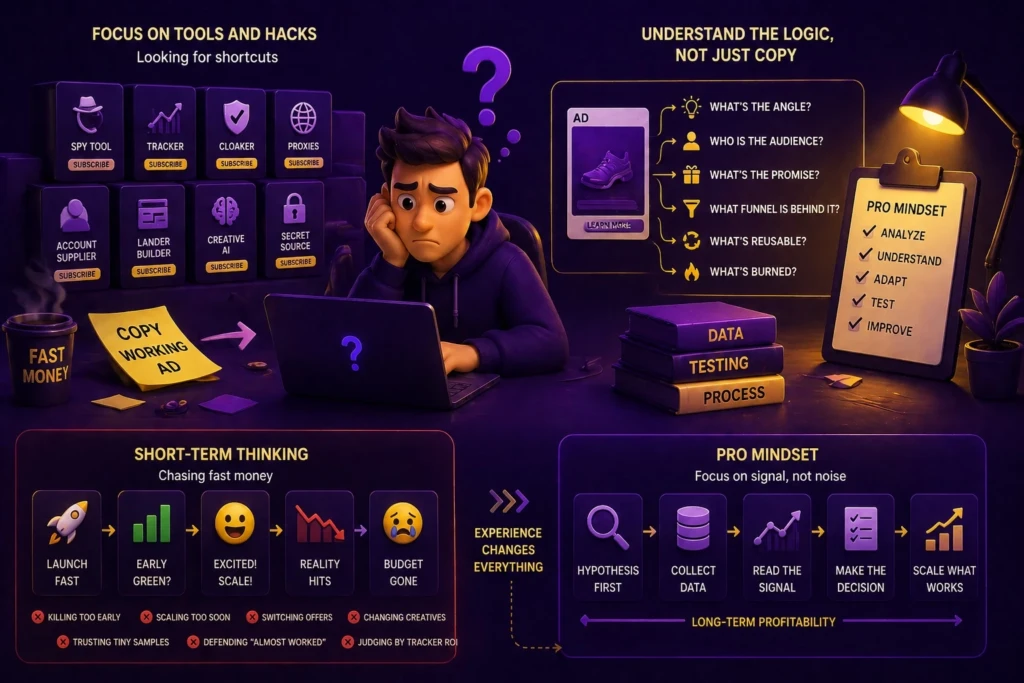
The classic beginner move is hunting for shortcuts. Better tracker. Better spy tool. Better cloaker. Better proxy. Better account supplier. Better prompt for creatives. Better “secret” source. There is nothing wrong with good tools, but tools do not fix weak thinking.
A beginner sees a spy ad and thinks: “This creative is working, I should copy it.”
A pro sees the same ad and asks: “What is the angle? What audience does it pull? What promise structure does it use? What funnel probably sits behind it? What part is reusable, and what part is already burned?”
That is the affiliate marketing skills difference in one example. The beginner copies the surface. The pro extracts the logic.
The same happens with tools. A beginner buys five subscriptions and still cannot decide what to kill. A pro can run a lean stack and make sharper decisions because the process is cleaner. Tools amplify skill. They do not replace it.
Short-term thinking
Beginners also tend to chase fast money. They want a campaign to prove itself in one day, preferably in the first few hundred dollars. If the first signal is green, they get excited. If it is red, they panic. Both reactions are expensive.
Short-term thinking creates bad habits:
- killing campaigns before the data is mature
- scaling campaigns before approval is known
- switching offers too often
- changing creatives too early
- trusting tiny samples
- defending campaigns because they “almost worked”
- judging by tracker ROI before payout reality settles
A beginner wants certainty from incomplete data. A pro accepts that early data is only early data. Day 1 tells you if something deserves more attention. It does not tell you if you have a scalable business.
How pros think and operate
A pro affiliate does not necessarily know every secret. They just have fewer blind spots. They understand that affiliate marketing is not only about finding a winning campaign. It is about building a machine that can test, validate, scale, and recycle learning without losing control.
The pro is not calmer because the business is easier. The pro is calmer because the process is stronger.
System and process mindset
Professional affiliates think in systems. They do not treat every launch as a fresh adventure. They have a repeatable workflow:
- offer selection
- angle research
- creative briefing
- landing page logic
- tracking QA
- launch rules
- test budget
- kill criteria
- validation stage
- approval check
- scale decision
- post-test review
This does not mean they are slow or corporate. Good teams still move fast. But they move through a structure.
A beginner asks: “Should I launch this?”
A pro asks: “Where does this fit in the testing pipeline?”
That is the difference between activity and process. A beginner has campaigns. A pro has a workflow.

Long-term profitability focus
Pros also think beyond the first payout. They care about real economics, not just visible conversion volume.
They look at:
- approved CPA
- approval rate
- payout timing
- hold period
- refund or clawback risk
- backend quality
- account burn
- creative fatigue speed
- test-to-winner ratio
- full operating cost
- real ROI
This is why professional affiliates are often less impressed by “big” numbers. A beginner sees $90 payout and gets excited. A pro asks what approval looks like. A beginner sees +40% tracker ROI and wants to scale. A pro asks whether rejected leads, holds, duplicate postbacks, and tool costs are included.
Long-term profitability focus means the pro is willing to ignore campaigns that look sexy but cannot survive validation. That discipline is boring. It is also where the money is.
Key differences in decision-making
The biggest difference between beginner vs pro affiliate behavior is not what they launch. It is how they decide.
Beginners decide from emotion mixed with partial data. Pros decide from data, context, and risk control. They still use intuition, but they do not let intuition override the numbers when the numbers are clear.
Data vs assumptions
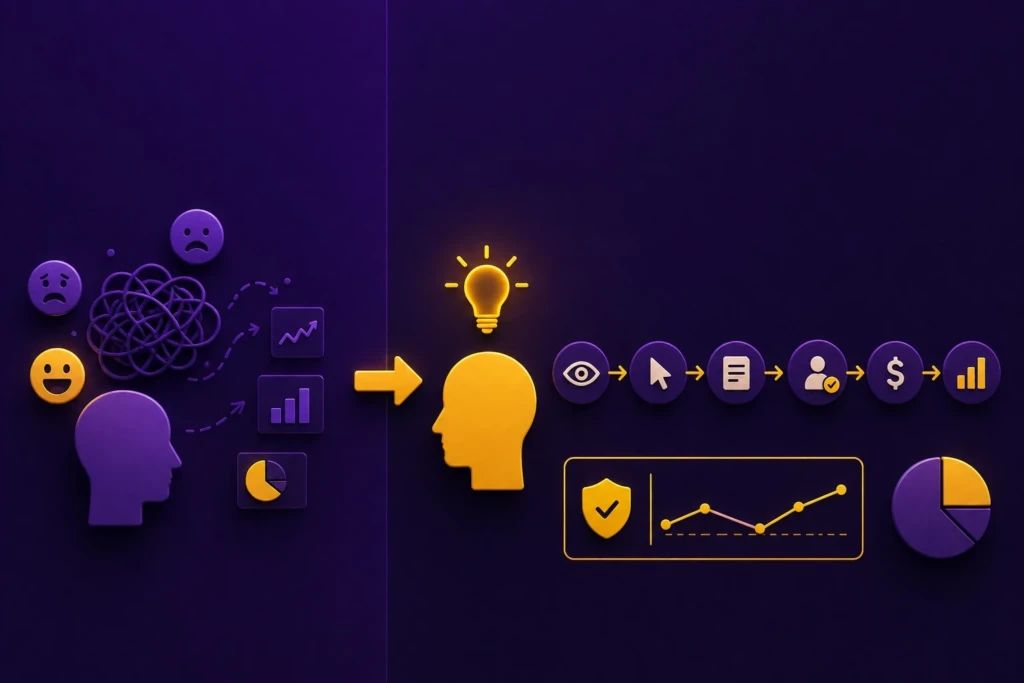
Beginners fill gaps with assumptions. If CPC is low, they assume traffic is good. If leads are coming in, they assume the offer is working. If tracker ROI is green, they assume the campaign is profitable. If a creative gets clicks, they assume it is strong.
Pros separate signal from assumption.
Low CPC means cheap clicks. It does not mean quality.
Lead volume means users completed an action. It does not mean approved revenue.
Tracker ROI means the tracker calculated something. It does not mean collectible profit.
High CTR means the creative attracts attention. It does not mean the audience will buy.
A pro wants the whole chain to speak:
- impression to click
- click to lander
- lander to lead
- lead to approval
- approval to payout
- payout to cash
- cash to profit after full cost
That is how data becomes useful. Not as a screenshot, but as a decision system.
Risk management approach
Beginners often think risk management means being afraid to spend. That is wrong. Risk management means knowing what kind of loss you are accepting and why.
A pro can spend aggressively because the risk is structured. The campaign has a test budget, a kill rule, a validation stage, a scale rule, and a reserve plan. If it fails, the loss is contained and the lesson is reusable.
A beginner spends emotionally. They top up because the campaign “might turn.” They scale because the tracker is green. They keep testing because they already spent too much to quit. That is not risk-taking. That is loss attachment.
Professional risk control looks like this:
- max daily loss is defined
- scale thresholds are written before launch
- test budget is separated from scale budget
- tracking mismatch pauses decisions
- approval drop triggers review
- creative fatigue triggers rotation
- payout delay affects cash allocation
The pro does not avoid risk. The pro prices risk.
Testing discipline
Testing is another major affiliate marketing experience gap. Beginners test to “find something.” Pros test to answer a specific question.
A weak test sounds like:
“Let’s launch this offer with a few creatives and see what happens.”
A strong test sounds like:
“We’re testing whether this pain-angle static creative can produce approved leads under $24 CPA in GEO X with broad mobile traffic. Budget cap is $500. Kill if CTR stays below threshold after enough impressions or no qualified lead appears by $180 spend. Continue only if approval quality is acceptable.”
That is a real test. It has a hypothesis, budget, metric, threshold, and next step.
The beginner creates noise. The pro creates information.
Where beginners lose money
Beginners usually lose money in predictable places. Not because they are stupid, but because the business punishes incomplete thinking.
Poor traffic choices
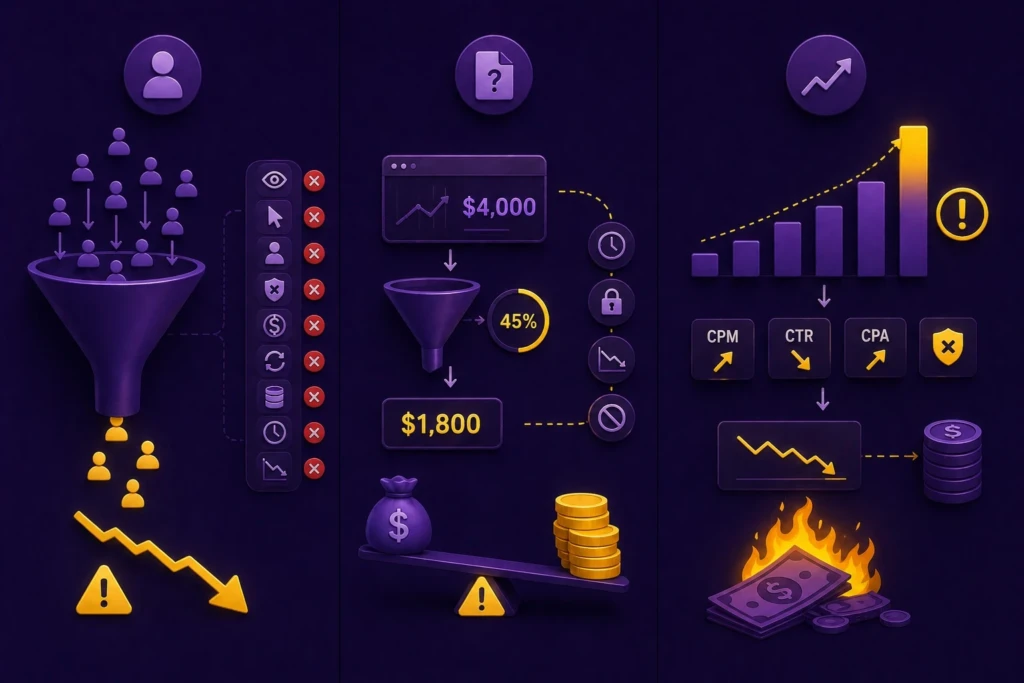
The first loss point is traffic quality. Beginners love cheap traffic because it makes the dashboard feel alive. Low CPM, low CPC, lots of clicks, fast movement. It feels like progress.
But cheap traffic can be useless if the audience does not continue deeper into the funnel.
Bad traffic choices show up as:
- low lander engagement
- weak click-to-lead rate
- fake or shallow leads
- poor approval
- weak deposit rate
- high refund risk
- bad backend value
- fast creative fatigue
- low retention
A beginner says: “Clicks are cheap.”
A pro asks: “What do those clicks become?”
That question saves money.
Ignoring approval and backend
The second loss point is approval and backend blindness. Beginners often treat conversion as revenue. In affiliate, that is dangerous.
If a buyer generates 100 leads at a $40 payout, the tracker may show $4,000 revenue. But if approval lands at 45%, approved revenue is $1,800. If ad spend was $2,200, the campaign is not close. It is negative before tools, accounts, and time.
Backend matters too. Even if the front payout is real, low-quality users can lead to payout cuts, tighter caps, lower approval, longer holds, or offer removal. Beginners often learn this late because the ad account looks fine while the advertiser is already unhappy with quality.
A professional affiliate does not ask only, “Did it convert?” They ask, “Did it approve, pay, and create value?”
Scaling without validation
The third loss point is premature scaling. This is probably the most common reason beginners burn budgets.
The campaign gets early conversions. The buyer gets excited. Budget jumps. Then the real traffic mix changes. CPM rises. CTR softens. CPA drifts. Approval drops. The winner was not a winner. It was a pocket.
Validation means proving that performance holds beyond the lucky opening window. That usually requires:
- enough spend depth
- enough conversion volume
- stable CPA
- acceptable approval
- no major tracking mismatch
- early fatigue check
- payout confidence
- controlled scale test
A beginner scales a good feeling. A pro scales a validated pattern.
What actually changes with experience
Experience does not make affiliate marketing easy. It makes the operator better at reading the game. The pro sees patterns faster, cuts losses sooner, and knows which problems matter.

Better understanding of funnel
Experienced affiliates stop seeing campaigns as isolated ads. They see funnels.
They understand that each layer affects the next:
- creative quality affects click intent
- click intent affects lander behavior
- lander behavior affects lead quality
- lead quality affects approval
- approval affects payout
- payout affects cashflow
- cashflow affects scaling capacity
This is why pros do not obsess over one metric. They want to know where the funnel is leaking. If CTR is strong but click-to-lead is weak, the issue may be promise mismatch or lander friction. If leads are cheap but approval is poor, the issue may be traffic quality or offer mismatch. If approval is fine but cash is slow, the issue is payout timing and working capital.
Experience turns the dashboard from a scoreboard into a diagnostic tool.
Faster decision cycles
Pros also make decisions faster, but not because they are impulsive. They are faster because they know what to look for.
A beginner needs three days to admit a creative is dead. A pro sees the pattern earlier.
A beginner waits for more spend because they are emotionally attached. A pro knows when more spend will not create new information.
A beginner keeps asking whether the campaign might recover. A pro asks what condition would justify keeping it alive.
Fast decision cycles save budget. If a team cuts bad tests 24 hours earlier across dozens of launches, the monthly savings can be huge.
The pro is not always right. But the pro is rarely confused for long.
Improved pattern recognition
Pattern recognition is one of the most underrated affiliate marketing skills. After enough launches, a pro starts seeing familiar shapes.
They recognize:
- cheap traffic that will not approve
- CTR spikes caused by curiosity, not intent
- landing pages that create friction
- offers with suspicious payout-to-approval ratios
- creatives that will fatigue fast
- accounts that are becoming unstable
- early ROI that is probably inflated
- validation delays that will hurt cashflow
- scale attempts that are too aggressive
This is not magic. It is accumulated pain converted into judgment.
The difference is that beginners experience losses as isolated events. Pros organize losses into patterns.
How to move from beginner to pro
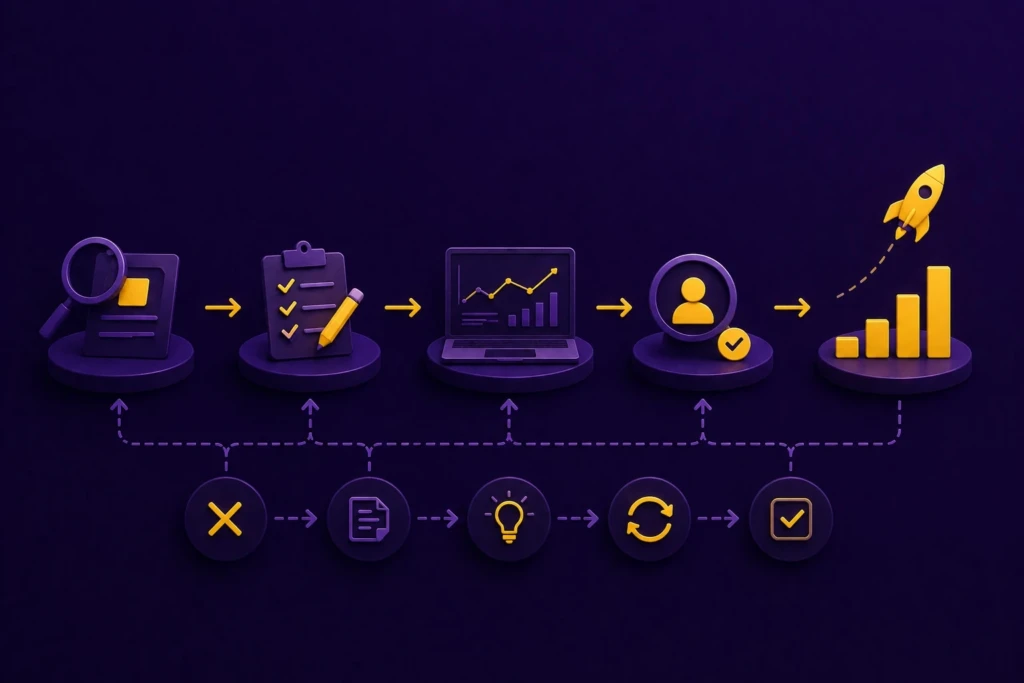
You do not become professional by watching more case studies. You become professional by building a process that makes your results less random.
Building a repeatable system
Start with a repeatable workflow. Every campaign should go through the same basic stages:
- Research.
- Hypothesis.
- Creative brief.
- Tracking QA.
- Controlled launch.
- Early signal review.
- Validation.
- Approval check.
- Scale or kill.
- Post-test notes.
This is not bureaucracy. This is how you stop paying for the same mistake twice.
A repeatable system helps you understand:
- what was tested
- why it was tested
- how much it cost
- what happened
- what was learned
- what should happen next
Without that, you are just launching.
Tracking and analyzing data
Professional affiliates track more than ad metrics. They connect the whole performance chain.
At minimum, track:
- spend
- CPM
- CTR
- CPC
- CPA
- CVR
- click-to-lead rate
- approval rate
- approved CPA
- payout speed
- real ROI
- creative fatigue
- account burn
- test-to-winner ratio
- backend value where available
But the point is not to collect numbers for decoration. Every metric should lead to a decision.
If approval drops, review traffic and offer quality.
If CTR drops, rotate creative.
If CPC is cheap but lead quality is bad, stop defending cheap traffic.
If tracker and network data diverge, pause scaling until reconciled.
If backend value is weak, adjust offer or traffic source.
Data only matters when it changes behavior.
Learning from losses
Losses are not automatically learning. A loss becomes learning only when you document why it happened.
After every failed test, write down:
- what was the hypothesis?
- what was the budget?
- what failed first?
- was the issue creative, traffic, lander, offer, approval, tracking, or timing?
- would the result change with another audience or format?
- should this be retested later?
- what should not be repeated?
This is where beginners waste money. They lose, feel bad, and move on. Pros extract the lesson and reduce future burn.
The goal is not to avoid losses completely. That is impossible. The goal is to make losses smaller, clearer, and more useful.
Scaling with control
Finally, moving to pro level means scaling without losing your head.
Controlled scaling means:
- no scale before validation
- no huge budget jumps on thin data
- no scaling tired creatives
- no scaling when approval is unknown
- no scaling with tracking mismatch
- no scaling without backup assets
- no scaling without cashflow awareness
A pro does not scale because the campaign looks exciting. A pro scales because the setup has earned the next level of spend.
That is the whole game.
FAQ
What is the difference between a beginner and a pro affiliate?
A beginner usually focuses on tools, quick wins, and surface metrics. A pro focuses on systems, funnel quality, approval, real ROI, risk control, and repeatable testing.
How long does it take to become a professional affiliate marketer?
It depends on budget, volume, and how quickly you learn from losses. Some buyers need years because they repeat mistakes. Others improve faster because they document tests, track real economics, and build process early.
What skills do professional affiliates need?
Key skills include media buying, offer analysis, creative testing, funnel diagnostics, tracking, data interpretation, risk management, and budget control. The biggest skill is making clean decisions from imperfect data.
Why do beginner affiliates lose money?
Beginners usually lose money by chasing cheap traffic, trusting raw tracker ROI, ignoring approval, scaling too early, testing too many variables, and failing to document what went wrong.
How do I become a professional affiliate marketer?
Build a repeatable testing process, track the full funnel, review losses honestly, control budget stages, and stop making decisions from emotion. Professionalism starts when your workflow becomes less random.
Is affiliate marketing beginner-friendly?
It can be beginner-friendly to enter, but it is not easy to make stable profit. The entry barrier is low, but the skill gap is high. Beginners need process, patience, and clean tracking to survive.