

Scaling Telegram Ads almost never goes smoothly. A bundle that looks clean on a small budget can start bleeding the moment you push more spend into it. At low volume, the campaign may show cheap clicks, decent bot starts, acceptable joins, maybe even early regs. Then the budget goes up — and suddenly traffic quality drops, CR gets weaker, the bot starts leaking users, moderation risk increases, and ROI falls apart.
The problem is not always Telegram as a source. Most of the time, the problem is the system around it. Telegram scaling exposes everything: weak channel selection, low-intent traffic, bad pre-sell, messy bot logic, poor tracking, risky assets, and backend metrics that were never strong enough to support scale. This article breaks down the main telegram ads scaling problems, what breaks first when you increase budget, where money disappears, and how to build a safer model for affiliate marketing Telegram scaling.
Contents
- Why scaling changes Telegram performance
- What breaks first when you increase spend
- Traffic quality degradation at scale
- Funnel and conversion issues
- Risk and moderation factors
- Where money is lost
- How to scale Telegram ads safely
- FAQ
Why scaling changes Telegram performance
The biggest mistake in Telegram buying is thinking scale means “same traffic, just more of it.”
It does not.
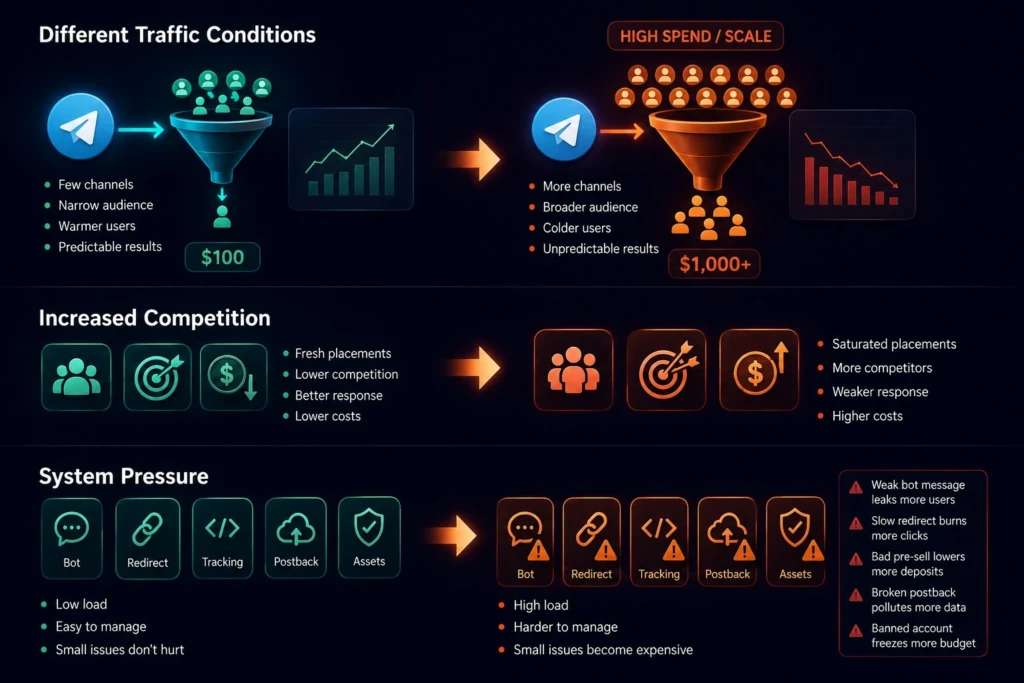
When you scale Telegram Ads, you change the whole environment. You buy more placements, touch broader audiences, push harder into channels, increase bot load, expose your funnel to more user types, and create more risk around accounts, balances, moderation, and tracking.
At small spend, a bundle can survive because the traffic pocket is narrow. You may be buying from one decent channel, one clean audience, one responsive GEO segment, or one placement that still has fresh users. Once you increase budget, you usually move outside that clean pocket.
That is where telegram ads performance issues start.
Different traffic conditions
Low-budget Telegram traffic is often more controlled.
You test a few channels, buy a placement, send traffic into a bot, and watch early numbers. If the channel has a good match with the offer, the first data can look strong.
But when you scale, conditions change:
- more channels;
- broader audiences;
- colder users;
- weaker placements;
- more repeated exposure;
- more promo-fatigued users;
- less predictable traffic behavior.
The campaign may still be the same, but the traffic mix is not.
That is why a funnel that works at $100 can fail at $1,000. You are no longer buying the same audience. You are buying a larger, noisier version of the market.
Increased competition
Competition also hits harder at scale.
Good Telegram placements are not unlimited. Clean channels with relevant audiences get booked, saturated, copied, and priced up. If multiple affiliate teams are pushing similar offers, the audience gets tired fast.
More competition creates:
- higher placement costs;
- weaker response rates;
- lower user trust;
- repeated exposure to similar offers;
- worse click quality;
- lower backend value.
A channel that worked well two weeks ago may already be burned by similar promos. A GEO that looked cheap may now be full of buyers chasing the same users. A vertical that had fresh attention may become noisy very quickly.
Scaling means you are fighting harder for the same attention.
System pressure
Scaling adds pressure to the whole setup.
The funnel has to handle more users. The bot has to respond properly. Tracking has to stay clean. Redirects must work. Postbacks must fire. Moderation-safe assets must survive. Backup channels, accounts, and domains need to be ready.
At small volume, small issues are easy to miss.
At scale, every small issue becomes expensive.
A weak first bot message leaks more users.
A slow redirect burns more paid clicks.
A bad pre-sell lowers more deposits.
A broken postback pollutes more data.
A banned account freezes more budget.
Scaling does not create all problems. It reveals them faster.
What breaks first when you increase spend
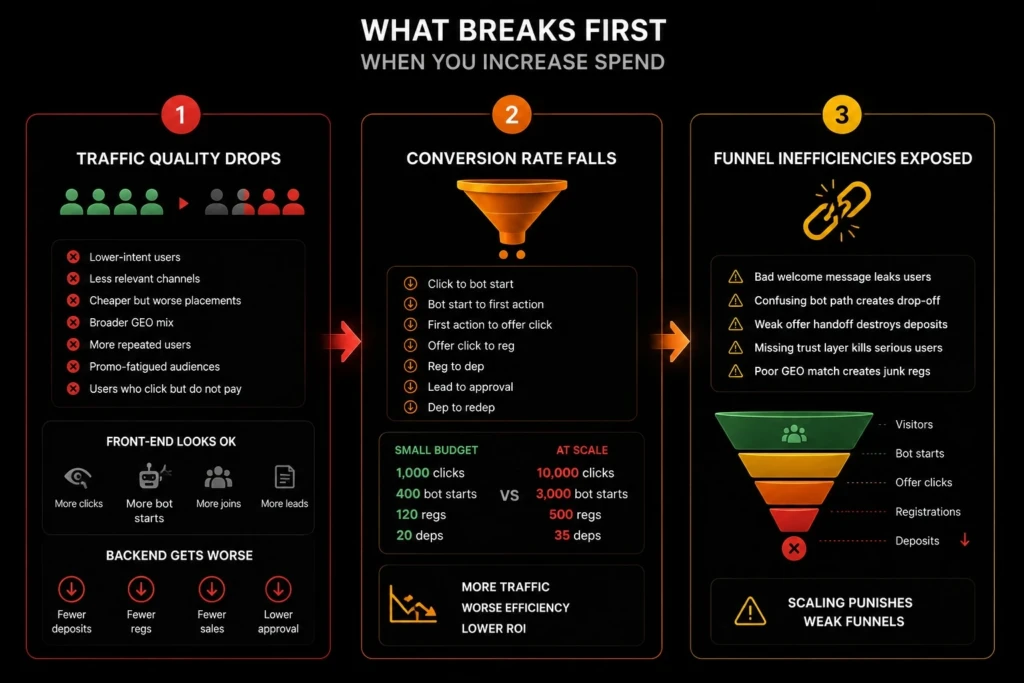
When Telegram spend increases, three things usually break first: traffic quality, conversion rate, and funnel efficiency.
These are the main telegram ads budget increase problems. The buyer spends more, but value does not grow proportionally. Volume goes up, but profit does not follow.
Traffic quality drops
Traffic quality is usually the first thing to weaken.
At low spend, you may reach the best audience pocket. These users are more relevant, more responsive, and less exposed to similar offers. At higher spend, you need more users, so you start buying weaker inventory.
This can mean:
- lower-intent users;
- less relevant channels;
- cheaper but worse placements;
- broader GEO mix;
- more repeated users;
- promo-fatigued audiences;
- users who click but do not pay.
The dashboard may still show traffic, but backend quality starts dropping.
You get more clicks, but not more deposits.
More bot starts, but not more regs.
More joins, but not more sales.
More leads, but lower approval.
That is the first signal that scale is not healthy.
Conversion rate falls
The second break is CR.
As traffic quality gets weaker, conversion rate usually falls at every step:
- click to bot start;
- bot start to first action;
- first action to offer click;
- offer click to reg;
- reg to dep;
- lead to approval;
- dep to redep.
The buyer sees more traffic but worse efficiency.
This is where telegram ads ROI drop becomes visible. The campaign spends more money to create fewer valuable users per dollar.
For example:
At small budget:
- 1,000 clicks;
- 400 bot starts;
- 120 regs;
- 20 deps.
At scale:
- 10,000 clicks;
- 3,000 bot starts;
- 500 regs;
- 35 deps.
Volume increased 10x. Deposits did not. The funnel did not scale. It diluted.
Funnel inefficiencies exposed
The third break is funnel efficiency.
A weak funnel can survive at small spend because the loss is not dramatic. Maybe the bot is generic. Maybe the pre-sell is thin. Maybe the CTA is unclear. Maybe the channel-to-offer match is average. On small volume, this may still produce enough signal to look promising.
At scale, weak points become obvious.
A bad welcome message starts leaking hundreds of users.
A confusing bot path creates massive drop-off.
A weak offer handoff destroys deposit rate.
A missing trust layer kills serious users.
A poor GEO match creates junk registrations.
Scaling does not forgive weak funnels. It punishes them.
Traffic quality degradation at scale
Traffic degradation is one of the most common telegram ads scaling mistakes buyers ignore.
They assume Telegram volume is linear: more spend equals more of the same users. In reality, more spend often means lower average quality.
Expansion into weaker audiences
To scale, you usually have to expand.
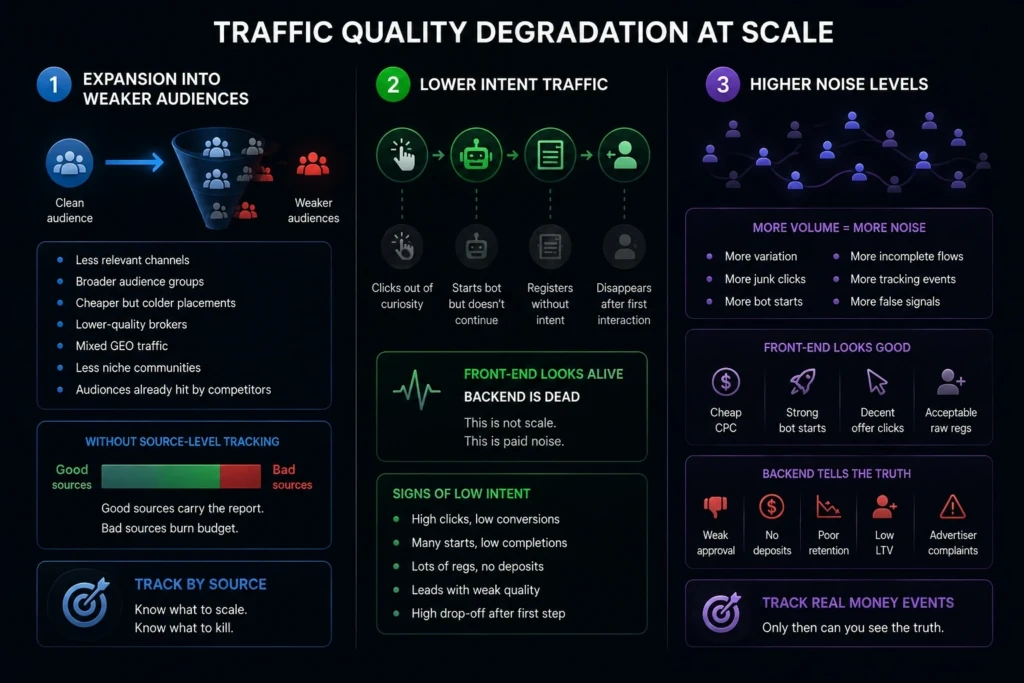
That expansion may include:
- less relevant channels;
- broader audience groups;
- cheaper but colder placements;
- lower-quality brokers;
- mixed GEO traffic;
- less niche communities;
- audiences already hit by competitors.
The first channel may be clean. The next ten may not be.
If you do not segment traffic, weak placements get blended into the average. A few good sources carry the report, while bad sources quietly burn budget.
That is why source-level tracking is mandatory in Telegram scaling. Without it, you cannot know which channels deserve more spend and which ones should be killed.
Lower intent traffic
Lower intent is the real killer.
Telegram users can click easily. They are used to moving between channels, bots, links, mini apps, communities, and promo posts. But easy clicking does not mean buying intent.
At scale, you often get more users who:
- click out of curiosity;
- start the bot but do not continue;
- register without deposit intent;
- submit low-quality lead data;
- join channels but never buy;
- disappear after the first interaction.
This creates the illusion of activity.
Your front-end looks alive, but the backend is dead.
That is not scale. That is paid noise.
Higher noise levels
Volume increases noise.
More users means more variation, more junk clicks, more bot starts, more incomplete flows, more tracking events, more false signals, and more misleading averages.
This makes decision-making harder.
A buyer may see:
- cheap CPC;
- strong bot starts;
- decent offer clicks;
- acceptable raw regs.
But backend says:
- weak approval;
- no deposits;
- poor retention;
- low LTV;
- advertiser complaints.
At scale, noise can hide the truth unless the team is tracking real money events.
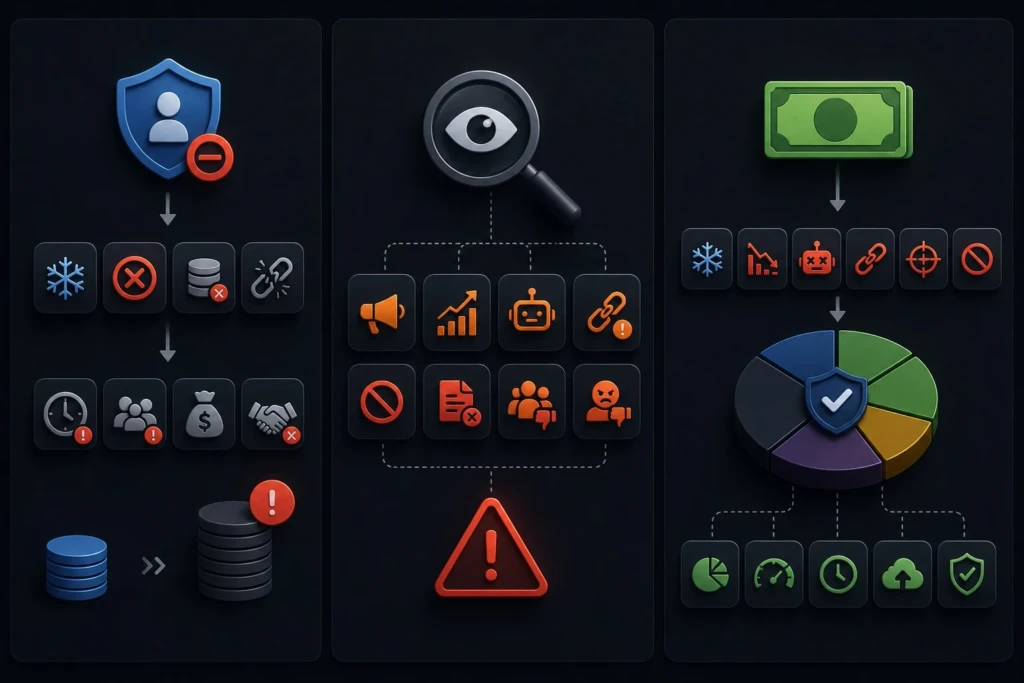
Funnel and conversion issues
Telegram scaling puts the funnel under pressure.
If the funnel is strong, it can absorb broader traffic and still monetize a part of it. If the funnel is weak, scale exposes every leak.
Weak pre-sell structure
Pre-sell is often the missing layer in Telegram funnels.
Many buyers send users from a placement into a bot or offer too quickly. The user clicks from curiosity, but the funnel asks for a hard action before building enough intent.
At low spend, a few motivated users may still convert.
At scale, this breaks.
A weak pre-sell fails to:
- confirm the ad promise;
- explain the value;
- build trust;
- qualify users;
- reduce doubt;
- make the CTA logical.
Without pre-sell, Telegram traffic stays cold. Cold users do not deposit, buy, approve, or retain well.
Drop-offs increase
When spend goes up, drop-offs usually increase.
The key is knowing where.
Possible leaks:
- users click but do not start the bot;
- users start the bot but do not tap first button;
- users tap but do not reach offer;
- users reach offer but do not register;
- users register but do not deposit;
- users deposit once but never redeposit.
Each leak has a different cause.
Low bot start may mean redirect or expectation problem.
Low first action may mean weak bot entry.
Low offer click may mean poor pre-sell.
Low registration may mean offer mismatch.
Low deposit may mean low intent or payment friction.
Low redep may mean weak retention mechanics.
If you do not track step-by-step, you cannot fix scale. You can only guess.
Monetization problems
A scaled Telegram funnel can still produce shallow conversions but fail to monetize.
This is common in affiliate marketing.
The buyer gets:
- more joins;
- more bot starts;
- more raw leads;
- more registrations;
- more clicks to offer.
But not enough:
- approved leads;
- first deposits;
- purchases;
- subscriptions;
- redeps;
- LTV.
That means the funnel is optimized for movement, not money.
The problem is not volume. The problem is conversion quality.
Risk and moderation factors
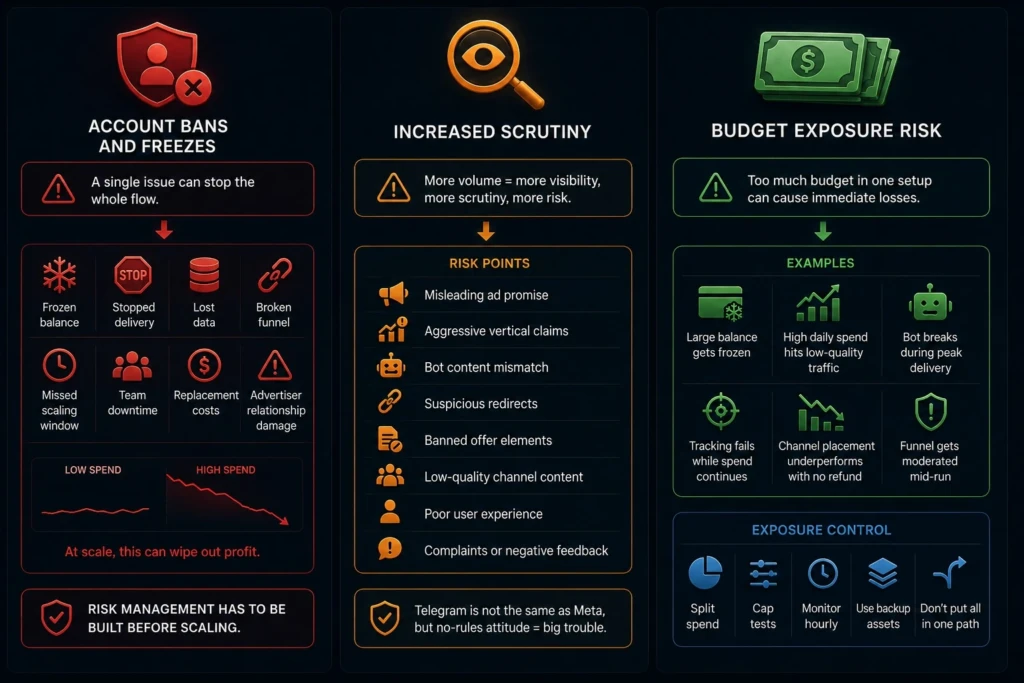
Telegram scaling is not only about traffic and CR. It also increases operational risk.
More spend means more visibility, more scrutiny, more account exposure, more balance risk, and more pressure on assets.
Account bans and freezes
Bans and freezes are financial risks, not just technical problems.
If you scale with one account, one channel, one bot, one domain, or one payment balance, you are exposed. A single issue can stop the whole flow.
The damage can include:
- frozen balance;
- stopped delivery;
- lost data;
- broken funnel;
- missed scaling window;
- team downtime;
- replacement costs;
- advertiser relationship damage.
At small spend, this hurts.
At scale, this can wipe out profit.
Risk management has to be built before scaling, not after the first freeze.
Increased scrutiny
Scaling can bring more scrutiny.
When volume grows, risky claims, aggressive bot logic, suspicious redirects, weak compliance, or inconsistent funnel paths become more dangerous.
A campaign that passed at low visibility may get flagged when spend increases or when more users interact with the flow.
Risk points include:
- misleading ad promise;
- aggressive vertical claims;
- bot content mismatch;
- suspicious redirects;
- banned offer elements;
- low-quality channel content;
- poor user experience;
- complaints or negative feedback.
Telegram is not the same as Meta, but buyers who treat it like a no-rules source are asking for trouble.
Budget exposure risk
Budget exposure is one of the biggest scaling dangers.
If you put too much money into one setup and something breaks, losses become immediate.
Examples:
- large balance gets frozen;
- high daily spend runs into low-quality traffic;
- bot breaks during peak delivery;
- tracking fails while spend continues;
- channel placement underperforms with no refund;
- funnel gets moderated mid-run.
Professional buyers use exposure control.
They split spend.
They cap tests.
They monitor hourly.
They use backup assets.
They avoid putting the whole bankroll into one path.
Where money is lost
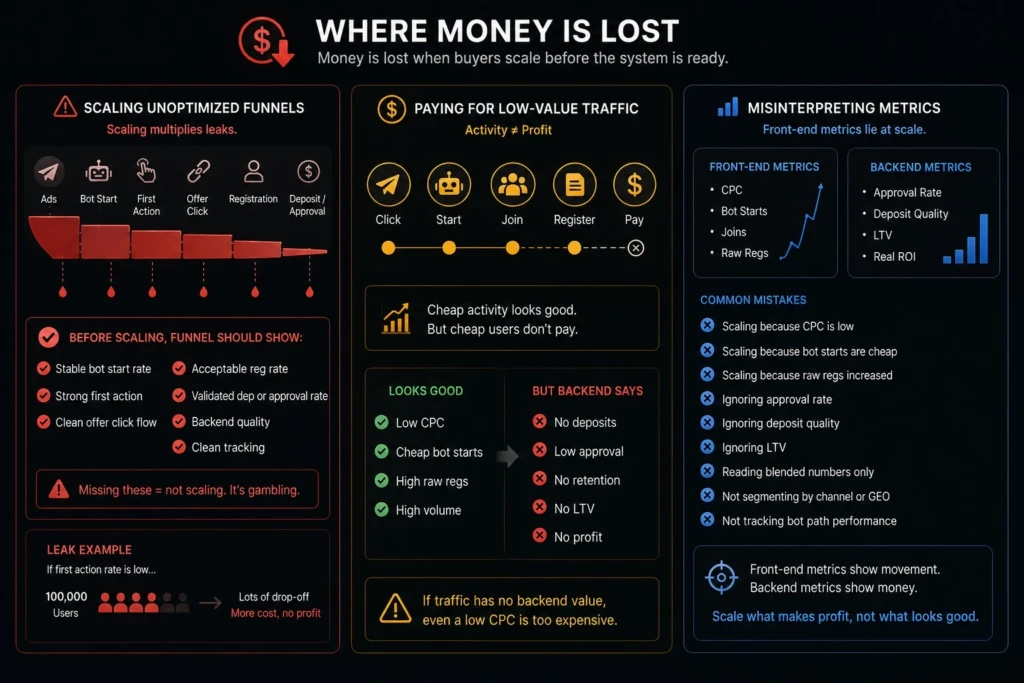
Money is lost when buyers scale before the system is ready.
The campaign may have traffic, but traffic alone does not mean profit. Telegram scale requires quality control across source, funnel, bot, tracking, backend, and risk.
Scaling unoptimized funnels
Scaling an unoptimized funnel is one of the most expensive mistakes.
If the bot has poor first action rate, scaling will send more users into that leak. If the pre-sell is weak, scaling will expose it. If the offer handoff is bad, more traffic will only create more drop-off.
Before scaling, the funnel should already show:
- stable bot start rate;
- strong first action;
- clean offer click flow;
- acceptable reg rate;
- validated dep or approval rate;
- backend quality;
- clean tracking.
If these are missing, budget increase is not scaling. It is gambling.
Paying for low-value traffic
Low-value traffic is the silent killer.
At scale, you may start paying for users who technically interact but never monetize.
They click.
They start.
They join.
They register.
But they do not pay.
This hurts especially when buyers optimize by top-funnel numbers. Cheap bot starts can look amazing until you calculate cost per deposit or approved lead.
If the traffic has no backend value, even a low CPC is too expensive.
Misinterpreting metrics
Bad metric reading kills Telegram scale.
Common mistakes:
- scaling because CPC is low;
- scaling because bot starts are cheap;
- scaling because raw regs increased;
- ignoring approval rate;
- ignoring deposit quality;
- ignoring LTV;
- reading blended numbers only;
- not segmenting by channel or GEO;
- not tracking bot path performance.
At scale, front-end metrics become even more dangerous because they produce bigger numbers and more confidence.
But the only metrics that justify scale are backend metrics.
How to scale Telegram ads safely
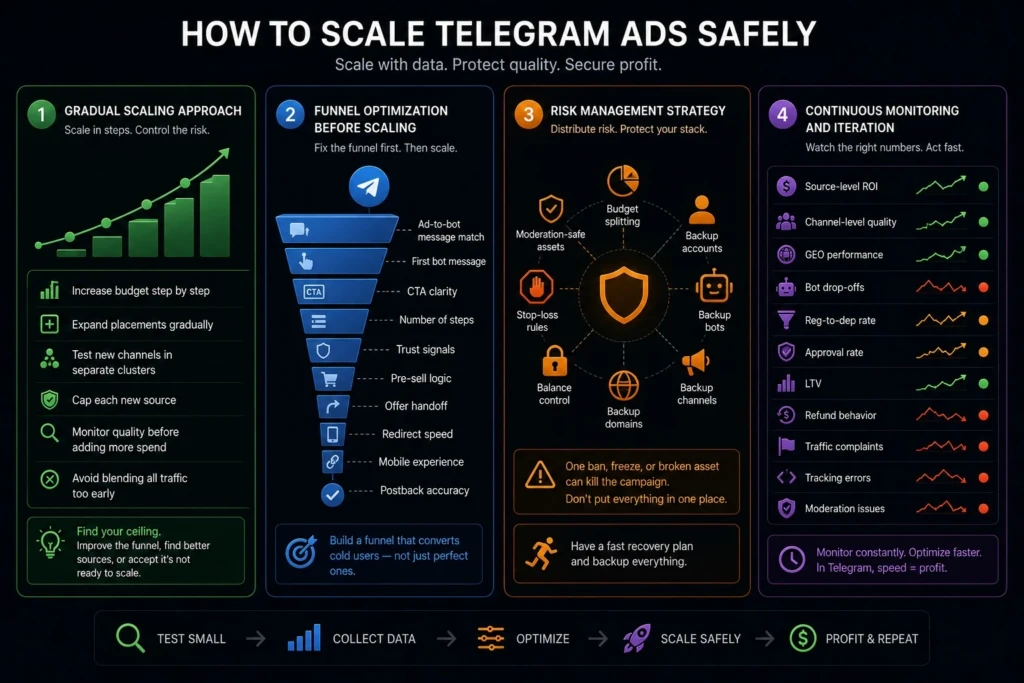
Safe Telegram scaling is not about being slow forever. It is about earning the next budget level with data.
The goal is to increase spend without destroying traffic quality, funnel performance, backend value, or operational stability.
Gradual scaling approach
Do not jump from small test budget to aggressive volume just because one placement worked.
Use controlled increases:
- increase budget step by step;
- expand placements gradually;
- test new channels in separate clusters;
- cap each new source;
- monitor quality before adding more spend;
- avoid blending all traffic too early.
Gradual scaling helps identify where performance starts to break.
If quality drops after a certain spend level, that is your current ceiling. You either improve the funnel, find better sources, or accept that the setup is not ready for more.
Funnel optimization before scaling
Optimize the funnel before increasing spend.
Check:
- ad-to-bot message match;
- first bot message;
- CTA clarity;
- number of steps;
- trust signals;
- pre-sell logic;
- offer handoff;
- redirect speed;
- mobile experience;
- postback accuracy.
The funnel should be strong enough to handle colder users before you expand traffic.
If the funnel only works with perfect users, it is not scalable.
Risk management strategy
Risk control is part of scaling.
You need:
- budget splitting;
- backup accounts;
- backup bots;
- backup channels;
- backup domains;
- daily spend caps;
- balance control;
- stop-loss rules;
- moderation-safe assets;
- fast recovery plan.
Do not let one ban, one freeze, or one broken asset kill the whole campaign.
Telegram scale should be distributed. Concentration creates fragility.
Continuous monitoring and iteration
Scaling requires constant monitoring.
Watch:
- source-level ROI;
- channel-level quality;
- GEO performance;
- bot drop-offs;
- reg-to-dep rate;
- approval rate;
- LTV;
- refund behavior;
- traffic complaints;
- tracking errors;
- moderation issues.
Do not wait for the final report to discover that the campaign is bleeding.
Telegram can move fast. Your optimization has to move faster.
FAQ
Why do Telegram ads perform well at low budget but fail when scaled?
Low-budget campaigns often hit a clean audience pocket. When spend increases, traffic expands into broader, colder, and lower-intent audiences. This usually hurts CR, approval, deposits, LTV, and real ROI.
What breaks first when scaling Telegram Ads?
Traffic quality usually breaks first. After that, conversion rate drops, funnel leaks become visible, backend value weakens, and risk exposure increases through bans, freezes, or moderation issues.
Why does Telegram Ads ROI drop after budget increase?
ROI drops because higher spend often brings weaker users, more useless clicks, lower conversion quality, higher drop-offs, and worse backend metrics. More traffic does not always mean more value.
How can I scale Telegram Ads safely?
Scale gradually, segment sources, optimize the bot and pre-sell before adding budget, track backend events, split risk across assets, and monitor performance by channel, GEO, bot path, and real ROI.
What are the biggest Telegram ads scaling mistakes?
The biggest mistakes are scaling too fast, trusting cheap CPC, ignoring backend metrics, blending weak and strong sources, using unoptimized funnels, and keeping too much budget in one account or asset.
Should I scale Telegram Ads based on bot starts or joins?
No. Bot starts and joins are front-end signals, not profit signals. Scale only when backend metrics support it: approved CPA, deposits, sale quality, redep, retention, LTV, and real ROI.