

Most campaigns do not fail because there are “no working combos left.” That is the lazy explanation. Campaigns fail because the setup is usually broken before the buyer admits it: weak testing logic, dirty data, poor creative strategy, traffic that does not match the offer, funnels that cannot hold lower-intent users, and scaling decisions made before the numbers are mature.
In 2026, the market is less forgiving. CPMs are higher, AI has made creative cloning easier, algorithms are more aggressive, users are more exposed, and advertisers are stricter with approval and backend quality. That means even experienced buyers can lose money if they treat campaigns like isolated launches instead of systems. This breakdown explains why campaigns fail in affiliate marketing, where the setup usually breaks first, which mistakes hide behind decent-looking metrics, and how to build campaigns with a better chance of surviving real traffic.
Contents
- Why most campaigns fail
- Where campaigns break first
- How traffic, offer, and funnel interact
- Hidden mistakes that kill performance
- Where money is actually lost
- How to build campaigns that survive
- FAQ
Why most campaigns fail
Campaign failure is rarely pure randomness. Yes, paid traffic always has volatility. Some tests will die even if the buyer does everything correctly. Some offers will underperform. Some GEOs will get crowded. Some creatives will miss. That is normal.
But most campaign failure reasons are not mysterious. They are operational. The buyer launches without a clear hypothesis, tests too many variables at once, trusts early data too much, ignores approval, and then makes optimization decisions that create more noise instead of clarity.
A bad campaign is not always obvious from the first day. Sometimes it gets clicks. Sometimes it gets leads. Sometimes the tracker even shows green ROI. The problem is that the campaign cannot survive the full commercial chain: approval, payout, backend value, scaling pressure, creative fatigue, and full cost.

Lack of system and structure
The first reason campaigns fail is lack of structure. A buyer launches an offer with a few creatives, a broad audience, some borrowed angles, and a rough budget. If it works, they scale. If it fails, they move on. That feels fast, but it is not a system.
A structured campaign starts with clear questions:
- What hypothesis are we testing?
- Which variable matters most?
- What budget is allowed for this test?
- What result proves signal?
- What result kills the test?
- Which metric decides the next step?
- When do we wait for approval before scaling?
- What do we document after the test?
Without that, every test becomes a vague bet. If it fails, the team does not know why. Was the creative weak? Was the audience wrong? Was the offer bad? Did the lander kill the intent? Did tracking break? Was the sample too small? Was approval the real issue?
This is one of the biggest affiliate marketing strategy mistakes: launching campaigns that cannot teach you anything clean.
Misunderstanding key metrics
The second reason is bad metric interpretation. Beginners do this constantly, but experienced buyers also fall into it when they are under pressure.
CTR is not profit.
CPC is not traffic quality.
CPA is not approved value.
Tracker ROI is not cash.
Lead volume is not backend quality.
Early green numbers are not validation.
A campaign can show 2.2% CTR, $0.48 CPC, and +30% tracker ROI and still be negative once approvals, rejected leads, account costs, tools, and payout timing are counted. On the other side, a campaign can look average on ad metrics but produce stronger approved value because the audience has better intent.
The professional question is not “does the dashboard look good?” The question is “which part of the chain is actually producing collectible profit?”
That difference matters because wrong metrics create wrong actions. If the buyer optimizes for cheap clicks, they may destroy approval. If they optimize for raw leads, they may feed the advertiser junk. If they optimize for Day 1 ROI, they may scale before the business result is real.
Where campaigns break first
Most campaigns break in one of three places: creative, traffic match, or funnel. Sometimes all three are weak, but usually one layer cracks first and then drags the rest down.

Creative failure
Creative failure is the most visible failure. If the ad cannot earn attention, the rest of the funnel does not matter.
Creative problems usually show up as:
- low CTR
- high CPC
- weak thumb-stop rate
- poor hook retention
- fast fatigue
- weak angle-message fit
- low-quality curiosity clicks
- no clear promise
But creative failure is not always just “bad design.” A nice-looking ad can still fail if the angle is wrong. A messy-looking ad can work if the promise hits the right nerve. In affiliate, creative is not decoration. It is the first filter for intent.
A common mistake is copying a competitor ad and assuming the visual is the asset. Usually, the real asset is the angle logic: the pain point, curiosity gap, qualification, proof, or emotional trigger. If you copy the surface and miss the logic, the campaign fails with a familiar-looking creative and no real signal.
Traffic mismatch
The second break point is traffic mismatch. The audience does not belong to the offer.
This is one of the most common reasons why ads don’t work. The creative may get clicks, the landing page may load, and the offer may be real, but the people entering the funnel are not the people who can approve, deposit, buy, retain, or create backend value.
Traffic mismatch shows up as:
- cheap clicks with poor lead quality
- good CTR but weak conversion rate
- many leads but low approval
- high bounce after prelander
- weak call-center contact rate
- poor deposit or sale rate
- refund or chargeback problems
- backend quality complaints
A buyer can get traffic at $0.30 CPC and still lose to another buyer paying $0.80 CPC if the second audience has stronger intent. Cheap traffic is not cheap if it fails deeper in the funnel.
Funnel weaknesses
The third break point is the funnel. This is where many campaigns fail silently.
A funnel can be weak because:
- the lander promise does not match the ad
- the page loads too slowly
- the CTA is unclear
- the prelander overpromises
- the form has too much friction
- mobile layout is bad
- the offer terms feel different from the ad
- tracking breaks between steps
- users are not properly qualified
At low spend, funnel weakness can hide. The campaign may catch enough high-intent users to look okay. At scale, weaker users enter, and the funnel gets stress-tested. That is when small friction becomes expensive.
This is why facebook ads campaign failure often appears after initial promise. The first traffic pocket converts. Then the campaign broadens, intent gets weaker, and the funnel cannot hold the new mix.
How traffic, offer, and funnel interact
A campaign is not just an ad plus an offer. It is a system. Traffic, offer, and funnel interact constantly. If one layer is wrong, the whole setup gets distorted.

Balance between elements
A strong campaign has balance.
The creative attracts the right type of user.
The traffic source can reach that user at a workable cost.
The landing page continues the same promise.
The offer matches the expectation.
The approval rules can tolerate the traffic quality.
The payout supports the CPA.
The backend value justifies scale.
When that balance works, the campaign has room. When one part is off, the numbers start lying.
For example, a high-payout finance offer may need strong qualification and high-intent traffic. If the buyer feeds it broad curiosity clicks from aggressive creatives, the tracker may show leads, but approval may collapse. The campaign did not fail because the payout was bad. It failed because the traffic and offer economics did not match.
Weakest link principle
Campaigns usually break at the weakest link.
If the creative is weak, the buyer pays too much for clicks.
If traffic quality is weak, approval and backend suffer.
If the lander is weak, clicks do not become leads.
If the offer is weak, leads do not become money.
If tracking is weak, decisions are wrong.
If approval is weak, tracker ROI becomes fantasy.
If scaling is too aggressive, every weakness gets amplified.
This is why isolated optimization often fails. A buyer sees high CPA and changes the creative. But the issue might be approval. Or they change the lander when the real problem is low-intent traffic. Or they increase budget when the campaign needed more validation.
Good optimization starts by finding the weakest link, not by touching everything at once.
Scaling impact on system
Scaling does not just increase spend. It changes the campaign environment.
At $300/day, the campaign may operate inside a cleaner traffic pocket. At $3,000/day, it needs more inventory, broader audience layers, more placements, and more creative durability. That changes the quality mix.
Scale usually increases pressure on:
- CPM
- CPC
- CTR
- CVR
- approval rate
- account stability
- creative fatigue
- payout timing
- operational workload
A campaign that survives small spend may not survive scale. Not because the original data was fake, but because the system was never tested under pressure.
That is why controlled scaling matters. If you jump budget too hard, you do not learn whether the campaign can scale. You learn how fast it breaks.
Hidden mistakes that kill performance
Some campaign killers are obvious. Others are hidden because they look like normal buying behavior. These are the mistakes that drain budget while the team still feels productive.
Rushing tests and conclusions
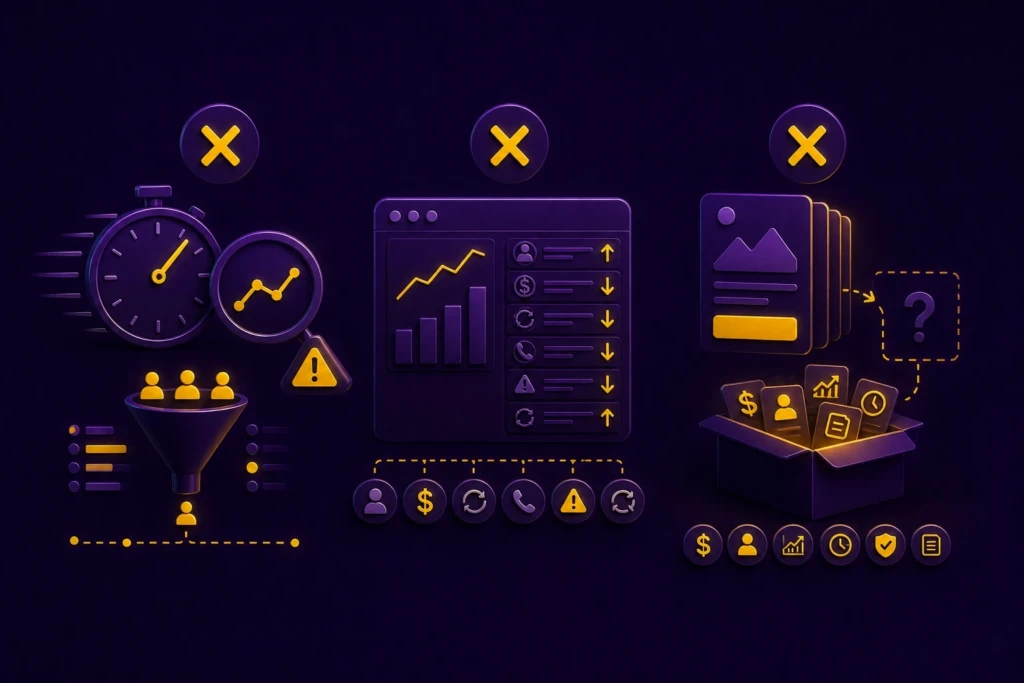
Rushed tests create bad conclusions. Buyers often launch, watch the first few hours, and decide too quickly.
They kill too early because the campaign did not produce instant signal. Or they scale too early because the first conversions looked good. Both mistakes come from the same issue: demanding certainty from immature data.
Early data can be distorted by:
- small sample size
- easy first responders
- delayed approvals
- incomplete tracking
- early algorithm exploration
- low frequency
- temporary auction softness
- random conversion spikes
A campaign that looks bad after $80 spend may not have enough data. A campaign that looks amazing after $300 spend may still be unproven. The correct test depth depends on payout, CPM, funnel length, GEO, and conversion volume.
Normal tests produce uncertainty. Bad tests produce no usable learning.
Ignoring backend metrics
Backend metrics are where many “winning” campaigns die.
A buyer may see raw conversions and positive tracker ROI, but the advertiser sees:
- low approval
- weak deposit rate
- poor retention
- high refund rate
- low LTV
- bad call-center contact rate
- fraud flags
- low repeat value
Sooner or later, that comes back as lower approval, payout cuts, tighter caps, longer holds, or offer removal.
In 2026, backend quality matters more because advertisers are stricter and tracking systems are more complex. If your campaign produces front-end action but not business value, it may look alive for a few days and then collapse commercially.
The pro move is to track approved CPA, approval rate, payout speed, and backend value wherever possible. Raw conversion count is not enough.
Copying without understanding
Blind copying is still one of the most expensive affiliate marketing mistakes in 2026.
A buyer sees an ad in a spy tool and copies:
- the visual
- the headline
- the prelander structure
- the offer category
- the CTA style
But they do not know:
- the original payout
- approval rate
- traffic source details
- account trust
- audience state
- creative fatigue stage
- lander test history
- backend quality
- scale timing
- compliance context
The copied campaign fails, and the buyer says the spy tool was wrong. Usually, the spy tool was not the problem. The buyer copied the artifact, not the mechanism.
Competitor research should reveal patterns, not provide launch instructions.
Where money is actually lost
Money is not lost only when a campaign fully fails. It is lost through uncontrolled testing, scaling losers, and making the wrong optimization moves.

Budget burn during testing
Testing costs money. That is normal. The problem is test burn without learning.
A team might run:
- 10 creative tests at $150 each
- 3 offer tests at $300 each
- 2 GEO tests at $500 each
That is $3,400 in test spend before finding anything stable. If those tests were structured, the team bought learning. If they were chaotic, the team bought noise.
Budget burn becomes dangerous when:
- tests have no hypothesis
- kill rules are unclear
- budgets are emotional
- variables are mixed
- tracking is not checked
- results are not documented
- losing logic gets repeated
A failed test is acceptable. A failed test that teaches nothing is expensive twice.
Scaling losing campaigns
The fastest way to lose money is scaling a campaign that only looks profitable.
This happens when the buyer scales based on:
- raw tracker ROI
- small sample size
- early conversions
- cheap CPC
- shallow leads
- unverified approval
- incomplete cost accounting
Example:
A campaign spends $1,000 and shows $1,400 tracker revenue. The buyer sees +40% ROI and pushes budget. Later, approval lands at 55%, real revenue becomes $770, and the original test was negative all along. If the buyer scaled to $5,000 before approval settled, the loss multiplies fast.
That is not scaling. That is multiplying a reporting error.
Poor optimization decisions
Poor optimization is often worse than no optimization. Buyers edit campaigns because they want to feel in control.
They may:
- change budget and creative at the same time
- kill the best-quality audience because CPC is higher
- keep low-quality cheap traffic alive
- edit campaigns during unstable learning
- switch landers before enough data
- rotate creatives without reading fatigue
- scale while tracking mismatch is unresolved
- optimize for leads instead of approved value
Every wrong action adds noise. Then the buyer cannot tell whether performance moved because of the market, the edit, the creative, the audience, or the offer.
Good optimization is surgical. Bad optimization is panic with buttons.
How to build campaigns that survive
You cannot make every campaign win. But you can build campaigns that fail cleaner, teach faster, and scale only when the proof is strong enough.
Structured testing approach
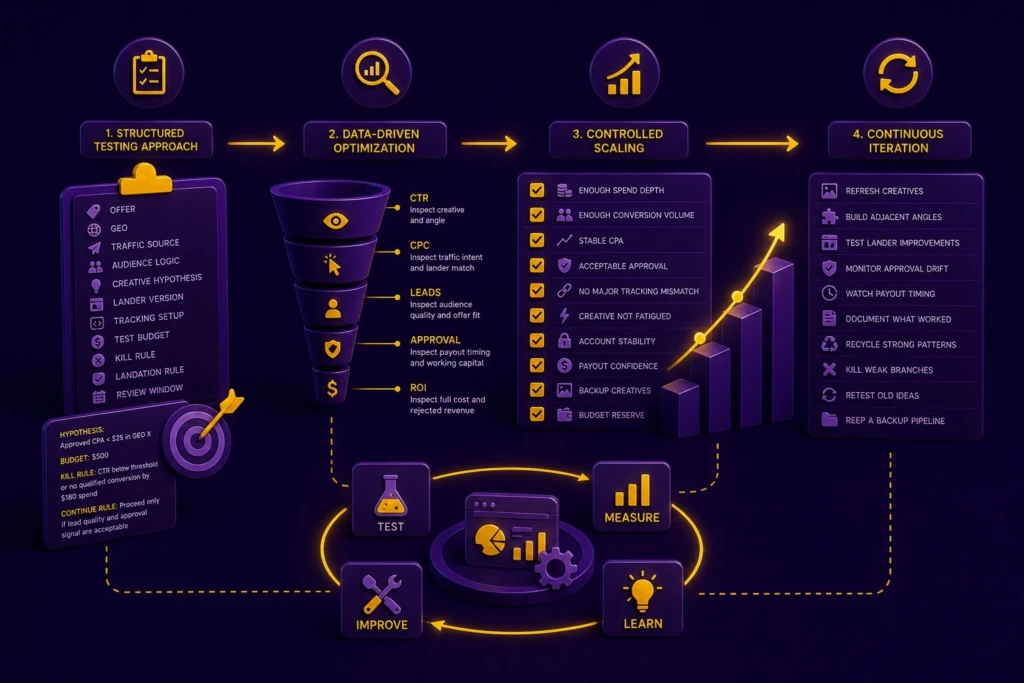
Start with a clear test structure.
Every campaign should define:
- offer
- GEO
- traffic source
- audience logic
- creative hypothesis
- lander version
- tracking setup
- test budget
- kill rule
- validation rule
- review window
A simple structure might be:
Hypothesis: this angle can generate approved leads below $25 approved CPA in GEO X.
Budget: $500 for initial validation.
Kill rule: stop if CTR is below threshold after enough impressions or no qualified conversion appears by $180 spend.
Continue rule: proceed only if early lead quality and approval signal are acceptable.
That is a test. “Launch and see” is not.
Data-driven optimization
Optimization should follow the funnel.
If CTR is weak, inspect creative and angle.
If CPC is cheap but CVR is weak, inspect traffic intent and lander match.
If leads are cheap but approval is weak, inspect audience quality and offer fit.
If approval is fine but cash is slow, inspect payout timing and working capital.
If tracker ROI is green but finance is red, inspect full cost and rejected revenue.
The campaign tells you where to look if the data is connected properly. If systems are fragmented, the buyer guesses.
Controlled scaling
Controlled scaling means the campaign earns each new spend level.
Before scaling, check:
- enough spend depth
- enough conversion volume
- stable CPA
- acceptable approval
- no major tracking mismatch
- creative not already fatigued
- account stability
- payout confidence
- backup creatives
- budget reserve
Scale gradually. Do not stack major changes. Do not raise budget hard, swap creatives, change audience, and edit lander in the same window. If performance drops, you need to know what caused it.
A scale campaign should become more boring as it grows, not more chaotic.
Continuous iteration
Winning campaigns are maintained, not discovered once.
Continuous iteration means:
- refresh creatives before they die
- build adjacent angles
- test lander improvements
- monitor approval drift
- watch payout timing
- document what worked
- recycle strong patterns
- kill weak branches
- retest old ideas with new execution
- keep a backup pipeline
A campaign that works today is not guaranteed to work next week. The market moves, users fatigue, competitors copy, and algorithms shift delivery. Survival depends on iteration.
FAQ
Why do most affiliate marketing campaigns fail?
Most campaigns fail because of weak structure, poor testing, traffic-offer mismatch, funnel problems, bad metric interpretation, and scaling before validation. Failure is usually systematic, not random.
Why do Facebook Ads campaigns fail in affiliate marketing?
Facebook Ads campaigns often fail because the creative attracts the wrong intent, traffic quality does not match the offer, or the funnel cannot convert broader users once spend increases. Approval and backend quality also matter.
Why do ads get clicks but no sales?
Clicks without sales usually mean the traffic is low-intent, the ad promise does not match the offer, the landing page has friction, or the audience is curious but not commercially qualified.
What is the biggest affiliate marketing mistake in 2026?
The biggest mistake is trusting surface metrics too early. CTR, CPC, raw leads, and tracker ROI can look fine while approval, payout, backend value, and full cost make the campaign negative.
How can I reduce campaign failure?
Use structured testing, isolate variables, track the full funnel, wait for approval signals, optimize based on data, and scale gradually. The goal is not to avoid all losses, but to make each test produce clear learning.
When should I scale a campaign?
Scale only after enough spend depth, stable CPA, acceptable approval, clean tracking, and early creative durability. If the campaign only looks good on raw tracker data, it has not earned scale.