


From Pioneer to Digital Powerhouse
When New Jersey legalized online casino gaming in 2013, it set a precedent that reshaped U.S. gambling policy. The state later played a decisive role in overturning the federal sports betting ban in 2018, clearing the path for nationwide expansion.
By early 2026, the Garden State has moved firmly into a digital-first era. Online casino revenue now consistently rivals — and often surpasses — the nine land-based casinos in Atlantic City. What began as a complementary channel has become the industry’s growth engine.
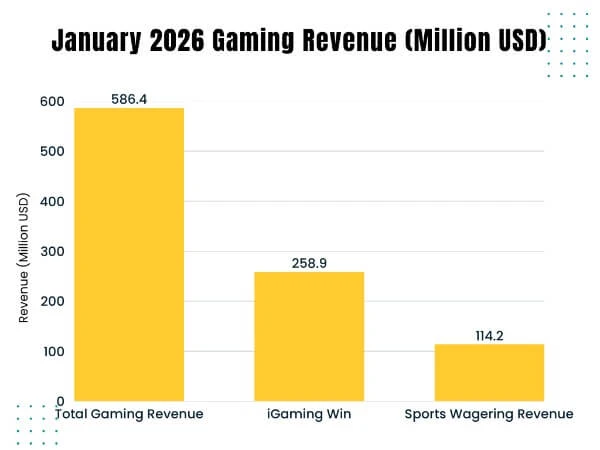
January 2026 alone produced nearly $259 million in iGaming revenue, reinforcing that the market is far from saturation.
Market Size and Performance
Record-Breaking 2025
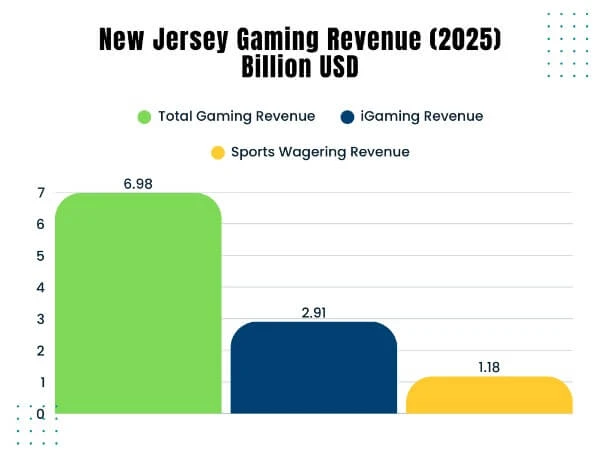
The New Jersey gaming industry closed 2025 with $6.98 billion in total revenue — a 10.8% increase year-over-year. Online casino operations were the standout performer:
- $2.91 billion in annual iGaming revenue
- 22% YoY growth in online casino win
- Digital gaming accounting for nearly half of total gaming revenue
January 2026 Snapshot
The market opened 2026 with strong momentum:
- $258.9 million in monthly iGaming revenue
- 16.8% YoY growth compared to January 2025
- Online casinos outperforming physical properties for the third consecutive month
Sports wagering remains volatile, influenced by major sporting outcomes, but mobile betting still accounts for more than 96% of all wagers placed.
Product Mix: Slots Rule, Poker Steady
New Jersey’s portfolio is broad, but dominance is clear.
Online Casino (Slots & Tables)
- Contributes roughly 99% of total iGaming win
- Slots drive volume
- High-limit table games deliver premium revenue
Sports Wagering
- $1.18 billion in 2025 revenue
- App-based wagering defines the category
Peer-to-Peer Poker
Liquidity has strengthened through participation in the Multi-State Internet Gaming Agreement (MSIGA), allowing shared pools with other regulated states. Monthly poker revenue typically ranges between $2.2 million and $2.8 million.
Lottery Modernization
The New Jersey Lottery generated $3.34 billion in FY2025 sales. Digital courier platforms such as Jackpocket are reshaping player access without fundamentally altering its retail backbone.
Leading Operators and Market Concentration
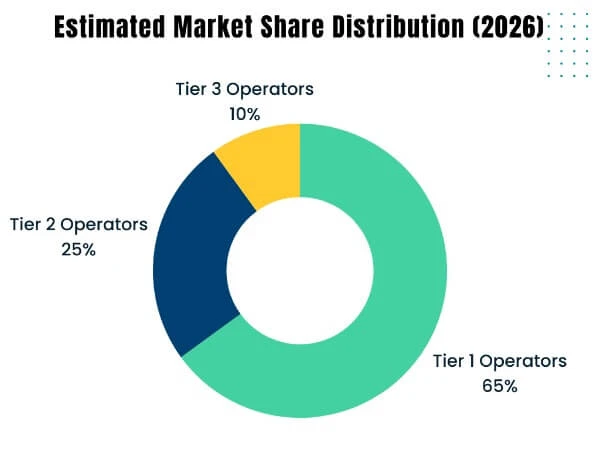
The market is heavily consolidated. The “Big Three” control nearly 65% of total iGaming revenue.
Tier 1 Leaders
- FanDuel (partnered with Golden Nugget) – January 2026 leader
- DraftKings (Resorts Digital) – primary challenger
- BetMGM (Borgata) – cross-vertical powerhouse
Emerging Challengers
- Hard Rock Bet
- Fanatics Betting & Gaming
Despite more than two dozen active apps, rising acquisition costs and the increased 19.75% gaming tax are tightening competitive margins.
Regulatory Framework: Tight and Expanding
Oversight is managed under a dual-agency system:
- New Jersey Division of Gaming Enforcement (DGE) – investigative and enforcement authority
- New Jersey Casino Control Commission (CCC) – licensing authority
2026 Financial Obligations
- iGaming tax: 19.75%
- Sports betting tax: 19.75%
- Investment Alternative Tax: 2.5%
- Annual problem gambling contribution: $250,000
All servers must remain in secure Atlantic City facilities, with strict KYC and multi-factor authentication requirements.
Legislative Watchlist: Player Protection 2.0
Lawmakers are debating a series of bills reshaping the compliance landscape:
- SB 3401 – Restrictions on push notifications and direct marketing
- SB 3461 – Potential ban on credit card gambling deposits
- Sweepstakes prohibition – Licensing requirement for dual-currency platforms
- SB 2160 – Enhanced oversight of micro-betting markets
The direction is clear: proactive enforcement over reactive discipline.
Consumer Trends: Mobile, Social, Instant
The 2026 New Jersey player is “mobile-first.”
- Over 95% of digital wagers projected via mobile devices
- 36% of gamblers engage both online and in-person
- Strong growth among Gen Z players aged 21–25
Live dealer gaming and micro-wagering are reshaping engagement. High-speed 5G infrastructure enables rapid in-play bets — pitch-by-pitch, point-by-point markets — replacing traditional long-hold wagers.
AI personalization has become standard. Platforms dynamically reorganize game lobbies based on behavior, reportedly increasing engagement by 10–15%.
Payments and Identity Tech
Frictionless checkout is now expected.
- Instant bank transfers via open banking
- Biometric login with integrated digital wallets
- Faster withdrawals replacing traditional ACH delays
The transactional experience is becoming nearly invisible — speed equals retention.
Opportunities and Pressure Points
Opportunities
- AI-driven personalization to boost retention
- Micro-influencer partnerships targeting younger demographics
- Niche apps focusing on specialized verticals (e.g., poker-only models)
Challenges
- Tax pressure amid regional competition
- Customer acquisition costs among the highest globally
- Political tension over cannibalization of Atlantic City casinos
Outlook: Growth with Guardrails
New Jersey’s iGaming market has entered digital maturity. The easy gains of early legalization are gone, replaced by a fight for retention, margin efficiency, and regulatory precision.
If current trends hold, annual iGaming revenue could surpass $3 billion by year-end. Yet the next phase will depend less on expansion and more on operational discipline, compliance technology, and the ability to retain a digitally native audience.
Summary
New Jersey remains the benchmark for regulated iGaming in North America. With $2.91 billion in online casino revenue in 2025 and continued growth into 2026, digital gambling now stands as the state’s primary gaming driver. However, rising taxes, regulatory tightening, and fierce operator competition signal a more complex chapter ahead — one defined by technology, consolidation, and responsible growth rather than unchecked expansion.