
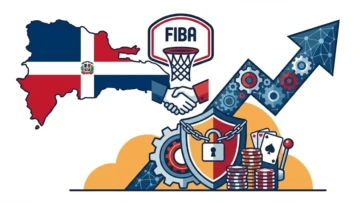
The Dominican Republic has taken a significant step toward strengthening anti-money laundering controls in its gambling sector through a new cooperation agreement between the Ministry of Finance and the Financial & International Business Association.
Government Partners with FIBA
The agreement was signed by Minister Magín Díaz and David Schwartz, CEO of Financial & International Business Association (FIBA).
According to the Ministry, the partnership aims to enhance Anti-Money Laundering and Counter-Terrorist Financing (AML/CFT) controls across casinos, lottery operators, sports betting platforms and electronic lottery concessionaires.
Authorities described the move as a strategic measure to prevent illicit financial flows in one of the country’s most financially active regulated sectors.
Launch of AML Certification Program (AMLCA–Gambling)
A core element of the agreement is the development of the AMLCA–Gambling certification program, which will provide specialized AML/CFT training for:
- Government officials
- Gambling operators
- Compliance officers
- Other obligated entities
The program is designed to ensure that professionals overseeing financial monitoring in the gaming sector are equipped with international best practices in risk detection, reporting and compliance.
The initiative will also leverage FIBA’s collaboration with Florida International University (FIU), bringing academic expertise into the certification and training process.
Authorities emphasized that certified and well-trained personnel at the first line of supervision are critical to strengthening national AML defenses.
Preparing for International Evaluations
The Ministry acknowledged that the reform has implications beyond domestic enforcement.
The partnership is expected to reduce vulnerabilities in international assessments conducted by bodies such as Financial Action Task Force of Latin America (GAFILAT), the regional arm of the Financial Action Task Force.
These evaluations measure countries’ compliance with global AML standards and can impact international financial reputation and risk ratings.
Gaming is widely considered a high-risk sector due to:
- High transaction volumes
- Cash-intensive operations
- Cross-border financial activity
Strengthening oversight mechanisms may therefore improve the Dominican Republic’s standing in future evaluations.
Institutional Reform and Regional Trend
Officials described the agreement as part of a broader institutional strengthening strategy aimed at modernizing regulatory supervision and aligning with global compliance standards.
Across Latin America, regulators have increasingly prioritized AML/CFT reforms in sectors vulnerable to financial crime. The Dominican Republic’s move signals a growing recognition that professionalization, certification and inter-institutional cooperation are essential for sustainable sector growth.
Looking Ahead
The success of the AMLCA–Gambling program will likely be measured by:
- The number of certified compliance professionals
- Improved transparency and reporting standards
- Reduced regulatory risk exposure
- Stronger outcomes in international AML evaluations
By formalizing cooperation with FIBA and integrating academic expertise, the Dominican Republic is positioning its gambling industry to operate under more rigorous compliance standards and enhanced global credibility.