


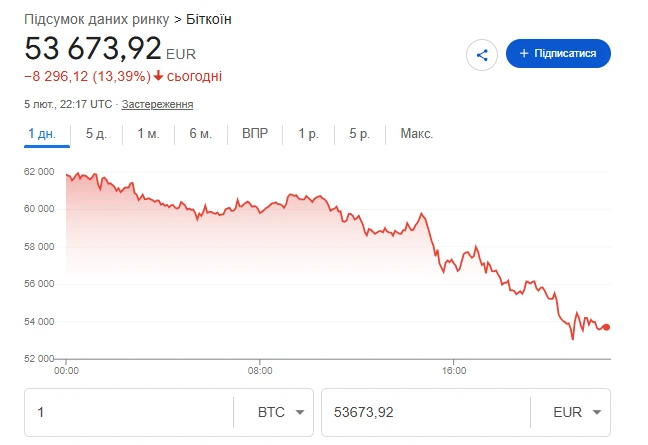
The digital asset winter has returned with a vengeance. Bitcoin’s plunge accelerated on Thursday, as the world’s largest cryptocurrency fell more than 12% to trade below $64,000 in late afternoon trading, a level not seen since October 2024. The sharp sell-off underscores how vulnerable cryptocurrencies remain when global investors aggressively turn away from risk.
The drop marks a stunning reversal from late last year, when bitcoin surged to record highs above $125,000 a coin. In the four months since that euphoric peak, the digital currency has lost nearly half its value, wiping out fortunes and shaking faith in the “digital gold” narrative.
Since its high-water mark on Oct. 6, bitcoin has shed more than $1.2 trillion worth of value, according to data from CoinMarketCap. The selling comes as institutional and retail investors alike pull back from riskier assets like crypto and high-growth tech stocks, rotating capital into traditional “safe haven” assets like gold, Treasury bonds, and defensive equities.
The Great Rotation: Gold Shines as Crypto Fades
For years, crypto evangelists argued that bitcoin was an uncorrelated asset—a hedge against inflation and fiat currency debasement. However, the last four months have dismantled that thesis.
Since bitcoin’s October peak, the gap between its performance and gold’s has widened significantly to historic levels. As of Thursday afternoon:
- Bitcoin has fallen 35% since February 2025.
- Gold has soared nearly 70% in the same period.
This year alone, the divergence is stark: gold is up more than 11%, while bitcoin is down more than 26%.
As crypto plummets, the U.S. dollar is also facing pressure. Wary investors are rethinking their exposure to American assets amid renewed trade and tariff threats from the Trump administration, alongside geopolitical instability involving U.S. allies over Greenland, protests in Iran, and the capture of Venezuela’s president earlier in January.
Consequently, capital is flowing out of digital wallets and into Treasury bonds and European and Asian stocks, seeking stability in a chaotic macroeconomic environment.
The “Death Spiral” Warning
The bitcoin crash is especially worrying for the broader crypto industry because bitcoin acts as the market’s anchor. When it sinks, it drags everything else down with it.
Michael Burry, the legendary investor who famously shorted the housing market before the 2008 financial crisis, issued a grave warning on Thursday. In a Substack post that quickly went viral, Burry wrote that bitcoin’s sell-off could turn into a “death spiral,” noting that “sickening scenarios have now come within reach.”
Analysts at Citi echoed the bearish sentiment in a note to clients this week. They pointed out that the flow of money into bitcoin exchange-traded funds (ETFs)—the vehicles that helped fuel bitcoin’s meteoric rise last year—has completely dried up.
“The buying pressure has evaporated,” the Citi analysts wrote. They noted that bitcoin has now fallen below the average entry price for many U.S. spot bitcoin ETF investors, which Citi estimates at about $81,600. As prices drop further below this “breakeven” point, panic selling from retail investors is likely to accelerate.
Corporate Casualties: MicroStrategy and Coinbase Hit Hard
The pullback is proving particularly painful for publicly traded companies that tethered their fortunes to the crypto market.
Shares of MicroStrategy, the largest corporate holder of bitcoin, plummeted over 17% on Thursday. The drop pushed the stock down to levels that imply the market is valuing the company’s massive bitcoin stockpile at a discount.
MicroStrategy has spent years aggressively accumulating bitcoin under the leadership of Michael Saylor. The company now holds more than 713,000 coins, having paid an average of roughly $76,000 per bitcoin, according to its latest regulatory filing. With prices now trading well below $64,000, the company is sitting on billions of dollars in unrealized losses, making investors increasingly uneasy about the firm’s solvency if the slide continues.
The pressure is rippling across the entire ecosystem:
- Coinbase, the largest U.S. crypto exchange, saw shares fall sharply as trading volumes and asset values declined.
- Circle, the issuer of the USDC stablecoin, and Robinhood, a retail trading favorite, also posted significant losses on Thursday.
Vibes from Washington: The “Warsh” Effect
Market jitters are being exacerbated by political maneuvering in Washington. President Trump’s selection of former Fed governor Kevin Warsh as his nominee for Federal Reserve chair has triggered a reset in risk assets.
While Trump has publicly demanded lower interest rates, Warsh is viewed by Wall Street as a monetary hawk with a track record of fighting inflation. Markets are betting that Warsh will prioritize price stability over asset price support, meaning he will not be quick to cut interest rates to juice the markets.
“Higher interest rates and less fluid capital typically make it harder for investors to sustain high-risk bets like crypto,” noted Louis Navellier, an investment manager and market strategist at Navellier & Associates.
Compounding the fear is the realization that the government will not be a backstop. Treasury Secretary Scott Bessent explicitly stated this week that the U.S. government does not have the power—or the inclination—to step in and support cryptocurrencies in the event of a crash.
Bessent’s comments dimmed hopes of a rescue, a stark reality check for an industry that had hoped the Trump administration would be its champion.
Legislative Stall
Despite a generally positive reception from the White House regarding digital innovation, the crypto industry is still struggling to get clear rules of the road approved by Congress.
“Although there has been progress on crypto legislation, the pace has been slow and uneven,” Citi analysts wrote.
Lawmakers have advanced piecemeal legislation in recent months, including efforts to clarify how stablecoins should be overseen. However, broader rules on market structure—seen as critical for bringing institutional certainty to the sector—remain stalled in committee.
Without these guardrails, and with the price of bitcoin in freefall, the “crypto winter” of 2026 is shaping up to be colder and harsher than many anticipated.